In order to hold your drumsticks correctly, you need a loose, relaxed grip with all fingers on the stick. This is necessary to play at the top of your game with proper technique.
Jim Chapin famously described it as “holding a baby bird.” Grip the sticks too tight, and you’ll squeeze it to death - too loosely, and the bird will fly away. But that just scratches the surface of how you’ll hold the drumstick (or baby bird). We’ll take you through that with our handy step-by-step guide below. This will give you all the dexterity to play as fast, loud, quiet, or groovy as you’d like (as well as prevent injuries from playing).
When you’re done reading, you will be familiar with:
- Step-By-Step Guide to Holding the Sticks
- What is a Fulcrum?
- Different Fulcrums (and How to Use Them)
- Different Grips
- Step-By-Step Guide to a Relaxed Setup
- Common Mistakes
- Choking Up or Down (Intentionally)
- Conclusion paragraph
- FAQ
Step-by-Step Guide to Holding the Sticks
It may seem like overkill, but beginners really should follow this exact process when first picking up the sticks to ensure proper technique. Chances are, if you take lessons, this would be covered in your first lesson - so we’ll go through it here for your convenience!
-
Grab the stick with your thumb and pointer finger
You’ll want to first grab the stick between the pad of your thumb and the indent behind your top index finger knuckle - your thumb should point up the stick, while you’re index finger should wrap around it sideways
-
Find the balance point of the stick
You’ll want a bouncy, drummable surface for this part (like a practice pad)
-
Rotate your hand so that your thumb is on top of the stick (still pointing up the stick), with your index finger underneath - the stick should be laying in the indent behind your index finger’s top knuckle
-
After holding the stick in this spot, simply drop the stick onto the practice pad
-
-
If the stick doesn’t want to fall forward, you are holding it too high up the stick
-
If the stick falls with a thud (or very few bounces), you are holding it too low
-
If you get lots of bounces from the stick off the pad, you’ve found the balance point
-
If you are using Vic Firth branded drumsticks, this balance point is often marked with the American Flag logo (but this process will still work with any drumstick)
-
Another way to test the balance point of the stick is by trying to do the old grade-school “make the pencil look like it’s made of rubber” trick - it’ll be easiest to do this at the balance point of the stick
-
Wrap all of your other fingers around the stick
You’ll want to do this gently but comfortably - the stick should be resting in the middle of your palm
Congratulations, you can now hold the drumsticks! Why did we need a whole article on this? Because there’s more to it.
What is a Fulcrum? (And How to Use It)
The word “fulcrum” is probably giving you flashbacks to school, and learning about simple machines. If not, it’s the rotational point on which a lever rotates. A prime example that should be familiar to most: the middle of a teeter-totter is a fulcrum. When you found the “balance point” of the stick, you used the “front fulcrum” of the stick.
This is our main “fulcrum” and the most dexterous and capable, as we can fully use all of our fingers as well as our wrists when the stick is held here. If you never learn to use the other fulcrums, that’s okay, but we should cover those as well.
Different Fulcrums (and How to Use Them)
As we just covered, the front fulcrum is the most versatile. But that’s not the only way to hold the stick - let’s cover all of our bases here, with pros and cons of each fulcrum.
Front Fulcrum
When you use the front fulcrum, the stick rotates at the point between your thumb and the indent behind your pointer finger’s top knuckle. As mentioned earlier, it’s the most versatile. As the stick rebounds, the butt of the stick should push your three back fingers out away from your hand (but they should all still remain on the stick). This gives you the ability to use your fingers and your wrists at all times.
You can work on this by holding the stick with all of your fingers loosely wrapped around the stick, as they should be - then, using your other stick, push the front of the original stick upwards and get used to this feeling (of the butt of the stick pushing your back three fingers away from your palm).
You can further practice this “rebounding” feeling by simply playing full strokes on a practice pad. Use German grip, play the stick onto the drum like you’re dribbling a basketball - you’re throwing it down, and just letting the stick come back on its own, resulting in the butt of the stick pushing your back three fingers away from your palm.
Back Fulcrum
In the back fulcrum, the stick is most tightly gripped between the palm of the hand and your pinky and ring fingers. The stick has more freedom to move around in your hand with this grip.
- Back fulcrum lacks the technical abilities of front fulcrum, but works well in reducing hand fatigue when you need to give certain hand muscles a break
- This fulcrum has its time to shine in simpler, repetitive styles that might still be fast and loud. Punk drummers find themselves more likely to use it.
Middle Fulcrum
In the middle fulcrum, the pointer finger points up the side of the stick slightly, instead of wrapping around the stick as it would in the front fulcrum. As the name suggests, middle fulcrum adopts the prowess of front fulcrum with the relaxed feel of back fulcrum.
Fulcrums are one of the many topics that many elite players will still disagree on. I, for instance, almost exclusively use the front fulcrum (although, I probably occasionally slip into the other fulcrums without even realizing it). It’s generally agreed upon to be the most useful if you were to choose only one, but exploring your options is obviously worth your time. Many would argue that Vinnie Colaiuta is, technically speaking, best drummer of all time, and here’s an example of him using back and middle fulcrums with his right hand on the ride cymbal in the middle of a mind-blowing performance (he then switches between these fulcrums several times throughout the song).
So that covers all the different ways we can hold the sticks, but are there other angles we can play the drums with?
Different Grips
This name is sort of misleading - we always want to hold the sticks in generally the same way, but the angle our hands make in relation to the drum can vary. Here are the three main “grips” associated with drumming (and this doesn’t include traditional grip - these are all within the style of “match grip,” and even when you use traditional grip in the left hand, you’d want to use all of these in your right hand):
German Grip
-
-
The backs of your hands are flat, parallel with the surface you’re about to play. You should be able to balance a coin on the back of your hand before you play, and the drumsticks should point towards the center of the snare drum at a 45-degree angle (where this grip is often used most).
-
Playing with this grip should mimic the feeling of dribbling a basketball
-
The drumsticks should come out of your hands at a 45 degree angle, and make a 90 degree angle between them. If you look down at the shape your arms and drumsticks make, they should look like a (talented) preschooler’s drawing of a house.
-
This is the most commonly used grip for concert percussionists playing the snare drum. In drumline, when snare drummers use traditional grip for their left hand, they will still use German grip for their right hand.
-
French Grip
-
-
In French Grip, we’ll be holding the sticks with our palms facing sideways.
-
Pretend you’re about to shake someone’s hand - this is the angle you’ll be using to hold the drumstick.
-
In this grip, you’ll mostly be using the front fulcrum, and also mostly be using fingers - the wrist is less mobile, but still necessary for playing with power in this grip.
-
French grip’s focus on finger control gives you tons of finesse, speed, and dexterity - especially at lower volumes and higher tempos.
-
This is how timpani players traditionally play, and is also great for specific surfaces on the drumset, depending on their angle and placement (for instance, you might find yourself playing the floor tom in French grip quite a bit).
-
American Grip
-
- American Grip is essentially a mix between German and French grip.
- Your hands will be angled slightly - not quite flat, not quite sideways, but somewhere in the middle (roughly halfway, although this isn’t a hard and fast rule)
- This grip gives you the best of both worlds (German and American). The term was coined by Gene Krupa (an American) when he was asked what grip he used - French or German - and he answered “American.”
Step-By-Step Guide to a Relaxed Setup
By now, you may have heard that you need to be relaxed, all the while following all of the instructions listed above. That can seem like quite a bit to tackle; nothing is a bigger pain than trying to “relax” (just ask anyone with anxiety). Luckily, we can tackle this with this step-by-step approach before we even grab our sticks.
-
Sit down at your kit, practice pad, or snare drum
…or whatever surface you plan to play on. Make sure to have good posture (sit up straight).
-
With this good posture, let every muscle in your body go completely dead
…outside of the ones keeping your torso straight. Let every part of your arms fall to your sides, completely paralyzed.
-
Bring your wrists up
Pretend that there are puppet strings attached to the centers of your wrists, bringing them up so your arms are pointing straight forward (they can be parallel with the ground, or angled slightly upwards).
-
- DO NOT move your elbows or shoulders. Many new drummers, even when trying to follow this guide to a tee, will unintentionally move their elbows out or their shoulders up - resist this urge.
- Think of yourself as a very lazy zombie, and the virus has only caught hold of your wrists at this point. Your hands should be lazily dangling downward, just like the rest of your unconscious body
-
Raise your hands slightly
You’ll want to do this by pretending another set of puppet strings is attached to the bottom knuckle on both of your middle fingers, bringing up your hands to be about parallel with the ground
-
Now, grab the sticks!
This will leave you with a primo, relaxed German grip.
Common Mistakes
Even after you know how to hold the sticks, many find it hard to maintain this grip while playing. Here are the most common missteps drummers find themselves making once the song starts.
The back fingers come off the stick
Getting used to your fingers staying on the stick without squeezing, which results in the back fingers getting pushed around, is incredibly hard (and counter-intuitive). When these back fingers come off of the stick, you lose the ability to guide the rebound in a perfectly vertical fashion - this will force you to squeeze the stick with your front fulcrum, and lead to tense, restricted playing
One intermediate stepping stone many drummers use as a band-aid is this: their back fingers still come off the stick, but they form a wall that “catches” the back of the stick. The butt of the stick then bounces back into the palm of the drummer’s hand.
That isn’t a long-term solution, but will work for a while. The “rebound” exercise from the “front fulcrum” description above can help fix this long-term.
Bending your wrists sideways
In German Grip, the 45 degree angle of the sticks (or 90 degree angle between them) seems strange to many new drummers - they tend to bend their wrists outwards so that the stick is more parallel to the drummer’s arms. This problem can be compounded on the kit if you play cross-handed between the hi hat and snare drum
To fix this, ditch the kit - go back to square one, and work on the relaxed setup tips from earlier on your practice pad or snare drum
Squeezing too tight
The loose grip on the stick that we want also tends to feel strange to newer drummers, so they’ll squeeze too tight on the stick - we want there to be a slight gap between your palm and the stick before you start to play
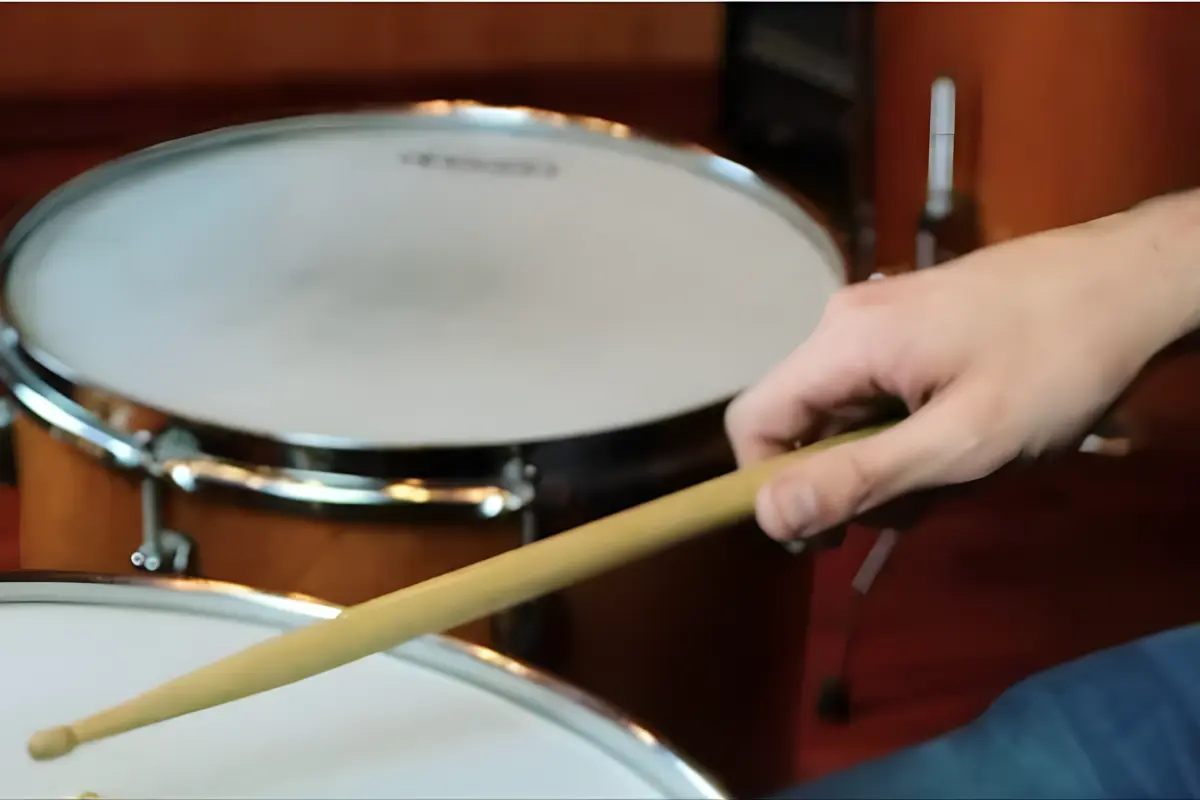
(This is how the gap between the stick and your palm should look)
To get used to a loose feeling of the stick, try the rebound exercise mentioned above. Some drummers still manage to play quite well, even with a squeezed grip on the sticks - they do so by using primarily wrists, and loosening up intuitively when they want to utilize their fingers. The same can’t be said for the next mistake.
Squeezing the stick unevenly
Squeezing the stick unevenly takes your fingers out of the equation entirely, and puts too much stress on the parts of your hand squeezing harder. Some drummers even suffer from individual fingers getting “boxed out” off of the stick as, for instance, a pinky finger crawls up the stick and pushes the ring and middle fingers away. Once again, trying the rebound exercise above will help prevent this form of squeezing on the stick
Choking Up or Down (Intentionally)
Earlier, we found the balance point of the stick. This is where your front fulcrum should be most of the time for maximum utility with the stick. However, for certain specific situations, advanced drummers will experiment with where this fulcrum lands on the stick.
For example, heavy drummers may want extra torque and to feel like the stick has extra “throw.” They can get this power by choking down on the stick as far as having their pinky finger even with the bottom of the stick. Heavy drummers are also more likely to opt for extra long sticks to make choking up and down more doable, as well as adding this “throw” to the stick.
Some light jazz drummers may choke up on the stick from time to time, for a more sensitive touch. They may even utilize their slower, less-efficient bicep muscles in order to “pull their punches” with more finesse (on top of using wrist and finger muscles). These drummers may use sticks with a longer taper and more bottom-heavy feel to further increase their volume control.
Why you should Hold your Sticks this Way
Holding the drumsticks correctly is key to playing anything you want on the kit - whether you want speed, power, finesse, or groove. Your approach to drumming as a whole will have some nuance for personal preference, but there’s always a science to why most drummers do things a certain way - and holding your sticks correctly has even less wiggle-room than other topics in these blogs.
The Big Jazzy Question - What About Traditional Grip?
Most drummers today play matched grip, and that’s for a reason. Traditional grip was designed by marching drummers who slung their snare drum over their shoulder at an angle, so the left side was as high as the drummer’s chest - the only way to play on this surface was with traditional grip. This was passed down as the way to play drums as the art form moved to the drum kit, but an increasing number of drummers (myself included) have found it mostly unnecessary (although I personally still prefer traditional when using brushes in a jazz context, but that’s about it). However, if you play snare in a drumline, you’ll need to use traditional grip.
Either way, you’ll still use all the techniques above to hold your right stick when in traditional grip. And if you’re debating whether you should switch to traditional grip, you’ll still need a loose, relaxed grip no matter what.
FAQ
I’m following this guide to a tee and can’t play fast; what gives?
Once you have your physical setup locked in, you’ll still need to practice your rudiments and various stick control techniques to increase speed and technicality. You may also be starting with a perfect setup and gradually slipping into one of the common mistakes above as you start playing.
How do I know if I’m making one of those Common Mistakes?
If possible, try playing in front of a mirror; you can also video record your playing and watch it back, but playing in front of a mirror will give you visual feedback in real time.
Why am I way better on one drum than another on my kit?
You may be slipping into these common mistakes as you move around the kit - or, you might be only using German Grip when certain surfaces are better played with other grips (such as French Grip on the floor tom). You need to be capable with all of these grips in order to switch between them as you move around the kit.