To play a shuffle beat on drums, replace the straight eighth notes on your hi-hat with a swung triplet pattern — long-short, long-short — where you accent the first and third note of each triplet group and ghost or skip the middle note. The result is that characteristic rolling, loping feel that drives blues, rock, and R&B grooves.
That's the foundation, but the shuffle is one of those beats that's easy to understand on paper and takes real practice to make feel natural. The difference between a shuffle that grooves and one that just sounds uneven comes down to how consistently you land that triplet subdivision and how relaxed your limb coordination is when the bass drum and snare enter underneath it.
In this guide, we'll break down exactly what the shuffle is and why it feels the way it does, how to read it in drum notation, a step-by-step approach to building the groove from scratch, the most common shuffle variations across different styles, mistakes that beginners make and how to fix them, and practical tips for getting it to lock in. By the end, you'll have a clear path to making the shuffle feel like a natural part of your playing rather than an awkward exercise.
When you’re done reading, you will be familiar with:
- What Is a Shuffle Beat?
- How to Read Shuffle Notation
- Step-by-Step: Building the Shuffle Beat
- Shuffle Variations and Styles
- Common Shuffle Mistakes
- Beginner Tips for a Better Shuffle
- Songs to Practice the Shuffle With
- Final Thoughts
- FAQ

What Is a Shuffle Beat?
The shuffle is a rhythmic feel built on triplets — three evenly spaced subdivisions per beat — rather than the straight eighth notes you'd use in most basic rock and pop grooves. In a standard straight groove, the eighth notes divide each beat into two equal halves. In a shuffle, you play the first and third notes of each triplet group and leave the middle one out, creating an uneven "long-short" pattern that repeats on every beat.
The sound this creates is sometimes described as a "swinging" or "rolling" feel. It's the rhythmic backbone of a huge amount of music — Chicago and Texas blues, classic rock (think ZZ Top or John Lee Hooker), shuffle-based R&B, and even country and jazz in certain contexts. When someone says a groove "swings," this triplet-based subdivision is usually at least part of what they're talking about.
What separates the shuffle from other grooves is how the hi-hat (or ride cymbal) drives the feel. In a basic rock beat, the hi-hat often plays steady eighth notes. In a shuffle, those eighth notes become the two outer notes of a triplet — and that small change in subdivision transforms the entire energy of the groove.
How to Read Shuffle Notation
Understanding the shuffle on paper makes it much easier to learn — and helps you recognise it when you encounter it in drum tabs or sheet music.
In standard drum notation, a triplet is three notes written with a bracket and the number "3" above them, fitted into the space where two eighth notes would normally go. In a shuffle, you play the first and third of these three notes — the "1" and the "3" of the triplet — and you either rest on or lightly ghost the middle note.
Shuffle notation is also commonly written with a small icon at the top of the page or chart that shows a pair of eighth notes equalling a quarter-note triplet: two eighth notes with a "3" bracket and the instruction "swing." This tells you to interpret all eighth notes in the piece with a swung, triplet feel rather than straight. You'll see this constantly in jazz charts and blues lead sheets.
For more on reading drum notation generally — including how rests, note values, and accent marks work — our guide on how to read drum tabs gives a solid foundation to work from.
The Triplet Counting System
A practical way to feel triplets: count "1-trip-let, 2-trip-let, 3-trip-let, 4-trip-let." Each syllable is one triplet note. In the shuffle, you play on "1" and "let" (the first and third syllable of each group) and skip "trip." Over time this becomes instinctive — you're essentially internalising a different underlying pulse rather than consciously skipping beats.
Step-by-Step: Building the Shuffle Beat
The smartest approach to the shuffle is to add one element at a time. Rushing to play all four limbs in a groove you don't yet feel will just produce uneven, tense playing. Build the triplet subdivision first, then layer the other limbs in.
1. Feel the Triplet with Your Hi-Hat Hand Alone
Start without a kit — or just sit at the kit with no intention of playing a full beat yet. Tap on your knee or on the edge of your drum throne with one hand. Count "1-trip-let, 2-trip-let, 3-trip-let, 4-trip-let" aloud and tap all three notes of each triplet. Just get the feel of triplets in your hand.
Once that feels natural, start dropping the "trip" note. Tap only on "1" and "let." You'll hear the characteristic long-short pulse starting to emerge. Keep counting the missing middle note in your head — don't just leave a gap, feel the triplet division even when you're not playing the middle note.
2. Move the Shuffle to the Hi-Hat
Take that same pattern to the hi-hat. Play the outer two notes of each triplet on the closed hi-hat, starting slow — around 60 to 70 BPM with a metronome. At this tempo you should be able to hear and feel each triplet clearly. The hi-hat will produce two hits per beat: a longer one followed by a slightly shorter one — long-short, long-short.
Don't worry about accentuation yet. Just get the pattern smooth and consistent at a slow tempo before you do anything else.
3. Add the Snare on Beats 2 and 4
Once the hi-hat shuffle is sitting comfortably, add your snare drum on beats 2 and 4 — the classic backbeat. The snare hits coincide with the "2" and "4" counts, which are also the first note of the second and fourth triplet groups. In other words, the snare lands on the "long" note of those beats.
Practice the hi-hat and snare together without the bass drum until the combination feels natural. This is where a lot of beginners first notice a coordination wobble — the snare can pull the hi-hat slightly out of its triplet feel. If that happens, slow down further and focus on keeping the hi-hat subdivision steady regardless of what the right hand is doing.
4. Add the Bass Drum on Beat 1 (and Optionally Beat 3)
The most common shuffle bass drum pattern is a hit on beat 1 and again on beat 3, though many shuffles have the kick doing more complex things underneath. For now, keep it simple: kick on 1, snare on 2, kick on 3, snare on 4, hi-hat shuffling all the way through.
This is your basic shuffle groove. At 70–80 BPM it should start to feel like it has that rolling, driving quality that defines the feel. If it sounds mechanical or choppy, slow down — the triplet subdivisions aren't landing cleanly yet.
5. Refine the Accent and Relaxation
Once the pattern is locked in at a slow tempo, focus on two things: accent and relaxation. Accent the first note of each triplet pair on the hi-hat slightly more than the second — the "long" note should feel slightly heavier. And consciously relax your grip and arms. A shuffle that grooves feels effortless; one that's being forced sounds rigid.
Gradually increase the tempo — add 5 BPM at a time and only move up when the feel at the current tempo is solid. Most beginners find that the shuffle starts to feel natural somewhere between 80 and 100 BPM; above 110 it gets physically demanding and the triplet subdivision requires significant practice to maintain.
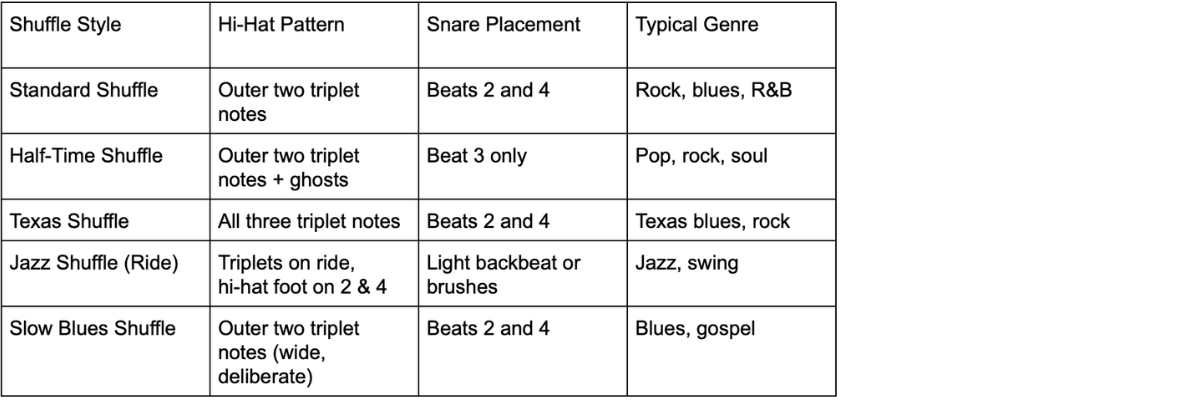
Shuffle Variations and Styles
The basic shuffle is the starting point, but the groove evolves significantly across different musical styles. Here are the most common variations you'll encounter.
The Half-Time Shuffle
The half-time shuffle is one of the most celebrated drum grooves in popular music — Jeff Porcaro's playing on Toto's "Rosanna" is the most-cited example. In a half-time shuffle, the snare moves from beats 2 and 4 to beat 3 alone, giving the groove a much slower, heavier feel despite the tempo being the same. Ghost notes on the snare (very light, quiet hits between the main strokes) fill in the space and create the driving, complex texture that makes this groove sound so full.
The half-time shuffle is harder to play than the standard shuffle because the ghost notes require independence between your two hands at the same time as maintaining the triplet hi-hat pattern. It's worth working towards once the basic shuffle feels solid.
The Texas Shuffle
The Texas shuffle, common in blues, plays the full triplet on the hi-hat — all three notes instead of just the outer two. The middle note is played lighter, creating a "long-medium-short" feel rather than pure long-short. The result is busier and more rolling than the standard shuffle, and it's often played on the ride cymbal for a slightly different texture. Stevie Ray Vaughan's band is a good reference point for this feel.
Ride Cymbal Shuffle
In jazz and some blues contexts, the shuffle moves to the ride cymbal rather than the hi-hat, and the foot hi-hat closes on beats 2 and 4 instead of the snare taking the backbeat. The ride produces a dryer, more articulate sound for the triplet pattern, which suits jazz tempos and feels well. The bell of the ride can also accent certain triplet notes for a brighter, more cutting sound.
The Slow Blues Shuffle
At very slow tempos — 60 BPM and below — the shuffle takes on a heavy, deliberate quality that's central to slow blues. At this pace, each triplet division is wide enough that you can hear the long-short gap clearly, and the groove feels almost like it's fighting against rushing. Keeping this groove relaxed and slightly behind the beat (rather than rushing ahead of it) is a skill that takes time to develop but is essential for convincing blues playing.
Common Shuffle Mistakes
Most shuffle problems come down to a handful of specific issues. If your shuffle isn't sitting right, check for these first.
Playing It Straight Instead of Swung
Why it's wrong: This is the most common beginner mistake — the hi-hat pattern ends up as even eighth notes rather than the long-short triplet feel. It sounds fine as a regular groove but doesn't shuffle at all. Usually happens because the player is thinking "skip the middle note" without actually feeling the triplet subdivision underneath.
How to fix it: Go back to counting triplets aloud — "1-trip-let, 2-trip-let" — while tapping. The shuffle only feels right when the triplet is actively felt, not just intellectually remembered. Record yourself and compare to a reference track; the difference between straight and shuffled will be immediately obvious.
Losing the Triplet Feel When Adding Other Limbs
Why it's wrong: The shuffle hi-hat pattern requires the hand to maintain a specific subdivision while the snare and bass drum add accents at different points. For many beginners, adding the snare backbeat pulls the hi-hat hand slightly ahead or behind, making the triplet feel uneven or collapse into straight time.
How to fix it: Slow way down and add one limb at a time. Achieve solid hi-hat shuffle before adding snare. Achieve solid hi-hat plus snare before adding bass drum. The coordination builds in layers — there are no shortcuts through that process.
Tensing Up at Higher Tempos
Why it's wrong: As tempo increases, many drummers unconsciously grip harder and tighten their arms in an attempt to keep up. This kills the feel. A tense shuffle sounds forced and robotic — it loses the rolling, relaxed quality that makes the groove work.
How to fix it: Back the tempo down to where your arms feel comfortable and loose. The shuffle should feel effortless at the tempo you're practising. If it doesn't, you're above your current comfortable speed. Build up incrementally — 5 BPM at a time — and never push past the point where the groove feels easy.
Rushing the "Short" Note
Why it's wrong: In the long-short triplet pattern, the short note sometimes gets played too early — almost turning it into an even eighth note again. This collapses the groove and makes it sound like the hi-hat is stumbling rather than rolling.
How to fix it: Practice with a metronome set to triplets (or a triplet subdivision click) rather than eighth notes. The click gives you all three points of the triplet so you can hear exactly where the short note should land. Some digital metronomes and drum machine apps have a triplet subdivision mode — use it.
Making the Shuffle Too "Perfect"
Why it's wrong: Ironically, an overly precise, mechanical shuffle can sound worse than one with a slightly human quality to it. Blues and R&B shuffles in particular are supposed to breathe — they often sit very slightly behind the beat, which gives them a dragging, relaxed quality that's part of what makes them feel good.
How to fix it: Once you can play the shuffle cleanly, listen to recordings and try to match the feel of the drummer. Allow yourself to settle back into the groove slightly rather than rushing to stay exactly on the click. That slight relaxation is part of the style.
Beginner Tips for a Better Shuffle
- Use a metronome set to the quarter-note pulse. The shuffle's hi-hat pattern should sit perfectly within a steady quarter-note click — not ahead of it, not behind it. The click is your anchor.
- Practice the hi-hat shuffle hands-only for at least a week before adding other limbs. If the subdivision isn't deeply internalised, the groove will fall apart the moment feet enter the picture.
- Listen to reference tracks obsessively. Muddy Waters, Little Walter, ZZ Top ("La Grange"), and countless blues and R&B recordings are built on shuffle grooves. Absorbing the feel through your ears is just as important as practising it on the kit.
- Practice with your eyes closed. Once you have the pattern, playing with your eyes closed helps you focus on feel rather than watching your hands — which is where the real groove lives.
- Record and compare. Record yourself playing a shuffle, then play it back alongside a reference track. Mismatches in feel or timing will jump out in ways you won't notice while playing.
- Try the shuffle on the ride cymbal. The ride gives you a different texture and requires slightly different wrist mechanics than the hi-hat. Alternating between the two helps you understand the groove from a different angle and builds versatility.
- Keep your grip loose. I can't stress this one enough — a relaxed shuffle feels like music.
- A tense one sounds like work. If your wrist starts tiring quickly, loosen your grip and let the stick rebound naturally rather than forcing it down.
Songs to Practice the Shuffle With
Playing along with actual music is the fastest way to internalise a groove. These tracks each feature a clear, well-recorded shuffle that's either at a manageable tempo or has a particularly distinct feel worth studying:
- "Mannish Boy" — Muddy Waters. A slow, heavy blues shuffle that makes the triplet feel very obvious at a learner-friendly tempo.
- "La Grange" — ZZ Top. The opening section is a classic Texas shuffle before the song kicks into gear. Clear, driving, and at a moderate tempo.
- "Pride and Joy" — Stevie Ray Vaughan. A swinging Texas shuffle at a good medium tempo. Chris Layton's drumming is a masterclass in making the groove feel effortless.
- "Rosanna" — Toto. The half-time shuffle reference. Listen before trying to play it — it's more complex than it sounds, but hearing the groove first makes the mechanics much clearer.
- "Stormy Monday" — T-Bone Walker / The Allman Brothers. A slow, deliberate blues shuffle where every note has space around it — good for working on relaxed feel at a slow tempo.
When playing along, don't worry about replicating the exact drum part at first. Just maintain the shuffle feel while the song plays. Match the tempo, lock onto the triplet subdivision, and groove with the music. That's what actually builds the feel.
Final Thoughts
The shuffle is one of those grooves that teaches you something important about drumming beyond the pattern itself — that feel matters as much as accuracy. You can play every note in exactly the right place and still not sound like the shuffle actually grooves, because grooves live in the physical feeling of the rhythm, not just its technical execution.
Take your time with the triplet subdivision. Let it get into your body before you push the tempo. Listen to the blues drummers and rock players who made these grooves iconic and absorb how they place every note. The long-short triplet feel is something you eventually stop thinking about and just play — and once that happens, the shuffle opens up a huge amount of musical vocabulary across styles you'll keep coming back to throughout your drumming life.
FAQ
What's the difference between a shuffle and a swing feel?
Both are based on triplets, but they're used in different contexts. "Swing" refers specifically to the jazz interpretation of the triplet feel — it can be more or less swung depending on the tempo and style, and often has a lighter, more buoyant quality. "Shuffle" typically refers to the more grounded, blues-influenced triplet feel used in rock, R&B, and country. The underlying subdivision is similar; the execution and stylistic context differ.
Is the shuffle hard to learn?
The basic pattern is relatively simple — the challenging part is making it feel natural and relaxed, which takes time. Most beginners can learn the mechanics in a few sessions; making it groove convincingly at various tempos typically takes a few weeks to a few months of regular practice.
What tempo should I practice the shuffle at?
Start at 60–70 BPM. When the groove feels completely comfortable and natural at that speed, move up to 75–80 BPM, then 85–90, and so on. Most shuffles in actual music sit between 80 and 120 BPM. Don't rush the tempo progression — a solid shuffle at 80 BPM is far more useful than a sloppy one at 110.
Can I play a shuffle on the ride cymbal instead of the hi-hat?
Absolutely — in jazz contexts, the ride is the primary surface for the shuffle feel. On the ride, the triplet pattern has a dryer, more articulate sound, and the bell can accent specific notes for additional texture. It's a great variation to develop once the hi-hat shuffle is solid.
Do I play all three triplet notes or just two?
In the standard shuffle, you play the outer two notes of each triplet group and skip (or lightly ghost) the middle one. In the Texas shuffle variation, all three notes are played, with the middle one softer. Your choice depends on the style and feel you're going for.
How does the shuffle relate to basic drum beats I've already learned?
The shuffle uses the same limb coordination as a basic rock beat — hi-hat, snare on 2 and 4, bass drum on 1 and 3 — but the hi-hat subdivision changes from straight eighth notes to swung triplets. If you already have a solid basic beat, you're adapting the hi-hat feel more than rebuilding from scratch. For a refresher on how basic beats are structured, our beginner drum beats lesson covers the foundational patterns in detail.
What drum rudiments help with the shuffle feel?
A strong single stroke roll helps with the alternating hi-hat motion, and any rudiment that develops triplet subdivision — like the triplet-based patterns in drum rudiments study — will reinforce the shuffle feel. Spending time on even triplet rolls at the practice pad translates directly to a more consistent shuffle hi-hat. Our drum rudiments guide covers the key ones worth building into your practice.