The paradiddle is a four-note sticking pattern — Right Left Right Right / Left Right Left Left (RLRR / LRLL) — played as a single continuous motion that develops both hands evenly while building coordination, speed, and control at the kit.
That's the short version. The reason the paradiddle earns a permanent spot on every serious drummer's practice list is that it does something most rudiments don't: it switches your lead hand mid-phrase. That forces your weaker hand to lead just as often as your dominant one, which is exactly how you close the gap between your left and right. Beyond the practice pad, the paradiddle is everywhere in real drumming — ghost note patterns, groove embellishments, fills across the toms, and transitions between snare and bass drum.
In this guide, we'll break down the single paradiddle step by step, cover how to count and feel the rhythm correctly, walk through the most useful variations (double, triple, and paradiddle-diddle), show you how to apply it around the kit, and highlight the mistakes that keep most beginners stuck. By the end you'll know not just how to play a paradiddle, but why it belongs in every practice session.
When you’re done reading, you will be familiar with:
- What Is a Paradiddle?
- How to Read Sticking Notation
- How to Play the Single Paradiddle: Step by Step
- How to Count and Feel the Paradiddle
- Paradiddle Variations: Double, Triple, and Paradiddle-Diddle
- Applying the Paradiddle Around the Kit
- Common Paradiddle Mistakes
- Beginner Practice Tips
- Final Thoughts
- FAQ

What Is a Paradiddle?
A paradiddle is one of the 40 Standard American Drum Rudiments — a set of foundational sticking patterns that form the technical backbone of drumming. The word "paradiddle" sounds a bit ridiculous, but it's actually a mnemonic: say "para-did-dle" out loud and you've got four syllables that match the four notes of the pattern.
The single paradiddle has this sticking: R L R R / L R L L. Two notes alternate (R-L), then you play a double on the same hand (R-R or L-L). The double is called the "diddle" — and it's the part that flips which hand leads each time the pattern repeats. That's what makes the paradiddle so useful: with any other alternating pattern, your right hand leads forever. The paradiddle forces balance.
At its core it's just four notes. But at speed, in musical context, it becomes a fluid, rolling motion that feels nothing like counting out four discrete strokes.
How to Read Sticking Notation
Before diving into technique, it's worth understanding the notation you'll see for rudiments. Sticking patterns are written using two letters:
- R = Right hand
- L = Left hand
- > or an accent mark = hit this note louder (the accented stroke)
So when you see R L R R / L R L L, you're reading left to right — right hand, left hand, right hand, right hand, then the pattern flips. The slash just separates the two halves to make it easier to read. Some notation places an accent mark (>) over the first note of each group to indicate where the natural emphasis falls.
If you want to go deeper into drum notation beyond rudiments, understanding how to read drum sheet music will open up a much wider range of material to practice from.
How to Play the Single Paradiddle: Step by Step
Start on a practice pad or snare drum. You don't need a full kit to get this down — the paradiddle is a hand technique, and a pad gives you clear, consistent feedback.
1. Grip Your Sticks Correctly
Before you play a single note, make sure your grip is solid. Whether you use matched grip or traditional grip, the key is a relaxed hold where the stick does most of the rebounding on its own. A death-grip on the stick kills your speed and tires your forearms out fast. If you're not sure how to hold drum sticks with proper technique, getting that sorted first will make every rudiment easier to learn.
2. Play Four Single Alternating Strokes Slowly
Start with basic alternating strokes: R L R L R L R L. This gets both hands moving at the same volume and height. Play slowly — 60 BPM is fine to start. The goal here isn't speed, it's even stroke height and volume between both hands.
3. Add the First Diddle
Now change the pattern to: R L R R. That's two alternating strokes, then two rights in a row. The second R (the diddle) should be the same height and dynamic as the first — don't accidentally accent it or let it die. Say "pa-ra-did-dle" as you play it: pa = R, ra = L, did = R, dle = R.
4. Add the Second Half
Now flip it: L R L L. Left hand leads. You're playing: R L R R / L R L L. That's one full paradiddle. Play it on loop until the four notes feel like a single phrase rather than four separate decisions.
5. Use a Metronome and Start Slow
Set a metronome to 60–70 BPM and play one paradiddle per beat (four sixteenth notes). Focus on keeping every stroke the same volume except the accented first note of each group, which you'll play slightly louder to give the phrase its natural shape. Work up speed only when the pattern feels clean — rushing this stage creates bad habits that are hard to break later.
6. Practice Both Right-Hand and Left-Hand Lead
The standard paradiddle starts with the right hand: R L R R / L R L L. Also practice starting with the left: L R L L / R L R R. Both versions come up in real playing situations, and starting left-hand-lead feels awkward at first for most drummers — which is exactly why it needs equal practice time.
How to Count and Feel the Paradiddle
The paradiddle is most naturally played as four sixteenth notes per beat. If you're counting in 4/4 time, one measure contains four beats, and each beat has four sixteenth notes — so one full measure = four paradiddles.
Count sixteenth notes like this:
1 e + a 2 e + a 3 e + a 4 e + a
Each syllable is one sixteenth note, and one paradiddle fits into one beat:
Beat 1: R L R R
1 e + a
Beat 2: L R L L
1 e + a
At slow tempos, counting out loud as you play is genuinely useful — it keeps your internal clock steady and makes it obvious when you rush the diddle. Most beginners rush the double stroke, so the "did-dle" syllables give you something concrete to line up against the beat.
Once the pattern feels natural, you'll stop counting individual syllables and just feel the phrase as a unit. That's the goal — it becomes automatic.
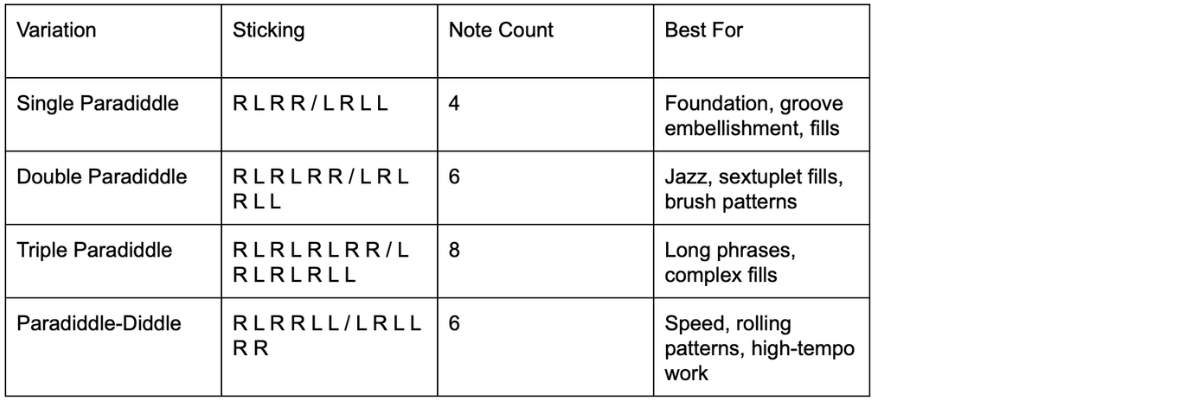
Paradiddle Variations: Double, Triple, and Paradiddle-Diddle
The single paradiddle is just the start. Once you have it solid, these variations extend the pattern and open up new musical possibilities.
Double Paradiddle
Sticking: R L R L R R / L R L R L L
The double paradiddle is six notes instead of four. It adds an extra alternating pair before the diddle. In 4/4 time, this fits naturally as a sextuplet (six evenly-spaced notes in one beat) or across the beat in different ways. The double paradiddle is a staple in jazz and fusion drumming — it's what sits behind a lot of brush work and ride cymbal comping patterns.
Triple Paradiddle
Sticking: R L R L R L R R / L R L R L R L L
Eight notes — three alternating pairs and a diddle. This one creates a longer phrase before the hand change, which makes it feel quite different from the single. Triple paradiddles work well in 8-bar fills and as the basis for some impressive-sounding cymbal/tom combinations.
Paradiddle-Diddle
Sticking: R L R R L L / L R L L R R
Six notes, but with two diddles instead of one. The extra diddle makes the hand change happen faster, which gives the paradiddle-diddle a different feel — quicker, more rolling. It's especially useful at high tempos and shows up a lot in speed exercises.
Applying the Paradiddle Around the Kit
A paradiddle on a single drum is a technique exercise. A paradiddle spread across the kit is music. Here's where to start taking it off the pad.
Ghost Note Grooves
One of the most practical uses of the paradiddle is in groove playing. Keep the accented strokes on the snare (or hi-hat) and play the unaccented notes as quiet ghost notes on the snare. This creates a texturally rich, full-sounding groove without adding any extra notes — the paradiddle's structure does the work for you. This technique is all over R&B, soul, and funk drumming.
Tom Fills
Assign each note of the paradiddle to a different drum. For a four-tom setup: high tom, mid tom, floor tom, snare — or any combination that makes musical sense. Because the paradiddle alternates hands naturally, moving between drums with it sounds smooth rather than clunky. Try a bar of groove, then drop into a paradiddle fill leading back to beat one.
Snare and Bass Drum Combinations
Play the paradiddle with both hands on the snare and add the bass drum on certain notes. A simple starting point: bass drum hits on the accented notes (the first note of each group). This gives you a driving, syncopated feel that sits differently from a standard groove and works well in fills and transitions.
Accenting Different Notes
Instead of always accenting the first note, try moving the accent to the second note (the "e") or the third note (the "and"). Each accent placement creates a completely different character. This is a great way to generate new patterns from a single sticking — the hands do the same thing, but the ears hear something totally different.
Common Paradiddle Mistakes
These are the issues that show up most often when beginners first tackle the paradiddle.
Rushing the Diddle
Why it's wrong: The two strokes of the diddle (R R or L L) want to speed up because your brain reads them as "two fast notes" rather than two equally-spaced notes. The result is a lopsided phrase where the first two notes feel like they're dragging and the diddle feels rushed.
How to fix it: Slow way down and count "1 e + a" out loud, lining up each note with a syllable. Record yourself on your phone — the timing problems are often obvious on playback even when they're hard to hear in real time.
Letting the Diddle Get Quiet
Why it's wrong: The second stroke of the diddle (the second R or second L) often gets softer because it's following immediately after the first. This creates an unintended accent on the wrong note and makes the pattern sound sloppy.
How to fix it: Practice the diddle in isolation: just R R / L L, alternating, keeping both strokes the same volume. The second stroke should rebound off the head at the same height as the first. Think of it as the stick doing the work, not your arm forcing it down again.
Playing Without Accents
Why it's wrong: A paradiddle with no accents sounds like a mush of even notes with no shape. The accent on the first stroke of each group is what gives the phrase its musical identity and makes it useful in actual playing.
How to fix it: Deliberately exaggerate the accent at first — make it noticeably louder than the other three notes. Once you can hear the contrast, bring it down to a more musical level. The natural rest of the rudiment's phrasing will follow.
Only Practicing Right-Hand Lead
Why it's wrong: The whole point of the paradiddle is that it develops both hands equally. If you always start with your right, you're just reinforcing your dominant hand's advantage.
How to fix it: For every minute you practice right-hand-lead paradiddles, spend an equal minute starting left. They'll feel very different at first — the left-hand lead version will be slower and sloppier. That gap is exactly what the paradiddle is designed to close.
Skipping the Slow Work
Why it's wrong: Pushing for speed before the pattern is clean just means you're practicing your mistakes faster. Sloppy paradiddles at 120 BPM don't turn into clean paradiddles at 120 BPM — they turn into deeply ingrained sloppy paradiddles.
How to fix it: Spend the first few weeks at 60–80 BPM. When the pattern is totally clean and automatic at a slow tempo, move up in small increments (5–10 BPM at a time). Speed that's built correctly is stable. Speed that's forced crumbles under pressure.
Beginner Practice Tips
A few habits that will make your paradiddle practice actually stick:
- Practice with a metronome every single time. The paradiddle is a timing rudiment as much as a hand coordination exercise. A metronome keeps you honest about whether your diddle is landing on the beat or rushing it.
- Say the sticking out loud. Literally say "R L R R / L R L L" while you play, especially in the early stages. Speaking and playing at the same time forces a mental connection that ingrains the pattern faster.
- Use a mirror or record your hands. Stroke height matters. Both hands should be hitting from the same height on non-accented notes. If your right is hitting from 8 inches and your left from 4 inches, the volumes won't match, no matter how hard you try to compensate.
- Practice slowly on a pillow or low-bounce surface occasionally. Removing the rebound makes your wrist and finger muscles work harder to control the stick. A few minutes of this each week translates to improved control on a normal pad or drum head.
- Short, focused sessions beat long unfocused ones. Ten minutes of clean, counted paradiddles every day beats an hour-long session twice a week. The muscle memory compounds daily, not in bursts.
- Apply it to the kit before you feel "ready". You don't need to have the paradiddle perfect on the pad before you take it to the drums. Trying it in a musical context — even imperfectly — shows you what to work on and keeps practice from feeling abstract.

Final Thoughts
The paradiddle looks simple on paper — four notes, two letters. But the work it does for your drumming is disproportionate to its simplicity. It builds hand independence, strengthens your weaker hand, introduces accent control, and gives you a vocabulary that translates directly into fills, grooves, and the kind of smooth-sounding patterns that make drumming feel musical rather than mechanical.
If you've never spent time on drum rudiments before, the paradiddle is the best place to start — more useful than the single stroke roll for most beginners because it addresses the balance problem right away. Get comfortable with the single paradiddle first, then bring in the double and the paradiddle-diddle once the foundation is solid. Take it off the pad and into your kit as soon as you can. That's when it becomes real.
FAQ
What is a paradiddle in simple terms?
A paradiddle is a four-note drumming pattern where you play two alternating strokes followed by two strokes on the same hand: Right Left Right Right / Left Right Left Left. It repeats continuously and switches which hand leads each time through.
Why is the paradiddle so important?
Because it's one of the only rudiments that naturally forces your weaker hand to lead as often as your dominant hand. That balance is fundamental to developing equal control across both hands, which affects everything from ghost notes to fills to hand speed.
How long does it take to learn the paradiddle?
You can learn the basic sticking pattern in a single practice session. Getting it clean, even, and accented correctly at a moderate tempo takes most beginners one to three weeks of consistent daily practice. Playing it fluidly at high speeds is a longer project — months of consistent work.
What's the difference between a single, double, and triple paradiddle?
The number refers to how many alternating stroke pairs come before the diddle (the double). Single = one pair (4 notes total). Double = two pairs (6 notes). Triple = three pairs (8 notes). Each one has a distinct feel and creates different musical possibilities.
Should I learn the paradiddle on a pad or a drum kit?
Start on a practice pad or snare drum — it's easier to hear the technique clearly without the distraction of the full kit. Once the sticking is clean, move it to the kit and try applying it across different drums and surfaces. Both environments teach you different things.
Can the paradiddle be used in actual songs?
Absolutely. The paradiddle is the foundation of ghost note grooves (common in funk and R&B), tom-fill sequences, brush patterns in jazz, and transitional fills in virtually every style of music. It's not just an exercise — it's a building block that shows up in real drumming constantly.