A steel drum — also called a steelpan or steel pan — is a pitched percussion instrument made from a hammered metal barrel, played by striking raised or indented note surfaces with rubber-tipped mallets. Each panel produces multiple musical pitches, making it both a melody and harmony instrument in one.
If you've heard that bright, shimmering, slightly bell-like sound coming from a Caribbean street band or festival stage, you've heard a steelpan. The instrument has a sound unlike anything else in the percussion world — warm but cutting, melodic but rhythmic. Despite looking deceptively simple, the steel pan has a sophisticated layout of notes and a playing technique that takes real practice to develop.
In this guide, we'll cover what a steel drum actually is, how it produces sound, the different types and their ranges, how to read a pan layout and play your first notes, what to look for when buying or renting one, common beginner mistakes, and tips for building real skill on the instrument. Whether you've stumbled on a pan at a music store or watched a steel band perform and wanted to know more, this is your starting point.
When you’re done reading, you will be familiar with:
- What Is a Steel Drum?
- How a Steel Pan Produces Sound
- Types of Steel Drums and Their Ranges
- Understanding the Note Layout
- How to Play a Steel Drum: Getting Started
- How to Choose a Steel Pan
- Common Mistakes Beginners Make
- Beginner Tips for Faster Progress
- Final Thoughts
- FAQ
What Is a Steel Drum?
The steel pan is one of the only musical instruments invented in the 20th century, and arguably one of the most important contributions the Caribbean has made to global music. It originated in Trinidad and Tobago in the 1930s and 1940s, developed by Afro-Trinidadian musicians who discovered that oil drums — the steel barrels used to transport petroleum — could be hammered into surfaces that held distinct pitches.
What makes the instrument remarkable is that a single round panel holds anywhere from a handful to over 30 different notes, all accessible by striking different areas of the dish. The player uses rubber-tipped mallets (called "sticks" or "mallets") to move around the pan's surface, combining melody and rhythm in a way that no other single instrument quite replicates.
Steel pans are the national instrument of Trinidad and Tobago and are central to the country's Carnival tradition. They've since spread worldwide, appearing in schools, orchestras, funk and jazz groups, and everything in between. The sound is immediately recognizable — that shimmering, tropical brightness — but the instrument itself is more versatile than its association with beach bars might suggest. Fully chromatic steelpans can cover multiple octaves and handle everything from folk songs to classical compositions.
How a Steel Pan Produces Sound
Understanding how a steelpan makes sound helps you understand why it needs to be played and maintained differently from a standard drum kit.
The surface of a steel pan is a concave dish — the bottom of an oil barrel that's been sunk (pushed inward) and then carefully hammered to create raised "notes." Each raised or slightly indented area of the dish is a distinct note. When you strike a note surface with a mallet, the metal vibrates at a specific frequency. Skilled pan makers (called "tuners") control the exact shape, depth, and tension of each note surface to set the pitch precisely.
What's unusual compared to most other percussion instruments is that the steel pan produces a complex, harmonically rich tone — not just a fundamental pitch but a series of overtones that give it that characteristic singing quality. A well-tuned pan's notes will sustain and ring even after the mallet has moved away, which is both what makes the instrument beautiful and what makes technique so important: unwanted notes can ring together if you're not careful.
The grooving (the lines scored between notes) helps isolate each pitch so they don't bleed into each other excessively. The rubber tips on mallets also matter enormously — harder rubber produces a brighter, more cutting attack; softer rubber gives a warmer, more muted tone.
Types of Steel Drums and Their Ranges
Steel pans come in several sizes and ranges, similar to how a string section has violins, violas, and cellos. In a steel band, different players handle different range instruments. Here's the main breakdown:
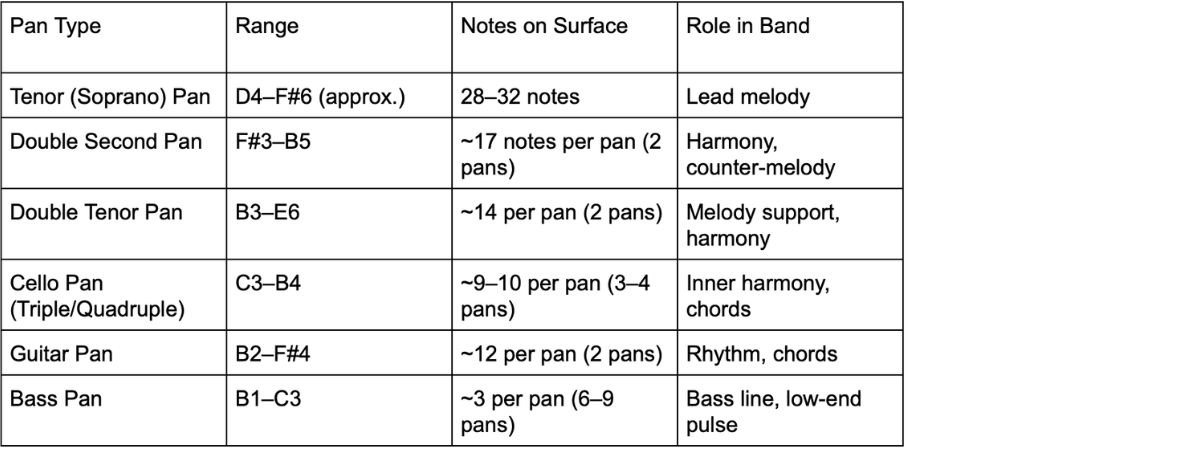
For beginners, the tenor pan (also called the lead pan or soprano pan) is the standard starting point. It's a single pan with a full chromatic range in the upper register, it's what most solo players use, and most beginner instruction assumes you're playing tenor. Everything below applies to the tenor pan unless otherwise noted.
Understanding the Note Layout
One of the first things that surprises beginners is that the notes on a steelpan are NOT arranged sequentially like a piano keyboard. They follow a circular pattern called the "cycle of fourths" (or fifths, depending on how you look at it), where each adjacent note is a perfect fourth away from the one next to it.
On a standard tenor pan, the layout runs roughly like this from the center outward:
- Center (innermost notes): The higher notes sit in the middle of the dish.
- Moving outward: Notes descend in pitch as you move toward the rim.
- Circular arrangement: Notes cycle through the chromatic scale around the pan, with adjacent notes a fourth apart rather than a half-step apart.
This arrangement exists because notes a fourth apart have very different harmonics — they don't interfere acoustically with each other the way adjacent half-steps would. It means a C and the D directly next to it don't make each other ring out of tune. The practical result for you as a player: scales and simple melodies require larger physical jumps than you'd expect, but chords and arpeggios fall under your hands more naturally once you've memorized the layout.
Learning the pan layout is like learning where the keys are on a non-standard keyboard. It takes time and repetition. Most players mark their practice pan with labels when starting out — there's no shame in it.
How to Play a Steel Drum: Getting Started
Playing the steel pan involves good mallet technique, memorizing the layout, and developing a feel for how hard and where to strike each note.
1. Set Up the Pan at the Right Height
A steel pan should hang from a stand (called a "frame" or "spider") so the surface sits roughly at your waist level when you're standing. The pan should be stable and not wobble when you strike it. Most beginners play standing up, though seated playing is possible on some setups.
Your arms should hang comfortably at your sides with your elbows slightly bent. If the pan is too high, your shoulders will tire quickly. Too low and you'll hunch, which kills both posture and control.
2. Hold the Mallets Correctly
Steelpan mallets are held loosely between the thumb and first two fingers, similar to how you'd hold drumsticks but with even more of a relaxed grip. The mallet should pivot from the wrist, not the elbow — elbow-driven strokes are slow and imprecise on a crowded note surface.
Use a "bounce" technique: let the mallet head drop onto the note surface and immediately rebound, rather than pressing into the surface. Letting the note ring after the bounce is what produces that signature sustain. Pressing in deadens the sound immediately.
3. Strike the Center of Each Note
Every note on the pan has a "sweet spot" — usually the center of that note's defined area. Hitting off-center on a crowded pan can activate neighboring notes and produce a muddy, unclear pitch. Take it slowly at first and focus on landing cleanly in the middle of each note.
4. Learn a Scale Before Learning Songs
Start with a C major scale. On a tenor pan, this means jumping around the circular layout rather than moving in a straight line. Go slowly, one note at a time, and try to build muscle memory for where each note sits relative to your body. Repeat the scale up and down until you can do it without looking.
A few common beginner songs to practice once you've got a scale or two down: "Mary Had a Little Lamb," "Twinkle Twinkle Little Star," "Hot Cross Buns." They sound simple, but they force you to find notes accurately at a steady tempo, which is exactly the skill you need.
5. Practice with Both Hands Equally
Good steelpan technique requires both hands working independently across different areas of the pan. Many beginners over-rely on their dominant hand. Practice scales and simple patterns with your non-dominant hand leading — it'll feel awkward at first but becomes essential for more complex playing.
6. Use Stickings (Hand Assignments)
In steelpan notation and teaching, "stickings" tell you which hand plays which note. Standard practice assigns notes to hands based on which side of the pan they sit on — notes on the left side of the pan generally go to the left hand, notes on the right to the right hand. But for certain scale patterns and songs, you'll need to alternate in specific ways to maintain smooth playing. When learning a new song, plan your stickings before you practice at speed.
How to Choose a Steel Pan
Buying a steelpan requires a little more research than picking up a standard drum accessory. Quality and tuning vary enormously by maker, and a poorly tuned pan is genuinely unpleasant to practice on.
New vs. Used
A brand-new, properly tuned tenor pan from a reputable builder will cost anywhere from $400 to $1,200+ depending on quality. Well-maintained used pans can be excellent value — but have someone who plays examine it first. An out-of-tune pan (where individual notes have gone sharp or flat) needs professional re-tuning, which adds cost.
What to Look For
- Even note spacing: The grooves between notes should be clean and consistent. Sloppy grooving leads to notes bleeding into each other.
- Tuning stability: Strike each note and check that it holds pitch clearly. Notes that go flat or wavy immediately after being struck are signs of a poorly hammered surface.
- Stand quality: A wobbly stand causes the pan to move as you play, killing accuracy. Heavy-gauge steel stands are worth the extra cost.
- Mallet quality: Pan mallets are simple but specific — the rubber hardness matters. Starter pans often come with mallets, but aftermarket options give you more tonal control.
Reputable Builders and Brands
Most high-quality steel pans are still handmade by individual craftspeople, many based in Trinidad. Some names with solid reputations include Panyard Inc. (US-based), Harry Mannette (historical, but his student lineage continues), and various Trinidadian craftspeople who ship internationally. For mass-market entry-level pans, look for reviews from steel band directors and teachers rather than relying on general music retailer star ratings.
If cost is a barrier, many schools and community music programs have pan rental programs — worth investigating before buying.
Common Mistakes Beginners Make
These are the technique and learning mistakes that slow almost every beginner down on the steel pan.
Striking Too Hard
Why it's wrong: Hammering the pan hard produces a harsh, clipped tone and activates surrounding notes you didn't intend to play. It also throws off your accuracy because the mallet bounces unpredictably when it hits too forcefully.
How to fix it: Use gravity, not force. Lift the mallet and let it fall onto the note under its own weight, guiding it to the sweet spot. The note should sing clearly after a light, controlled stroke. If it doesn't, the issue is usually your strike location, not your force.
Looking at Your Hands Instead of the Pan Layout
Why it's wrong: When you focus on your hands rather than the note surfaces you're targeting, your accuracy drops dramatically. You need to look at where you're hitting, not at how your hands look while doing it.
How to fix it: Slow everything down and track each mallet to its target before striking. As the layout becomes automatic, your eyes stay ahead of your hands — like reading ahead when you type. It only becomes possible through repetition.
Rushing Through the Layout Before Memorizing It
Why it's wrong: Trying to play songs before you know where the notes are locks you into constantly hunting for notes while you play — a habit that's very hard to break later.
How to fix it: Spend your first several sessions just learning note locations. Call out each note name as you strike it. Label the pan with tape if you need to. Build the map in your head before you try to navigate it at tempo.
Tensing Up the Wrist
Why it's wrong: A tense wrist turns every stroke into a choppy, effortful hit. Your control decreases, your speed plateaus, and sustained playing causes fatigue or strain.
How to fix it: Shake your hands out before practicing and consciously relax your grip. The mallet should feel like it's barely held — guided, not gripped. If your forearms are burning after 10 minutes of practice, your grip is too tight.
Neglecting the Non-Dominant Hand
Why it's wrong: If you only develop your dominant hand, you'll hit a ceiling fast. Most pan passages require both hands to share equally — especially as melodies move across the full layout.
How to fix it: Dedicate part of every practice session to non-dominant hand only. Play your scales and simple tunes with just that hand. It feels awkward for weeks, then suddenly stops feeling awkward.

Beginner Tips for Faster Progress
- Label your pan at first. There's no rule against it. A piece of painter's tape with each note name helps you learn the layout faster than any other method — just make sure to remove the labels once you've internalized the positions.
- Practice short sessions more frequently. Twenty minutes every day beats two hours on Sundays. The pan layout lives in muscle memory, and muscle memory is built through repetition over time, not marathon sessions.
- Record yourself playing. Even a phone recording reveals things you don't notice while playing — notes you're consistently missing, rhythm that's rushing, mallet angles that are off. Listen back every few sessions.
- Learn songs you can sing. If you can sing or hum a melody, your ear will catch your mistakes on the pan. Songs you can't sing tend to feel mechanical and harder to self-correct.
- Get the pan professionally tuned once a year. Steel pans go out of tune with regular playing. A pan that's slightly off-pitch makes practice harder and trains your ear to accept bad intonation. If notes sound "wobbly" or don't ring cleanly, it's time for a tune-up from a pan tuner.
- Join a steel band if you can. Playing with others is the fastest way to develop timing, listening skills, and confidence. Community steel bands exist in many cities, and most are beginner-welcoming.
Final Thoughts
The steel drum has one of the most distinctive voices in all of music — and it's also one of the more genuinely rewarding instruments to learn once you get past the layout. The first few weeks involve a lot of hunting for notes. Then something clicks, the map becomes familiar, and playing a melody feels smooth and natural in a way that's hard to describe but immediately recognizable when it happens.
It rewards patient, consistent practice over trying to rush songs you're not ready for. Learn the layout first, build your mallet control second, then let the songs come naturally from there. The instrument will meet you halfway.
FAQ
Is a steel drum the same as a steel pan?
Yes — the terms are interchangeable. "Steel pan," "steelpan," and "steel drum" all refer to the same instrument. "Steel pan" is the term most commonly used in the Caribbean, while "steel drum" is more common in North American casual usage. In the music industry and among players, "pan" is usually preferred.
What's the difference between a steel drum and a handpan?
They're related but distinct. A handpan (like a Hang drum or RAV Vast) is a convex, sealed instrument played with the hands, not mallets. A steel pan is concave, open at the top, and played with rubber-tipped mallets. Handpans typically cover fewer notes and have a more meditative, ambient sound. Steel pans are louder, more harmonically complex, and designed for ensemble playing.
How long does it take to learn the steel drum?
Most beginners can play simple songs within a few weeks of regular practice. Getting truly comfortable with the full layout and developing smooth two-handed technique takes several months. Playing in a steel band at a reasonable level — a year or more of consistent work for most people.
Do I need to read music to play steel pan?
No — many skilled pan players learn by ear and by watching others. That said, basic knowledge of note names (A, B, C, D, E, F, G and their sharps/flats) is essential because the layout is organized by note name. Formal music reading helps, especially if you want to play written arrangements, but it's not a prerequisite.
How much does a steel drum cost?
Entry-level tenor pans from mass manufacturers start around $200–$400, though quality at this price point is variable. A well-made pan from a reputable builder runs $600–$1,200 for a single tenor. Full bass setups (multiple pans on a frame) can cost $2,000–$5,000+. Rentals are available through many school music programs and Caribbean music organizations.
Can I play a steel drum indoors?
Yes, though acoustic steel pans are fairly loud — not as loud as a full drum kit, but loud enough to bother neighbors in apartment settings. Practicing in a basement, garage, or a room with some acoustic dampening helps. Unlike drumsticks on drum heads, mallets on steel produce a more musical, less percussive noise that many people find less grating. You won't need a drum shield, but fair warning to those who share walls with you.
Is the steel drum part of the drum kit?
No — the steel pan is a completely separate instrument from the standard drum kit. A drum kit is a percussion setup played with sticks and foot pedals to keep rhythmic time. The steel pan is a melodic pitched percussion instrument played with mallets. The two share nothing except the word "drum" and a broad category of being struck to produce sound.