A drum machine is an electronic device — or software — that generates percussion sounds and plays them back in a programmable rhythmic pattern. Instead of a human drummer sitting behind a kit, a drum machine triggers pre-recorded or synthesized drum and cymbal sounds at whatever timing and pattern you program into it.
That's the definition, but it barely scratches the surface of what drum machines actually do for musicians. For songwriters and producers, a drum machine is the foundation of an entire track. For live drummers, it's a practice tool, a writing partner, and sometimes a second percussionist on stage. If you've heard a hip-hop beat, an 808-driven pop song, or almost any electronic track from the last 40 years, you've already heard what drum machines do in practice.
This guide covers what drum machines are and how they work, the main types you'll encounter, the most iconic drum machines in music history, how drummers actually use them in practice and performance, the honest comparison between drum machines and live drumming, and what to look for if you want to get started with one. By the end you'll know exactly what drum machines are good for — and where they fall short.
When you’re done reading, you will be familiar with:
- How a Drum Machine Works
- Types of Drum Machines
- Iconic Drum Machines in Music History
- How Drummers Use Drum Machines
- Drum Machine vs. Live Drums: An Honest Comparison
- Getting Started with a Drum Machine
- Common Drum Machine Mistakes
- Beginner Tips for Drum Machines
- Final Thoughts
- FAQ
How a Drum Machine Works
Every drum machine, whether a vintage piece of hardware from the 1980s or a modern software plugin, is built around the same core idea: a sequencer that triggers sounds at specific points in time.
The sequencer is the brain. It divides a measure of music into a grid — usually 16 steps in a standard 4/4 bar, where each step is a sixteenth note — and lets you activate or deactivate each step for each drum sound. When you activate step 1 on the kick drum, the kick fires on beat one. Activate step 5 on the snare and you get a snare hit on beat two. The machine loops through all 16 steps at whatever tempo you set, triggering sounds wherever you've placed them.
The sounds themselves come from one of two sources:
- Samples: Pre-recorded audio clips of real drum hits — a recorded kick drum, a real snare, an actual hi-hat close. Sample-based machines tend to sound organic and familiar.
- Synthesis: Electronically generated sounds, where the machine creates the audio signal from scratch using oscillators, filters, and envelopes. Synthesized drum sounds range from realistic to completely otherworldly.
Modern drum machines often combine both — a library of samples plus synthesis controls that let you shape each sound's pitch, decay, tone, and color. Most also let you adjust the velocity (how hard each hit is) step-by-step, so you can program quiet ghost notes alongside loud backbeats, giving patterns more dynamics and life.
Types of Drum Machines
Drum machines come in several distinct forms, each suited to different uses and workflows.
Hardware Drum Machines
Standalone physical devices with their own controls, screens, and audio outputs. You program them directly on the unit, connect them to a speaker or mixer, and play. Hardware machines are tactile and immediate — you're not staring at a screen, you're hitting pads and pressing buttons. They range from affordable beginner units to professional studio workhorses that cost several thousand dollars.
Examples: Roland TR-8S, Arturia DrumBrute Impact, Elektron Digitakt, Teenage Engineering Pocket Operator.
Software Drum Machines (Plugins and DAW Instruments)
Virtual drum machines that run inside a digital audio workstation (DAW) like Ableton Live, Logic Pro, or FL Studio. They look and function like hardware machines on screen, but all the processing happens in your computer. Software machines are often cheaper (or free), endlessly flexible, and capable of outputting into a full recording environment without extra gear.
Examples: Native Instruments Battery, Splice Beatmaker, FL Studio's FPC, Ableton Drum Rack.
Apps
Mobile drum machine apps for phones and tablets. These range from simple beat-making toys to surprisingly capable production tools. Great for sketching ideas on the move. Not ideal for professional production, but useful for learning the concepts of step sequencing and pattern building without spending anything.
Examples: GarageBand (iOS), DM1, Groovebox by Ampify.
Drum Pads with Sequencers
Hybrid devices like the Akai MPC series or the Native Instruments Maschine combine a pad controller with a full-featured drum sequencer. You can play beats live by hitting pads, record your performance, and edit it in the sequencer afterward. These are often used by producers and live performers who want something between pure sequencing and live drumming.
Iconic Drum Machines in Music History
A few drum machines shaped the sound of entire decades and genres. Understanding them gives you useful context for how these tools have been used in real music.
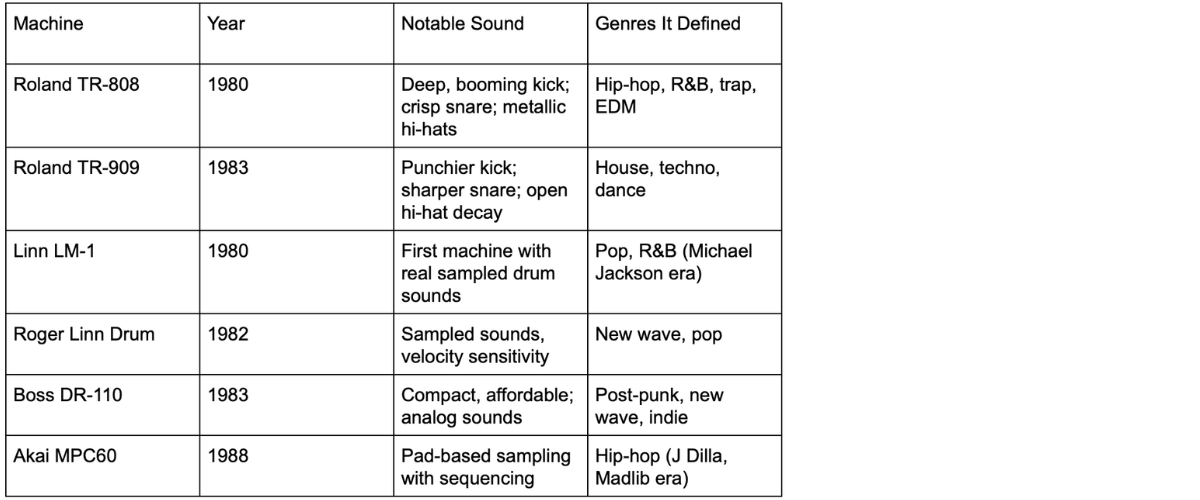
The Roland TR-808 deserves special mention. It was considered a commercial failure when it launched in 1980, discontinued quickly, and sold on the secondhand market for next to nothing. Hip-hop and electronic producers picked up used 808s in the early 1980s because they were cheap — and the sound of that cheap machine became one of the most recognizable drum sounds in all of popular music. If you've ever heard a trap song, you've heard the 808 kick and hi-hat.
How Drummers Use Drum Machines
Drum machines get stereotyped as replacements for drummers, but most working drummers interact with them in more collaborative ways than that framing suggests.
As a Practice Tool
A drum machine set to a steady groove is one of the most useful practice aids available — better than a simple metronome in some ways because you're playing along with a full rhythmic context rather than just a click. Program a basic rock beat or a hip-hop groove into a drum machine, set it looping, and practice your fills, rudiments, or new beats on top of it. The machine keeps time while you focus on whatever you're working on.
This is particularly useful for:
- Working on fills — you can hear them in context without needing a band
- Practicing switching between grooves without losing the tempo foundation
- Building confidence with time-keeping when a pure metronome click feels disconnected
For Songwriting and Demos
Drummers who write songs or produce music use drum machines to sketch out ideas without setting up the full kit. Program a rough drum part, record the rest of the song on top of it, then replace the machine tracks with live drums later. It's faster and quieter than recording real drums for every demo, and it lets you hear how the song is developing without committing to a final drum arrangement.
In Live Performance
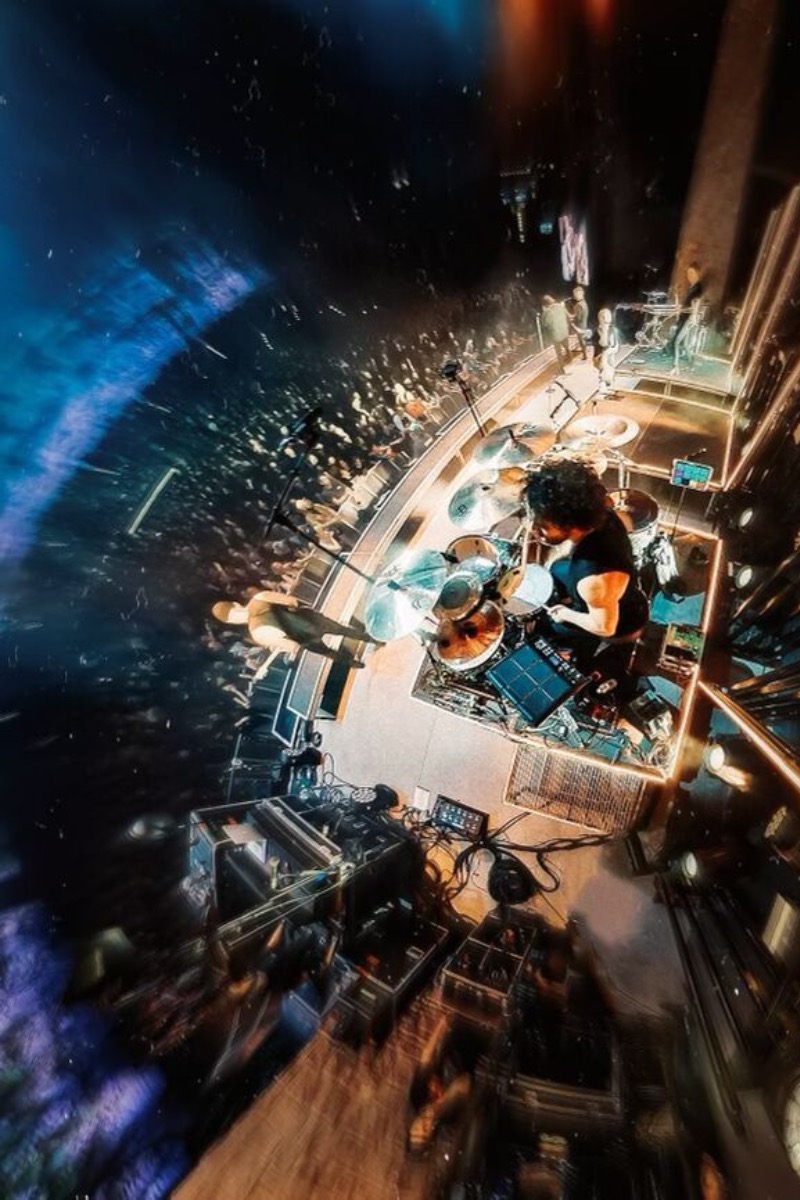
Some drummers perform alongside a drum machine running programmed loops — a technique used in everything from electronic acts to solo performers who want a fuller sound than they could produce alone. The machine handles the repetitive foundational pattern while the live drummer adds fills, accents, and live variation on top. This requires solid timekeeping since the machine runs at a fixed tempo and won't wait for you.
As a Replacement (When Necessary)
In genres like hip-hop, electronic, and pop production, drum machines often replace live drummers entirely. This isn't a comment on live drumming's quality — it's about workflow, consistency, and genre conventions. A well-programmed machine part can sit better in a mix than live drums for certain styles, and it can be edited to sample-perfect precision.
Drum Machine vs. Live Drums: An Honest Comparison
This comparison depends heavily on what you need and what genre you're working in. Neither is universally better.
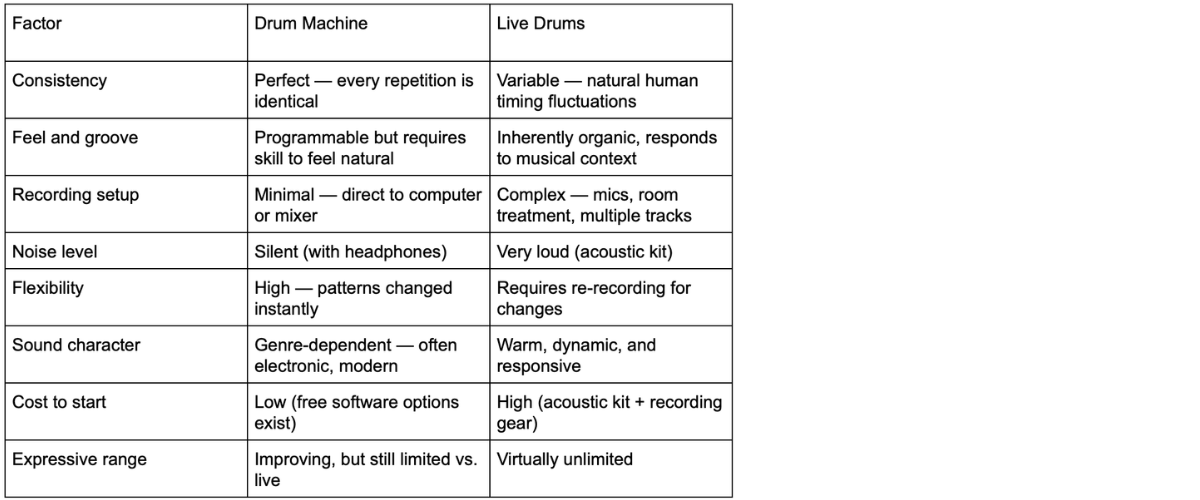
The human feel of live drumming — the slight variations in timing and velocity that make a groove breathe — is difficult to fully replicate with a machine, though modern producers have developed techniques like "humanizing" (adding small random timing offsets and velocity variations) to close the gap. On the other hand, a drum machine never gets tired, never rushes, and never needs three takes to play a difficult fill cleanly.
In most professional contexts today, producers use both: drum machines and samplers for the initial production, with live drum overdubs added where the track needs warmth, complexity, or a live performance energy.
Getting Started with a Drum Machine
You don't need to spend much to get started. Here's a practical path depending on where you are:
If You Want Free
Download a free DAW or use a browser-based step sequencer. Flat.io, BandLab's BeatMaker, and GarageBand (on Mac or iOS) all offer functional drum machine tools at no cost. Spend time programming simple patterns, learning what each step does, and developing your ear for how patterns interact with tempo and feel.
If You Want Hardware Under $200
The Arturia DrumBrute Impact and the Teenage Engineering Pocket Operators are popular entry-level hardware options with strong communities and good learning curves. The Roland TR-6S is another solid choice. These will teach you hands-on hardware workflow — tweaking knobs, adjusting patterns in real time — which is a different skill from working in software.
If You're a Drummer Who Wants a Practice Tool
Consider whether a drum machine is actually what you need, or whether a more comprehensive rhythm trainer — something like a Boss RC-505 loop station or even just a phone app with a programmable groove — serves you better. For pure practice purposes, the sequencing capabilities of expensive hardware aren't necessary. A simple app that lets you program a groove and set a tempo gets the job done.
Learning the Basics of Programming
Start with a four-on-the-floor pattern: kick on every beat (steps 1, 5, 9, 13 in a 16-step grid), snare on beats 2 and 4 (steps 5 and 13). Add hi-hat on every eighth note (steps 1, 3, 5, 7, 9, 11, 13, 15). That's a functional house/rock pattern and a template for understanding how the grid works. From there, move one element at a time — try moving the kick to step 3, or opening the hi-hat on step 7 — and listen to what changes.
Common Drum Machine Mistakes
Making Every Pattern Perfect and Robotic
Why it's wrong: Perfect timing sounds good in some genres (techno, certain house styles) but lifeless in others (R&B, hip-hop, jazz-influenced production). A pattern where every note hits exactly on the grid feels mechanical in a way that human listeners can subconsciously detect.
How to fix it: Use the velocity controls to vary dynamics — a ghost note snare hit shouldn't be at the same volume as the backbeat. Many machines and DAWs also have a "groove" or "humanize" function that adds subtle timing offsets. Or simply program your ghost notes and secondary hits at slightly lower velocities manually. Small inconsistency is what makes a machine groove feel alive.
Starting with Too Many Sounds
Why it's wrong: A beginner with a drum machine full of 200 kit sounds spends more time auditioning sounds than learning to program. The pattern-writing skill gets neglected, and nothing sounds cohesive because you're mixing sounds from five different kits.
How to fix it: Pick one complete drum kit and stick with it for a week. Learn how that kick, snare, and hi-hat interact at different velocities and tempos before reaching for anything else. You'll learn more about programming from one kit than from 20.
Ignoring Tempo
Why it's wrong: New drum machine users often program a pattern, think it sounds good, and only then realize they have no idea what tempo they're at or whether it fits the music they're making. Tempo is part of the feel — the same pattern at 90 BPM sounds completely different from the same pattern at 130 BPM.
How to fix it: Before you program anything, set your tempo intentionally. Know what genre and energy level you're going for, look up typical BPM ranges for that genre, and start there. Adjusting tempo after the fact often reveals that a pattern that worked at 95 BPM feels completely wrong at 115 BPM.
Never Listening Back Critically
Why it's wrong: Beginners get absorbed in the programming process and don't stop to listen to the pattern as music. You end up building something technically correct that doesn't actually groove.
How to fix it: Program a pattern, step away from the controls, and just listen. Walk around, nod your head, try to feel whether it locks in or feels stiff. If something doesn't feel right, figure out which element is causing it. Is the snare landing at the right velocity? Is the kick on an unexpected beat that's not working? Critical listening is a skill, and drum machine programming develops it faster than almost anything else.
Beginner Tips for Drum Machines
- Copy patterns you already know. Take a song you love and try to program its drum beat into your machine. Matching a real song forces you to figure out exactly what's happening rhythmically — which is a far better learning exercise than making something up from scratch with no reference.
- Vary velocity more than you think is necessary. The difference between a flat-feeling machine pattern and a grooving one is usually velocity. The backbeat snare might sit at 100 out of 127; ghost notes should be at 30–50. Hi-hat accents at 90, steady hi-hats at 70. The range matters.
- Learn one machine well before buying another. The urge to collect drum machines is real, and every new machine promises something the last one didn't have. But going deep on one machine — knowing every feature, every parameter, every sound — will serve you more than skimming five different ones.
- Use it alongside your practice routine. If you're an acoustic drummer, program a simple groove you want to practice against, loop it, and play along on the kit. Use it the same way you'd use a metronome, but with more rhythmic context. This is also a great way to sharpen your time-keeping because the machine won't adjust to you — you have to adjust to it.
- Explore swing and groove settings. Most drum machines have a swing function that shifts some notes slightly off the perfect grid to create a more human feel. Start with a light swing amount (30–40%) and listen to how it changes the feel. Swing is a big part of what gives classic hip-hop and jazz-influenced beats their characteristic push-and-pull.
Final Thoughts
Drum machines aren't the enemy of live drumming — they're a tool that extends what's musically possible. The best drummers and producers understand both worlds: what a machine does well (consistency, flexibility, accessibility) and what only a live drummer can deliver (feel, responsiveness, nuance, the energy of a human performance).
Whether you're a drummer curious about production, a beginner writer looking for a beat foundation, or someone who just wants to practice more effectively, understanding drum machines opens up a new dimension of rhythm. Start simple — one kit, basic patterns, a focus on groove rather than complexity — and build from there. The programming side develops quickly once you understand the grid, and the musical decisions involved in building a drum machine pattern will make you think about rhythm in new ways.
FAQ
Do drummers use drum machines?
Yes — many professional drummers use drum machines for practice, songwriting, and production. Some use them as a more musical alternative to a metronome; others use them to sketch out arrangements without setting up the full kit. In the studio, drummers and drum machines often appear on the same track.
What's the difference between a drum machine and a drum sampler?
The distinction is blurring but traditionally: a drum machine generates sounds internally (through synthesis or a built-in sample library) and has a step sequencer built in. A drum sampler lets you load your own audio samples and trigger them, often without a sequencer included. Modern drum machines like the Akai MPC series do both.
Can a drum machine replace a real drummer?
In some genres and contexts, yes — hip-hop, EDM, and electronic pop routinely use programmed drums exclusively. In genres where feel, dynamics, and live performance energy matter most (jazz, rock, blues, soul), a drum machine is a complement to live drumming rather than a replacement for it.
What is the best drum machine for beginners?
For free software: GarageBand's Drummer or FL Studio's FPC. For an affordable hardware machine: the Arturia DrumBrute Impact or Teenage Engineering Pocket Operator PO-32. For a versatile mid-range option: the Roland TR-8S. The "best" depends on your budget and whether you prefer hardware controls or software flexibility.
What is the 808 drum machine?
The Roland TR-808 is a drum machine released in 1980. It uses analog synthesis to create its sounds and became one of the most influential drum machines in music history despite being a commercial failure at launch. Its deep kick drum, sharp snare, and open hi-hat sounds define hip-hop, trap, and much of contemporary pop and R&B production.
Can I use a drum machine to practice drums?
Yes — this is one of the most underrated uses. Program a groove you want to practice against, loop it, and play along on your kit or practice pad. It gives you more rhythmic context than a straight metronome click and keeps you accountable to a steady tempo. It's also useful for practicing transitions and fills in the context of a repeating groove.