Drum rudiments are standardized sticking patterns — exercises like the single stroke roll, the paradiddle, and the flam — that form the technical foundation of drumming. Every advanced technique you'll ever use on a kit traces back to one of these patterns.
Most beginners skip rudiments entirely and jump straight to playing beats. That works for a while, and then it doesn't. At some point you'll want to play a fill that your hands can't execute cleanly, or your rolls will sound uneven, or your ghost notes will be inconsistent — and the root cause is almost always a gap in the basics. Rudiments are how you close that gap.
In this guide, we'll explain exactly what drum rudiments are, why they matter more than most beginners think, walk through the essential ones to learn first, show you how to practice them effectively, and cover the most common mistakes that slow drummers down. If you put in 10 focused minutes a day on the patterns in this guide, you'll notice real improvement in your playing within a few weeks.
When you’re done reading, you will be familiar with:
- What Are Drum Rudiments?
- Why Rudiments Matter (Even If You Just Want to Play Beats)
- The 40 Rudiments: What They Are and Where They Come From
- Essential Rudiments to Learn First
- How to Practice Drum Rudiments the Right Way
- Common Rudiment Practice Mistakes
- Beginner Tips for Building Rudiment Habits
- Final Thoughts
- FAQ

What Are Drum Rudiments?
Rudiments are defined sticking patterns that every drummer learns as the building blocks of technique. Think of them like scales for a pianist — not music in themselves, but the foundational movements that make music possible. They cover everything from basic alternating strokes to complex combinations of bounced hits, accents, and grace notes.
The Percussive Arts Society (PAS) maintains the official list of 40 International Drum Rudiments, organized into five families:
- Roll Rudiments — Patterns that create a sustained, connected sound (single stroke roll, double stroke roll, multiple bounce roll, etc.)
- Diddle Rudiments — Patterns built around double strokes in sequence (paradiddle and its variations)
- Flam Rudiments — Patterns using a grace note just before the main stroke (flam, flam accent, flamacue, etc.)
- Drag Rudiments — Patterns using two soft strokes followed by a full stroke (drag, single drag tap, lesson 25, etc.)
- Stroke Rudiments — Basic single and double stroke variations that underpin everything else
You don't need to learn all 40 to become a solid drummer. In practice, about 8–10 core rudiments cover the vast majority of what you'll use on the kit. The rest are advanced tools you pick up as you go.
Why Rudiments Matter (Even If You Just Want to Play Beats)
Here's the honest case for rudiments — not the textbook version, but the practical one.
Rudiments develop four things that you cannot build any other way: stick control, hand independence, dynamic range, and speed. When both hands are executing clean, even patterns independently, everything else on the kit gets easier. Your fills become more reliable. Your ghost notes sit in the pocket instead of clashing. Your rolls sound smooth instead of choppy.
The other thing rudiments do is give you vocabulary. When a drummer plays a flam into a fill, or ghosts a paradiddle between the kick and snare, those aren't random choices — they're rudiments applied to the kit. Learning the patterns off the pad means you can access them in real playing without thinking about them consciously. That's what "vocabulary" means: the technique is there when you need it, not a moment after.
If you're working on reading notation, rudiments pair naturally with that too. Drum sheet music is full of sticking notations, rolls, and ornaments that only make sense once you know what the underlying patterns feel like. Knowing how to read drum notation becomes much more useful once your hands actually know what a paradiddle or a flam feels like.
The 40 Rudiments: What They Are and Where They Come From
The modern 40 rudiment system traces its roots to military drumming in 17th and 18th century Europe, where field drummers used standardized patterns to communicate orders across battlefields. The National Association of Rudimental Drummers (NARD) first formalized a list of 26 rudiments in 1933. The PAS expanded and updated it to 40 in 1984, adding patterns from rudimental traditions around the world and organizing them into the five-family system still used today.
The full list of 40 is worth knowing, but you don't need to learn them in order or all at once. The most widely used breakdown for beginners focuses on the foundational patterns first and builds complexity from there. The table below gives a quick map of where to start:
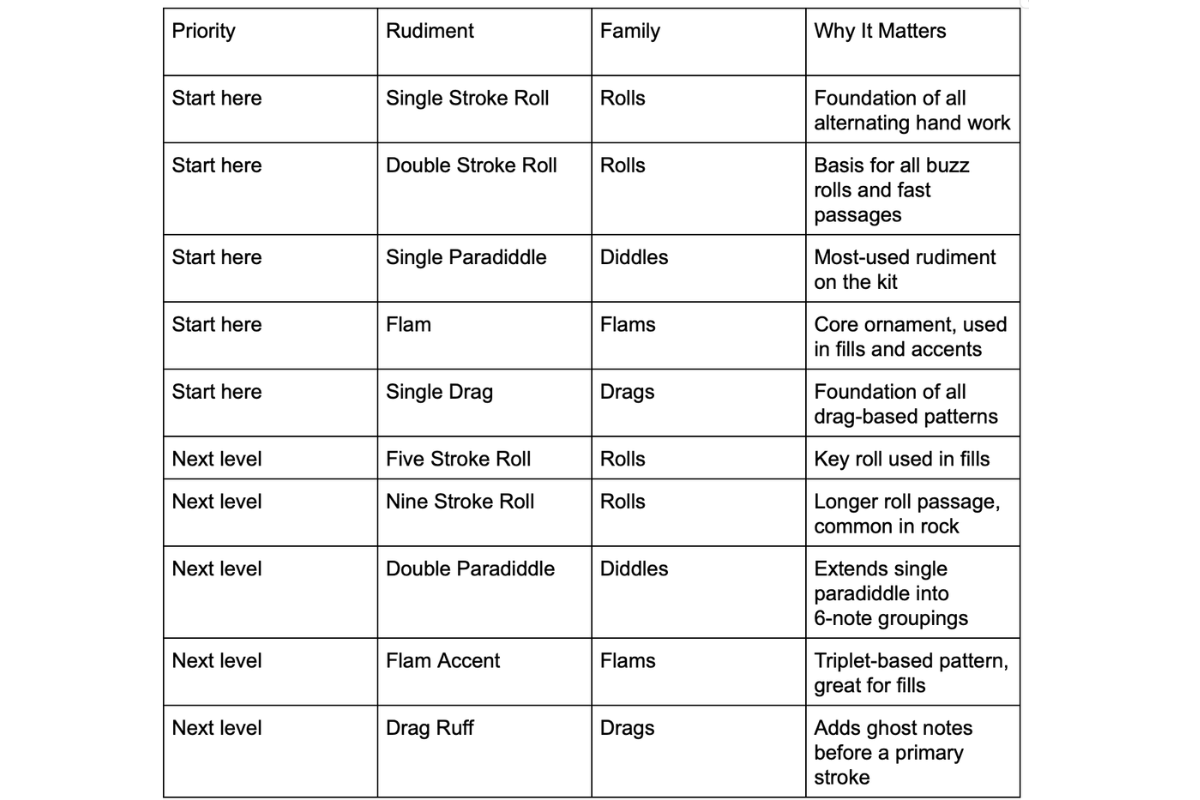
Essential Rudiments to Learn First
Don't try to work through all 40 at once. Here are the five rudiments that give you the most return on your practice time as a beginner. Master these before moving to anything else.
1. Single Stroke Roll (R L R L R L...)
The simplest rudiment and the most important: strict alternation between right and left hand, one stroke per hand. Every other rudiment builds on your ability to do this cleanly, evenly, and at varying speeds.
The key is evening out both hands. Most beginners have a dominant hand that naturally plays louder and faster. Your job is to get both sticks landing with the same weight at the same velocity. Practice slowly and listen critically — any imbalance you ignore at low speed will become an obvious problem at high speed.
2. Double Stroke Roll (R R L L R R L L...)
Two strokes per hand before switching. The trick here is getting the second stroke of each pair to sound as clean and even as the first. At slow tempo, you play two deliberate strokes with each hand. As speed increases, you shift to a controlled bounce — letting the stick rebound naturally off the head to produce the second stroke. That transition from "played" to "bounced" is the core technique challenge of this rudiment, and nailing it takes patience.
Once you have it, the double stroke roll opens up smooth, fast rolls that sound nothing like the choppy doubles beginners usually produce. It's also the foundation of the five-stroke, seven-stroke, and nine-stroke rolls.
3. Single Paradiddle (R L R R / L R L L)
Four notes per grouping: two alternating strokes followed by a double. The sticking pattern is R L R R, then L R L L, repeating. It feels awkward at first because the double stroke breaks the natural alternation — your hands want to just keep going RLRL. Stick with it.
The paradiddle is arguably the most-used rudiment on a full kit. Drummers use it to move between surfaces (kick, snare, toms) in fills, to create natural accent patterns, and as a ghosting tool between beats. The uneven groupings (two single, one double) create natural accents on the first note of each group, which locks in beautifully with most musical phrases. It also makes for a great hi-hat pattern when applied to the kit — the accent falls on beats one and three if you start on the right, one and four if you start on the left.
4. Flam (grace note + primary stroke)
A flam is two notes played almost simultaneously from opposite hands — a soft "grace note" just before a full stroke from the other hand. Written as a small note before the main note in notation, and felt as a slight "fa-LAM" sound rather than a clean single stroke. The grace note is quiet and intentionally close to the main stroke — not a separate beat, just an ornament that thickens the sound.
Flams are everywhere in rock and funk drumming — on snare backbeats for extra weight, in fills where you want a heavier stroke, on toms for accents. Getting the timing right takes practice. Too wide (the grace note too early) and it sounds like two separate hits. Too tight and it sounds like a bad unison. You're aiming for a single "fattened" sound.
5. Single Drag (grace notes + primary stroke)
Similar to a flam, but with two grace notes before the primary stroke instead of one. The sticking is: two soft notes from the same hand (a quick double), followed by a full stroke from the opposite hand. Written as "drag" or "ruff" in notation. The sound is a tight "da-da-DUM" — the two grace notes are very close together and very quiet, landing just before the main hit.
Drags add texture and forward momentum to fills, particularly in more nuanced styles. They're also the gateway into a whole family of drag-based rudiments once you have the basic motion down. Getting clean, quiet grace notes without accidentally accenting them is the challenge here.
How to Practice Drum Rudiments the Right Way
Practicing rudiments poorly is almost worse than not practicing them at all — bad habits ingrained at full speed are very hard to undo. Here's a process that actually builds technique.
Step 1: Start on a Practice Pad
Work on a practice pad or a snare drum before moving patterns to the full kit. A pad gives you immediate feedback on stick rebound and dynamic consistency without the distraction of different surface tensions across toms and cymbals. Pads are also quieter, which matters for late-night or apartment practice.
Step 2: Start Slow — Much Slower Than You Think
Set a metronome to 60 bpm and play the rudiment as single eighth notes. This tempo feels almost comically slow, but it's where you can hear everything: whether both hands are even, whether the rebounds are controlled, whether accents are landing in the right place. If you can't play it cleanly at 60 bpm, you don't own it at 120 bpm — you're just hiding the problems behind speed.
Step 3: Build Speed in Small Increments
Once the pattern is clean at 60, move to 70. Then 80. Then 90. Don't jump straight to your target tempo. Small increases let your muscle memory adapt without breaking down. Most drummers try to rush this process and end up plateauing — the technique stops improving because they never let it consolidate at a lower speed.
Step 4: Use the "Slow-Fast-Slow" Method
A classic rudiment practice format: play the pattern slowly for 4 bars, accelerate to a fast tempo over the next 4 bars, then decelerate back to slow over the final 4. This trains your hands to maintain form at multiple speeds and helps you find the edge of clean playing before you go beyond it. I find this more productive than staying at a fixed tempo the whole session — it maps directly to how rudiments actually appear in real playing, where tempo shifts constantly.
Step 5: Move It to the Kit
Once a rudiment feels solid on the pad, apply it around the kit. Paradiddles moving between snare and toms. Single stroke rolls on the hi-hat with your right hand while your left hand plays the snare. The point is that rudiments aren't just pad exercises — they're patterns that live inside your drumming. The more ways you apply them, the more naturally they show up when you're actually playing.

Common Rudiment Practice Mistakes
Most beginners make the same handful of mistakes. Knowing them upfront saves you weeks of frustration.
Practicing Only at Full Speed
Why it's wrong: Playing fast before the pattern is clean just locks in bad habits. Your hands will find shortcuts — slight imbalances, sloppy rebounds, dropped accents — that become harder to fix the longer they go uncorrected. Speed is the enemy of accuracy until accuracy is already there.
How to fix it: Slow is smooth, smooth is fast. Start every session with 5 minutes of slow, deliberate playing before you even think about tempo. Your top-end speed will actually increase faster this way, not slower.
Skipping the Weak Hand
Why it's wrong: Most right-handed drummers naturally favor their right hand and do most of their practice leading with it. This creates an imbalance — the left hand stays underdeveloped, which shows up as unevenness in rolls, weaker ghost notes on the left side, and inconsistent fills.
How to fix it: Deliberately practice leading with your non-dominant hand. If a rudiment starts R L R R, also practice it starting L R L L. Your weak hand will catch up faster than you expect once you give it focused attention.
Practicing Without a Metronome
Why it's wrong: Rudiment practice without a click is feel-good practice that doesn't improve your timing. You'll naturally speed up on easy passages and slow down on hard ones, which is the exact opposite of what you want to train. Timing is a skill, and it only improves under deliberate constraint.
How to fix it: Always use a metronome. A simple phone app works fine. Even playing to a static click at 60 bpm for 10 minutes a day will noticeably improve your internal clock over a few weeks.
Trying to Learn Too Many Rudiments at Once
Why it's wrong: Working on six rudiments at surface level produces six mediocre rudiments. The technique never goes deep enough to become automatic, which means none of them actually show up in your playing.
How to fix it: Pick one or two rudiments per week (or per practice cycle). Go deep on them — slow work, both leading hands, applied to the kit in different ways — before adding the next one. Mastery of five rudiments beats a shallow understanding of twenty.
Never Applying Rudiments to the Full Kit
Why it's wrong: If you only ever practice rudiments on a pad and never translate them to the kit, they stay abstract exercises. They don't connect to music, and they don't show up in your actual playing.
How to fix it: Every time you get a rudiment feeling solid on the pad, spend 5 minutes playing it around the kit. A paradiddle moving snare to floor tom to snare to tom is a fill. A single stroke roll across all four toms is a fill. Make the connection deliberately.
Beginner Tips for Building Rudiment Habits
- 10 focused minutes beats an unfocused hour. Rudiment practice is more about intensity of attention than duration. 10 minutes with a metronome, listening critically to every stroke, will do more than 60 minutes of distracted noodling.
- Record yourself. Your ears are unreliable judges of your own playing, especially early on. Phone recordings reveal imbalances between hands, accent issues, and tempo problems that you genuinely don't notice in the moment.
- Build a pad habit. Keep your practice pad accessible — on your desk, your couch, anywhere you'll actually use it. Many of the best rudiment workers I've encountered practice while watching TV, which sounds unserious but accumulates serious minutes over time.
- Mark your progress. Record a clean version of each rudiment at your current max tempo. Come back to it in a month. Hearing the actual difference is more motivating than any abstract measure of progress.
- Tie rudiments to songs you're learning. Every time you're learning a fill or a beat pattern that gives you trouble, ask yourself which rudiment is at its core. Isolate that rudiment, practice it on the pad, then bring it back to the song. This is how rudiments go from exercises to tools.
- Be consistent with setup. The way you hold your sticks when practicing rudiments should match the way you hold them on the kit. Sloppy grip on the pad means you're practicing sloppy grip — and the technique you build on the pad will transfer to the kit, good or bad. Knowing how to hold the drumsticks correctly is foundational before putting real time into rudiment work.
Final Thoughts
Rudiments are one of those things drummers either discover early and are grateful for, or discover late and wish they'd started sooner. The good news is it's never too late to start, and the gains come relatively fast once you commit to a few minutes of deliberate practice per session.
The five rudiments in this guide — single stroke roll, double stroke roll, paradiddle, flam, and single drag — are enough to meaningfully transform your playing if you practice them properly. Slow, even, both hands, with a metronome. That's the whole formula. Everything else is a variation on those fundamentals.
Start with one. Get it clean. Move to the next. Apply each one to the kit before you move on. Repeat until drumming starts to feel less like fighting your hands and more like playing music.
FAQ
How many drum rudiments are there?
The Percussive Arts Society officially defines 40 International Drum Rudiments, organized into five families: rolls, diddles, flams, drags, and strokes. In practice, most working drummers focus on 8–12 core rudiments and use the others selectively. You don't need to learn all 40 to play well — the foundational ones cover the majority of real-world drumming situations.
How long does it take to learn drum rudiments?
You can learn the basic motion of a rudiment like the single stroke roll or paradiddle in a single session. Getting it clean, even, and automatic at multiple tempos takes weeks of consistent practice. Most drummers who practice rudiments 10–15 minutes a day see noticeable improvement in their playing within 4–6 weeks.
Do I need a full drum kit to practice rudiments?
No — a practice pad is actually better for rudiment work. Pads give you consistent rebound feedback, are quiet enough for apartment practice, and keep the focus on your hands rather than the sound of the kit. A $20 rubber pad and a metronome app are all you need to get started.
What is the most important drum rudiment?
Most drum educators put the single paradiddle at the top of the list because it's the most versatile and the most commonly applied to the kit. Close seconds are the single stroke roll and the double stroke roll, which underpin virtually every other rudiment. If you could only learn three, those would be the three.
Should I practice rudiments on a pad or on the snare?
Either works, but a dedicated practice pad is preferable for everyday rudiment work. A snare drum has a different head tension than a pad and is subject to tuning changes that affect rebound. Pads give more consistent practice conditions. Once a rudiment is solid on the pad, move it to the snare and around the kit to apply it.
How do rudiments connect to actual drumming?
Every fill and technical passage you'll play on the kit is built from rudiments, whether you know it or not. A drummer playing a fill across the toms is often applying a paradiddle or a double stroke roll to different surfaces. Ghost notes on a funk groove are drags and buzz strokes. Learning the patterns explicitly makes it much easier to execute them intentionally in real playing rather than stumbling into them by accident.