To read drum tabs, scan each row from left to right as a single drum or cymbal played over time, where each character (like "o," "x," or "-") represents a hit or a rest at that moment. The rows stack vertically to show which pieces of the kit are played together, and the top row is usually a cymbal while the bottom row is the kick drum.
Drum tabs are the fastest way to learn songs you find online. They're text-based, work in any browser, and require zero music-reading background — which is exactly why amateur drummers and hobbyists across the internet share them on tab sites, Reddit threads, and forums. The trade-off is that they're less precise than formal drum notation, so understanding the conventions matters.
In this guide, we'll break down what a drum tab actually shows you, how to identify each row, what the most common symbols mean, how to handle timing without a time signature, the common mistakes beginners make when reading tabs, and how to translate a tab into actual playing. By the end you'll be able to pick up any drum tab on the web and figure out how the beat works in a few minutes.
When you’re done reading, you will be familiar with:
- What Are Drum Tabs?
- Drum Tabs vs. Drum Sheet Music
- The Anatomy of a Drum Tab
- Common Drum Tab Symbols
- How Timing Works in Drum Tabs
- Step-by-Step: How to Read a Drum Tab
- Common Mistakes When Reading Drum Tabs
- Beginner Tips for Practicing With Tabs
- Final Thoughts
- FAQ
What Are Drum Tabs?
A drum tab is a text-based way of writing down a drum part. Instead of using staff lines, note heads, and music symbols, it uses rows of ASCII characters (letters, dashes, and slashes) to show which drum or cymbal is hit and when.
Drum tabs were popularized by online guitar tab sites in the 1990s and early 2000s, when web forums needed a way to share music without uploading images or specialized software. The format stuck because it works everywhere — copy-paste a tab into any text box and it still reads correctly.
You'll find drum tabs on sites like Songsterr, 911Tabs, Ultimate Guitar, and countless drum forums. They're especially common for rock, metal, punk, and pop songs, where the drum parts are repetitive enough that a simplified text representation captures the groove without losing too much detail.
Drum Tabs vs. Drum Sheet Music
Drum tabs and formal drum notation both describe the same thing — what to play and when — but they're built for different audiences.
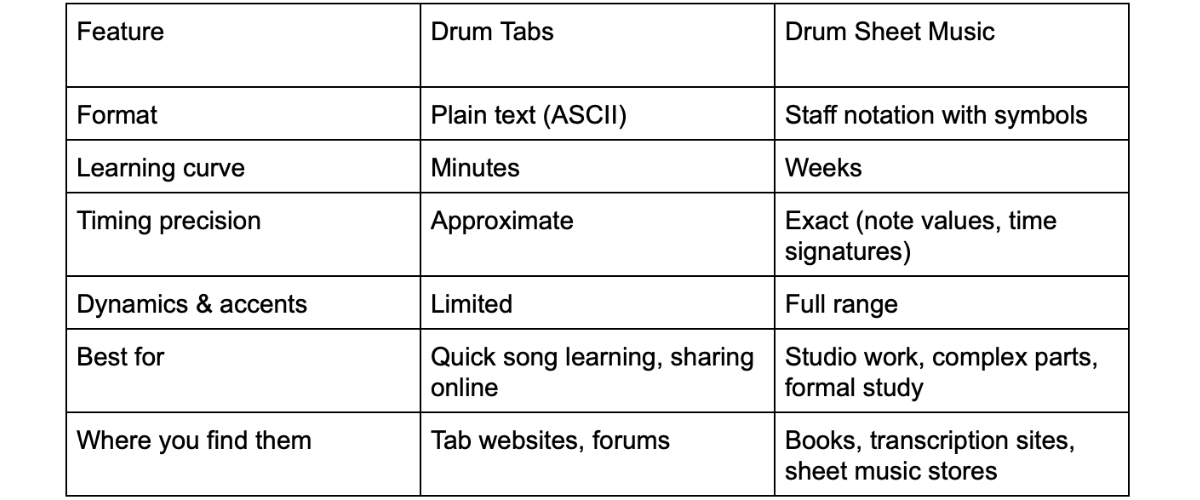
If you're serious about long-term drumming, you'll want both. Tabs are great for picking up a song you want to jam to this afternoon. Formal notation is what you reach for when you ne›ed to play a part exactly, study a complex pattern, or work with other musicians who read music. Our guide on reading drum notation walks through formal sheet music in detail.
The Anatomy of a Drum Tab
Every drum tab follows the same basic layout. Here's a simple example of a rock beat:

Three things are happening here:
- The left side has abbreviations. Each row is labeled with the drum or cymbal it represents — HH for hi-hat, SD for snare drum, BD for bass drum.
- The middle is the timeline. Reading left to right, each character represents a moment in time. Characters in the same vertical column happen simultaneously.
- The bars at each end mark the measure. The vertical pipe character (|) is the bar line, the same way it works in formal notation.
Top to bottom, the rows are usually ordered from highest-pitched (cymbals up top) to lowest (kick drum at the bottom) — roughly mirroring how the parts of a drum kit sit physically on the instrument. If you're shaky on which piece is which, our complete overview of drum set parts covers every piece in detail.
Common Drum Tab Symbols
Drum tabs use a small set of recurring characters. Once you know these, you can read about 95% of the tabs you'll encounter online.
Row Labels (Left Side)
- HH — Hi-hat (closed by default)
- HO — Hi-hat open
- HF — Hi-hat foot (pedal close)
- CC or Cr — Crash cymbal
- RD or Ri — Ride cymbal
- SD or S — Snare drum
- T1, T2, T3 — Toms (high, mid, low)
- FT — Floor tom
- BD or B — Bass drum (kick)
Hit Symbols (Inside the Tab)
- x — A hit on a cymbal (hi-hat, ride, crash)
- o — A hit on a drum (snare, tom, kick) or an open hi-hat
- O (capital) — An accented hit, often used for rim shots or louder strokes
- X (capital) — Accented cymbal hit or a choke
- - — A rest, or no hit on that beat
- g — A ghost note (very soft snare hit)
- f — A flam (two stick hits very close together)
- d — A drag (similar to a flam, longer)
- b — A buzz roll or buzz stroke
Other Common Marks
- | — Bar line (separates measures)
- || — Double bar line (end of section)
- : or :| — Repeat sign
- r or R — Right hand
- l or L — Left hand
Symbols aren't 100% standardized across the internet. Different tab authors use slightly different conventions, so always check the legend at the top of a tab if one is provided.
How Timing Works in Drum Tabs
This is the part that trips up new readers. Drum tabs don't have time signatures or note values like formal notation. Instead, each character is assumed to be of equal length — usually a sixteenth note.
Take this snare row:
SD|----o-------o---|
There are 16 character slots inside the bars. If we treat the whole measure as 4/4 time and each character as a sixteenth note, the snare hits land on counts 2 and 4 — the classic backbeat. The "----" before the first hit is three sixteenth-note rests followed by the hit on the fourth sixteenth (which is beat 2 in a 4/4 measure where each beat is four sixteenths).
You can also see tabs that use 8-character measures (each character is an eighth note) or 32-character measures (each character is a thirty-second note). The number of characters per measure tells you the underlying subdivision. To find this out, count the characters between the bar lines.
One important caveat: tabs assume a steady tempo, but they rarely tell you what the tempo is. To play a tab accurately, listen to the song while reading the tab — that's how you lock the timing in.
Step-by-Step: How to Read a Drum Tab
Here's a practical workflow for picking up a new drum tab.
1. Identify the Rows
Look at the left-side labels. Match each abbreviation to a piece of your kit. If a label is unfamiliar, check the tab's legend or assume the most common meaning (HH = hi-hat, SD = snare, BD = bass drum).
2. Count the Characters in One Measure
Find a pair of bar lines (|) and count the characters between them. Sixteen is the most common count, meaning each character is a sixteenth note. Eight means each is an eighth note. This tells you the subdivision.
3. Identify the Time Signature
Most rock and pop drum tabs are in 4/4. If the measure has 16 characters and the pattern feels like a standard rock beat, you're in 4/4. Odd-character measures (12, 14, 20) usually mean an odd time signature like 3/4, 7/8, or 5/4 — less common in tabs but they exist.
4. Read One Row at a Time
Don't try to read all rows simultaneously the first time through. Start with the kick drum row — that's usually the foundation. Tap the rhythm out on your leg. Then layer the snare on top. Then the hi-hat. Building up one limb at a time makes complex patterns much easier to absorb.
5. Listen to the Song While You Read
Tabs are approximations. The actual recorded drum part will have nuances — dynamics, ghost notes, slight timing shifts — that the tab can't fully capture. Listen along to lock in the feel, and adjust what you play to match what you hear.
6. Practice Slowly, Then Speed Up
Start at half the song's tempo with a metronome. Once you can play the pattern cleanly, gradually bring it up to full speed. Trying to read at full tempo on the first pass almost guarantees sloppy timing.
Common Mistakes When Reading Drum Tabs
A handful of habits trip up most beginners reading tabs for the first time. Spotting them early saves you weeks of bad practice.
Ignoring the Subdivision
Why it's wrong: If you assume every tab uses sixteenth notes when it actually uses eighth notes, your timing will be off by 2x. The whole pattern will feel rushed or dragged.
How to fix it: Always count the characters per measure first. Match that to the song's audible subdivision before you start playing.
Trying to Read All Rows at Once
Why it's wrong: Reading three or four rows simultaneously is a skill you build, not something you do on the first attempt. Beginners who try this usually freeze up and stop playing entirely.
How to fix it: Layer the limbs. Kick first, then snare, then hi-hat. Once each row feels automatic, combining them is much easier.
Treating Tabs as Note-Perfect
Why it's wrong: Tabs are written by hobbyists, not engineers. They miss ghost notes, dynamics, and small ornaments. Playing a tab exactly as written won't sound like the recording.
How to fix it: Use the tab as a roadmap, not a transcript. Listen to the song and add the feel and dynamics that the tab can't show you.
Skipping the Legend
Why it's wrong: Different tab authors use different symbols. Assuming "x" always means a closed hi-hat hit will eventually fail you on a tab where "x" means a flam or a buzz roll.
How to fix it: Always read the legend at the top of the tab. If there isn't one, default to the conventions in this guide but stay alert for inconsistencies.
Not Counting Aloud
Why it's wrong: Trying to keep time mentally while reading a tab is a lot of cognitive load. Beginners drift on tempo without noticing.
How to fix it: Count aloud — "1 e and a, 2 e and a" — while reading. It externalizes the timing and keeps you locked to the grid.
Beginner Tips for Practicing With Tabs
A few habits that pay off fast:
- Pick songs you already know. Reading a tab for a song you've heard 100 times is much easier than learning an unfamiliar song from a tab. Your ear fills in the gaps the tab leaves out.
- Use a metronome. Even if the tab is rough on timing, a metronome keeps you anchored. Set it to the song's BPM and play along.
- Watch a video alongside the tab. YouTube drum cover videos are gold. Watch a drummer play the part while you read the tab — you'll learn the feel in minutes instead of hours.
- Start with simple beats. Don't pick a Tool or Mars Volta tab as your first one. A straightforward rock beat in 4/4 (think AC/DC, Foo Fighters, Queens of the Stone Age) is a much better starting point. Our beginner drum beats lesson gives you 20 patterns to practice from.
- Bridge to formal notation. Once you're comfortable with tabs, learning formal notation gets easier because the underlying concepts (subdivisions, bar lines, drum-to-symbol mapping) are the same. Tabs are a great on-ramp.
- Cross-check questionable tabs. If a tab feels off, check a different source for the same song. Tab quality varies wildly. The most-viewed tab on a site is usually (but not always) the most accurate.
Final Thoughts
Drum tabs are the duct tape of drum notation — not the prettiest tool, not the most precise, but fast, universal, and good enough to learn 99% of the rock, pop, and punk songs you're likely to want to play. Once you understand the rows, the symbols, and the timing, the format opens up an enormous library of music you can pick up in an afternoon.
Treat tabs as a starting point, not the final answer. They get you most of the way to a song's drum part, and your ear gets you the rest. The drummers who learn the fastest are the ones who can hold a tab in one hand, a song in the other, and bridge the two with their own listening and feel.
FAQ
Are drum tabs easier than drum sheet music?
Yes — drum tabs use a simplified text format that anyone can read in a few minutes. The trade-off is that tabs are less precise. For learning beginner songs quickly, tabs are easier. For complex parts or studio work, you'll want formal notation.
Where can I find drum tabs for free?
Songsterr, Ultimate Guitar, 911Tabs, and the r/drums subreddit all host free drum tabs. Quality varies between authors, so check more than one source if a tab feels off.
Why don't drum tabs have time signatures?
Most drum tabs assume 4/4 time, since the overwhelming majority of rock and pop songs are in 4/4. If a tab is in an odd time signature, the author usually notes it in a header at the top.
What does "x" mean in a drum tab?
An "x" usually represents a cymbal hit — most often the hi-hat. A lowercase "x" is a closed hit, and an uppercase "X" is often an accented hit or a choke. Always check the tab's legend if you're unsure.
Can I write my own drum tabs?
Yes — that's part of the appeal. Drum tabs require no special software, just a text editor. Use the row-label and symbol conventions in this guide and you'll be readable to anyone in the drum community.
Should I learn tabs or formal notation first?
Tabs are a faster on-ramp, especially if you're a self-taught hobbyist learning songs by ear and online resources. Formal notation is the long-term investment — it'll serve you better if you plan to study music seriously, work with other musicians, or take lessons. Most drummers eventually learn both.
Why does my tab not match the song?
Either the tab was transcribed inaccurately (common with user-submitted tabs), or you're missing the dynamics and ornaments the tab can't capture. Try another version of the tab, listen carefully to the recording, and trust your ear over the tab when they disagree