Drum terms are the shared language drummers use to talk about their instrument, technique, and music — covering everything from the names of kit components to rhythm vocabulary, playing techniques, and gear. Knowing these terms helps you follow lessons, communicate with other musicians, and understand what instructors and tutorials are actually telling you to do.
When you start learning drums, you run into a wall of unfamiliar words fast. What's a batter head? What does "playing in the pocket" mean? What's the difference between a crash and a ride? It's not that these concepts are complicated — they just assume you already know the vocabulary, and most beginners don't. That's what this glossary is for.
In this guide, we've organized the most important drumming terms into clear categories: kit parts, drumhead terminology, playing techniques, rhythm and music concepts, and beat and genre vocabulary. Whether you're reading through a drum lesson, watching a tutorial, or talking to another drummer and nodding along while secretly lost — this is the reference you need.
When you’re done reading, you will be familiar with:
- Parts of the Drum Kit
- Drumhead Terminology
- Hardware and Gear Terms
- Playing Technique Terms
- Rhythm and Music Terms
- Beat and Genre Vocabulary
- Common Terminology Mistakes Beginners Make
- Beginner Tips for Learning Drum Vocabulary
- Final Thoughts
- FAQ
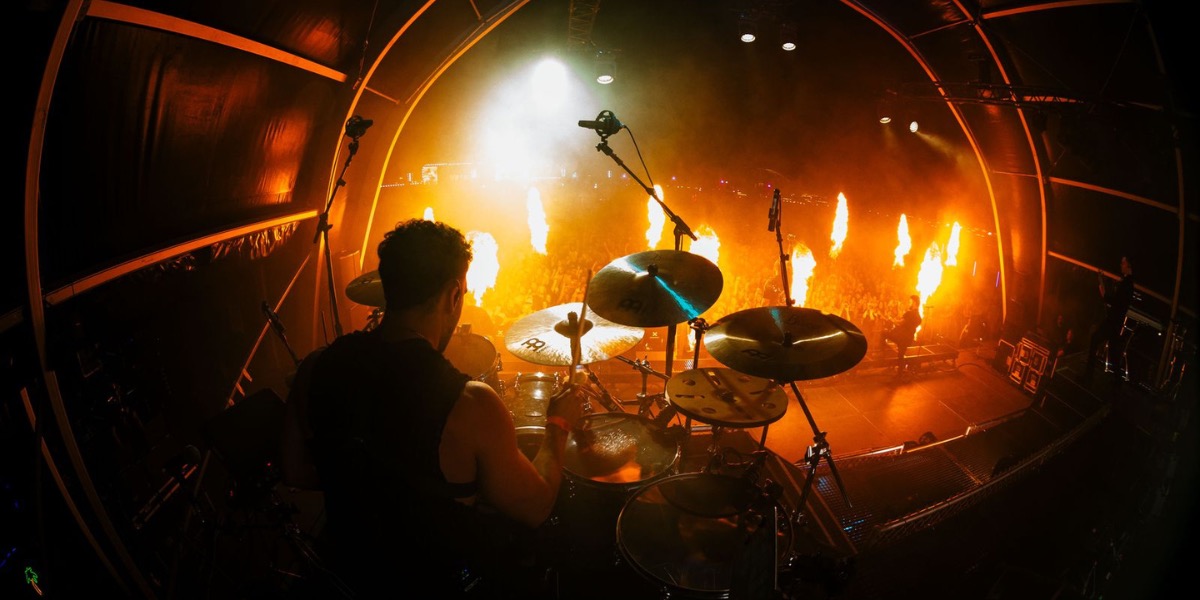
Parts of the Drum Kit
Before you can talk about how to play drums, you need to know what you're playing. These are the names for the core components of a standard drum set and what each one does.
Bass Drum (Kick Drum)
The large drum that sits on the floor, played with a foot pedal rather than a stick. It produces the deep, low-end thud that anchors most grooves. "Bass drum" and "kick drum" mean the same thing — both terms are used interchangeably.
Snare Drum
The drum that sits between your legs on a stand, usually positioned just below waist height. It produces a sharp, cracking sound on beats 2 and 4 in most rock and pop music. The snare gets its distinctive buzz from a set of thin metal coils (the snare wires) stretched across the bottom head.
Tom-Toms (Toms)
The cylindrical drums mounted above the bass drum or on separate stands. A standard 5-piece kit has two rack toms (mounted above the bass drum) and a floor tom (standing on its own legs). Toms are used for fills, accents, and to add melodic movement to a groove. They're tuned to different pitches — smaller toms are higher, larger ones are lower.
Hi-Hat
Two cymbals mounted on a stand and controlled by a foot pedal. Pressing the pedal brings the cymbals together (closed hi-hat); releasing it opens them (open hi-hat). The hi-hat is one of the most expressive parts of the kit — the sound changes dramatically depending on how open or closed it is and where you hit it.
Crash Cymbal
A cymbal designed to be hit hard for a sudden, loud accent — the "crash" you hear at the end of a fill or the beginning of a new section. Most kits have one or two crash cymbals, typically ranging from 14 to 18 inches in diameter.
Ride Cymbal
A larger, heavier cymbal (usually 20–22 inches) used to keep a steady rhythmic pattern rather than for accents. The ride has a clear, defined "ping" sound at the bow and a darker wash near the bell. You'll use the ride most often in jazz and as an alternative to the hi-hat in rock and metal.
Bell
The raised dome at the center of a cymbal, especially the ride. Hitting the bell produces a clear, high-pitched, cutting tone — used for accents in jazz and Latin patterns, and the classic "ding" sound in bossa nova.
Shell
The cylindrical wooden (or metal, or acrylic) body of a drum — everything except the heads, hoops, and hardware. Shell material and thickness have a major effect on a drum's tone. Maple shells are warm, birch shells are bright and punchy, and steel shells give a snare an aggressive crack.
Throne
The drum stool. It's called a throne because, well, you're sitting in command of the whole kit. Throne height and positioning are critical for posture, reach, and endurance — it's one of the most underrated setup decisions a drummer makes.
Bearing Edge
The angled edge at the top and bottom of a drum shell where the drumhead makes contact. The bearing edge shape and sharpness significantly affect how a drum resonates and how heads seat. A sharp, clean bearing edge produces better tone; a damaged or uneven one can make a drum nearly impossible to tune properly.
Lug
The metal fittings bolted to the outside of the shell that hold the tension rods. Each lug corresponds to a tension point around the drumhead. Most snare drums have 8–10 lugs; toms and bass drums vary.
Tension Rod (T-Rod)
The threaded bolt that screws into each lug and pulls the hoop (rim) down onto the drumhead. Tightening tension rods raises the pitch of the head; loosening them lowers it. You turn them with a drum key.
Hoop (Rim)
The metal or wooden ring that clamps the drumhead to the shell via the tension rods. Also the surface you hit when doing a cross-stick or rimshot.
Drum Key
The small T-shaped tool used to tighten or loosen tension rods. Every drummer should have at least one on them at all times — preferably two, because they have a habit of disappearing at exactly the wrong moment.
Drumhead Terminology
Drumheads are where most of the tone comes from, and there's a surprisingly specific vocabulary around them. Understanding these terms is essential when you're tuning, replacing heads, or reading about gear.
Batter Head
The top head — the one you actually hit. Batter heads are typically thicker and more durable than resonant heads to handle stick impact. The tension of the batter head controls most of the drum's tone and pitch.
Resonant Head (Reso Head)
The bottom head that resonates sympathetically with the batter head and projects the drum's sound outward. On a snare drum, the resonant head (sometimes called the snare-side head) is thinner and controls how the snare wires respond. On toms and bass drum, the reso head affects sustain, projection, and tone depth.
Coated Head
A drumhead with a white or matte coating on the playing surface. Coated heads produce a warmer, slightly drier tone than clear heads and are often preferred for brushwork and jazz.
Clear Head
An uncoated, transparent drumhead. Clear heads tend to produce a brighter, more open tone with more sustain. Common on toms and bass drums in rock and pop settings.
Two-Ply Head
A drumhead made from two layers of film. Two-ply heads are more durable, produce less overtones, and have a shorter sustain compared to single-ply heads. They're popular for live drumming where a controlled, punchy sound is preferred.
Seating (Breaking In a Head)
The process of stretching a new drumhead evenly across the bearing edge before tuning. You seat a head by pressing firmly on the center to force the film to conform to the shell. Skipping this step leads to inconsistent tension even after careful tuning.
Snare Wires (Snares)
The coiled metal wires or cables stretched across the resonant head of a snare drum. They vibrate against the bottom head to create the snare's characteristic buzz and crack. Tension is controlled by a strainer on the side of the drum.
Strainer (Throw-Off)
The mechanism on the side of a snare drum that engages or disengages the snare wires. Flipping the strainer lever drops the wires away from the resonant head, turning the snare into essentially a small tom — useful for certain musical styles or if you want a quick sound change mid-song.
Hardware and Gear Terms
Drum hardware is everything that isn't a drum or cymbal — the stands, pedals, and mounts that hold everything in place. These terms come up constantly in setup guides and gear discussions.
Bass Drum Pedal (Kick Pedal)
The foot pedal attached to the bass drum. When you press the footboard with your foot, it drives the beater (a mallet-like attachment) into the batter head of the bass drum. Single pedals have one footboard; double bass pedals have two, connected by a drive shaft, allowing you to play both feet on a single bass drum.
Beater
The mallet at the end of the bass drum pedal that strikes the bass drum head. Beaters come in felt (warm, rounded sound), plastic/hard (punchy, defined attack), and wood (very sharp attack). Most beginners use felt beaters.
Hi-Hat Stand
The adjustable stand that holds the hi-hat cymbals and connects the foot pedal to the clutch mechanism. Hi-hat height and the gap between the two cymbals affects how they sound and how easy they are to play.
Clutch
The part of the hi-hat stand that holds the top cymbal in place, allowing it to be raised or lowered. A memory lock clutch lets you set a specific opening height so the cymbals don't drop accidentally mid-performance.
Cymbal Stand
The adjustable stand that holds a crash, ride, or splash cymbal. Most are straight stands (for rides and high crashes) or boom stands, which have an extending arm that lets you position a cymbal at a wider range of angles — useful in tight spaces or complex setups.
Wing Nut
The knurled nut that tightens a cymbal onto a stand. Wing nuts should be loose enough that the cymbal can swing freely when struck — a cymbal locked tight against a stand will crack over time. A felted sleeve and felt washer sit between the cymbal and the stand to cushion the contact.
Tom Mount (RIMS Mount)
The hardware that attaches a rack tom to the bass drum or a separate stand. Traditional mounts bolt into the shell; RIMS-style mounts (and most modern isolated mounts) clamp to the tension rods to preserve the shell's resonance.
Memory Lock
A collar that clamps around a stand or rod to remember a specific height or position. Extremely useful for drummers who break down and rebuild their kit frequently — set your preferred heights once, lock them, and your setup is exactly the same every time.

Playing Technique Terms
Technique vocabulary is where a lot of beginners get confused, because these terms describe what you're doing with your hands and feet — and the difference between them often has a significant impact on how the drum sounds.
Stroke
A single hit on a drum or cymbal. There are several types of strokes in drumming technique: the full stroke (arm raised fully, comes back to full height after impact), the down stroke (comes down but stays low after impact), the tap (starts and ends low, minimum height), and the up stroke (starts low, rebounds high to prepare for the next note).
Rebound
The natural bounce of the stick off the drumhead after impact. Learning to control and use the rebound — rather than fighting it — is one of the most important fundamentals in drumming. Fast, clean playing relies on rebound efficiency.
Rimshot
Hitting the drumhead and the rim of the drum simultaneously with the stick. A rimshot on the snare produces a loud, sharp "crack" that cuts through a mix — common on backbeats in rock and pop. Not to be confused with a cross-stick.
Cross-Stick (Side Stick)
A technique where you lay the stick across the snare drum with the tip touching the head and click the shaft against the rim. Produces a dry, wooden "click" sound — heard often in ballads, country, and quiet acoustic settings. It's the opposite of a rimshot in both technique and volume.
Ghost Note
A very soft, barely audible stroke on the snare, played at low velocity to add texture and groove without drawing attention. Ghost notes are what separates a drummer who plays the beats from one who plays with feel — they're the quiet heartbeat underneath a groove.
Accent
A note played louder than the surrounding notes, to create dynamic contrast and emphasis. Accents are marked in drum notation with a ">" symbol. The interplay between accented and unaccented notes is fundamental to making beats feel alive.
Rudiment
A standardized drum pattern that forms the building blocks of drumming technique. The Percussive Arts Society defines 40 essential rudiments, including singles, doubles, paradiddles, and flams. Think of rudiments the same way musicians think of scales — foundational exercises that develop speed, control, and vocabulary.
Single Stroke Roll
The most fundamental rudiment: alternating strokes between your two hands, RLRL or LRLR. Everything in drumming starts here.
Double Stroke Roll
Two strokes with each hand before switching — RRLL RRLL. Requires controlled rebound and is essential for building speed.
Paradiddle
A four-note rudiment pattern — RLRR LRLL. It's one of the most versatile rudiments, used to create interesting sticking patterns across the kit. Our guide on drum rudiments covers the full set of essential patterns if you want to dig deeper.
Flam
A two-note stroke where a quiet grace note (played just before) precedes a louder primary stroke. Flams add thickness and weight to a note without playing it twice at equal volume. They appear constantly in marching percussion, rock fills, and snare patterns.
Buzz Roll (Press Roll)
A roll produced by pressing the stick into the head so each stroke bounces multiple times. Creates a smooth, sustained "ssss" sound. Different from an open double stroke roll, which has clearly defined individual strokes.
Sweep / Brush Sweep
A technique done with wire or nylon brushes (instead of sticks) where you drag or swirl the brush across the head to produce a sustained whooshing sound. Foundational in jazz and soft acoustic settings.
Linear Drumming
A style of playing where no two limbs play at the exact same time — notes are spread across the kit in a single-file sequence rather than stacked. Creates a clean, spacious groove with a distinct character.
Polyrhythm
Playing two or more conflicting rhythmic patterns simultaneously. For example, one hand playing a pattern of three evenly spaced notes while the other plays a pattern of two — they share the same start point but subdivide differently. Common in African drumming, jazz, and progressive rock.
Rhythm and Music Terms
Drums sit at the intersection of music and rhythm, and the vocabulary from both worlds shows up in lessons, charts, and conversations. These are the terms you'll encounter most often.
Tempo
The speed of the music, measured in BPM (beats per minute). A metronome or click track sets and maintains tempo. Most rock songs fall between 80–140 BPM; jazz can be much slower or faster depending on the style.
BPM (Beats Per Minute)
The standard unit of tempo measurement. 60 BPM means one beat per second. 120 BPM means two beats per second — common in rock, pop, and dance music.
Time Signature
The two-number fraction at the beginning of a piece of sheet music. The top number tells you how many beats are in a measure; the bottom tells you what type of note gets one beat. 4/4 (four quarter notes per measure) is by far the most common time signature in Western popular music.
Measure (Bar)
A single unit of time in music, defined by the time signature. In 4/4 time, one measure contains four quarter-note beats. Most drum patterns are one or two measures long and repeat.
Quarter Note (Crotchet)
The basic beat unit in 4/4 time — the "1, 2, 3, 4" you count. In drum notation, the bass drum and snare are most commonly notated in quarter notes.
Eighth Note
Half the value of a quarter note — two eighth notes fit in the space of one quarter note. The "1 and 2 and 3 and 4 and" count. Hi-hat patterns are usually played in eighth notes in rock and pop.
Sixteenth Note
Half the value of an eighth note — four sixteenth notes per beat. Counted "1 e and a, 2 e and a." Sixteenth note hi-hat patterns are common in funk, R&B, and more advanced grooves.
Triplet
Three notes played in the space where two notes normally fit. Triplets create a shuffling, rolling feel. The shuffle beat and jazz swing are both based on a triplet feel.
Subdivision
How you divide each beat into smaller units. Playing in eighth notes is subdividing the beat in two; sixteenth notes subdivide into four. Being aware of subdivisions helps you place notes accurately and feel the music more deeply.
Downbeat
The first beat of a measure — the "1." The downbeat is the rhythmic anchor around which everything else is organized.
Upbeat
The beat that comes just before the downbeat — the "and" of beat 4, or sometimes beat 4 itself. Also called the "pickup" when it leads into the next measure.
Syncopation
Placing accents or notes on the "weak" or "off" beats — the "ands" rather than the main beats. Syncopation creates tension and forward momentum. Most funk and reggae drumming is heavily syncopated.
Groove
A drum pattern that feels good — that has the right combination of timing, dynamics, and feel to make people want to move. "Playing in the groove" means your timing is locked in and your dynamics are serving the music. There's no single formula for it; it's something you develop over time through playing with other musicians.
Beat and Genre Vocabulary
Different styles of music have their own drum-specific vocabulary. Here are the terms that come up most often when discussing specific beats and genres.
Backbeat
Accenting beats 2 and 4 in a 4/4 measure — almost always on the snare drum. The backbeat is the rhythmic foundation of virtually all rock, pop, soul, funk, and country music. It's what makes the music feel "groovy" rather than mechanical.
Four on the Floor
Playing the bass drum on every quarter note beat — 1, 2, 3, and 4. This pattern is the backbone of disco, house, techno, and dance music. It creates an insistent, driving pulse that's easy to dance to.
Shuffle Beat
A groove based on a triplet subdivision where the middle note is omitted, creating a "da-da-dum" swing feel rather than straight eighth notes. The shuffle is the foundation of blues, classic rock, and boogie drumming. Our guide on how to play a shuffle beat breaks it down step by step.
Swing
A jazz concept where pairs of eighth notes are played unequally — the first note is longer and the second is shorter, based on a triplet feel. Swing is what gives jazz its characteristic "bounce." Playing straight eighth notes in a jazz context will sound wrong, because jazz swing is felt, not just counted.
Fill
A short drum phrase that interrupts or replaces a standard groove pattern, usually at the end of a phrase, to transition between sections or add variety. Fills can be as simple as one hit on the floor tom or as complex as a multi-bar solo passage. Knowing when NOT to fill is as important as knowing how to fill.
Pattern
A repeating sequence of drum strokes — the building block of a groove. Most basic rock beats are a single measure pattern played on loop.
Kick Pattern
The specific sequence of bass drum hits within a groove. The kick pattern defines much of a groove's character — a different kick pattern under the same hi-hat and snare can completely change how a beat feels.
Hi-Hat Variation
Any change in how the hi-hat is played — open vs. closed, hitting the edge vs. the bow, different rhythmic patterns. Hi-hat variation is one of the simplest tools for adding interest to a groove without changing the whole pattern.
Common Terminology Mistakes Beginners Make
Mixing up drum terms doesn't just cause awkward conversations — it can lead to genuine confusion when trying to follow instructions or describe a problem to your teacher. Here are the most common mix-ups to avoid.
Calling a Cross-Stick a Rimshot (and Vice Versa)
Why it's wrong: These two techniques sound completely different and require different physical motions. A rimshot is striking the head and the rim simultaneously with power — it's loud and cutting. A cross-stick is a quiet click produced by pivoting the stick on the head and tapping the shaft against the rim. Instructors will be confused if you describe one when you mean the other.
How to fix it: Remember that rimshots are loud and percussive; cross-sticks are soft and woody. If you're playing softly and resting your stick on the head, that's a cross-stick. If you're hitting hard through both surfaces at once, that's a rimshot.
Saying "Drum Kit" and "Drum Set" Are Different Things
Why it's wrong: They're the same thing. "Drum kit," "drum set," "drumset," and "kit" all refer to the full collection of drums, cymbals, and hardware a drummer plays. Some drummers prefer one term over the other, but there's no meaningful distinction.
How to fix it: Use whichever you prefer. You'll also hear "trap set" in older jazz and country contexts — that's also the same thing.
Confusing the Resonant Head with the Batter Head
Why it's wrong: The batter head is on top (the one you hit); the resonant head is on the bottom. When someone says "tune up your reso," they mean the bottom head. When someone says your batter is worn out, they mean the top. Getting these backwards when reading tuning advice will produce the opposite result from what you want.
How to fix it: Think "batter" = battered = hit. The head that gets battered is on top. The resonant head resonates underneath.
Using "Tempo" and "Time Signature" Interchangeably
Why it's wrong: Tempo is the speed (in BPM). Time signature is the meter — how many beats per measure and what type of note counts as one beat. A song can be in 3/4 at 180 BPM, or in 7/8 at 60 BPM. They describe different things.
How to fix it: When you want to talk about how fast, say tempo or BPM. When you want to talk about the rhythmic feel or meter, say time signature.
Beginner Tips for Learning Drum Vocabulary
Learning the terminology alongside the physical skills accelerates both. Here are some practical ways to build your drum vocabulary fast.
- Learn the names while you set up your kit. Say each component's name as you assemble it — bass drum, snare, floor tom, hi-hat, crash, ride, tension rods. Physical association cements vocabulary faster than flashcard study.
- Watch instructional videos with the intention to notice terms. When a lesson says "play a rimshot on beat 2," identify that moment. Connecting a term to a sound you hear in real time locks it in far more effectively than reading about it.
- Don't rush past words you don't know. If you're following a lesson and a term confuses you, stop and look it up before continuing. Continuing past confusion just layers more confusion on top of it.
- Practice describing what you're playing. When you learn a new beat, try to explain it out loud using drum terms — "kick on 1 and the 'and' of 2, snare on 2 and 4, hi-hat in eighth notes." Articulating what you're doing forces you to actually understand it, not just mimic it.
- Read drum charts and notation regularly, even if you're not great at it yet. Understanding how to read drum notation reinforces all the terminology around rhythm, note values, and beat structure simultaneously.
- Ask questions without embarrassment. Experienced drummers and teachers have heard every basic question a thousand times. Asking "what does 'groove' mean, exactly?" is not a sign of weakness — it's how vocabulary actually gets built.
Final Thoughts
Drum terminology isn't something you need to memorize before you start playing — it develops naturally as you practice, watch lessons, and talk to other drummers. The goal isn't to pass a vocabulary test; it's to have enough common language that you can follow instructions, understand what you're hearing, and communicate clearly about what you're playing and what you want to learn.
Start with the basics — learn your kit parts, understand batter vs. resonant, and know what a rimshot sounds like versus a cross-stick. The rest will fill in on its own as you keep playing. Keep this glossary bookmarked and come back to it when a term stops you in your tracks.
FAQ
What's the difference between a fill and a solo?
A fill is a short phrase — usually one to four beats — that transitions between sections of a song or adds a moment of variation within a groove. A drum solo is an extended passage where the drums take the musical spotlight, often without the full band playing. Fills happen constantly in normal drumming; solos are relatively rare outside jazz and progressive rock.
What does "in the pocket" mean?
Playing "in the pocket" means your timing is exactly right — locked in with the bass and the groove, not rushing ahead of the beat or dragging behind it. It's the quality that makes a drummer feel good to play with. A drummer with great technique but poor pocket feel will still sound uncomfortable; a drummer who plays in the pocket makes everyone else sound better.
What's the difference between a tom and a floor tom?
Both are tom-toms — cylindrical drums without snare wires. Rack toms (just called "toms") mount above the bass drum and come in smaller sizes (8", 10", 12", 13" are common). A floor tom is larger (14", 16", or 18") and stands on its own legs on the floor to your right. Floor toms produce a lower, deeper pitch.
What does "open hi-hat" mean?
An open hi-hat means the two hi-hat cymbals are separated rather than pressed together. This produces a longer, washy sustain instead of the tight "chick" of a closed hi-hat. In notation, an open hi-hat is marked with a small "o" above the note; a closed hi-hat is marked with a "+" sign.
What's the difference between a crash and a ride cymbal?
Crashes are smaller (14"–18") and designed to be hit hard for a sudden accent — they decay quickly. Rides are larger (20"–22") and designed to be played continuously to keep a steady pattern — they produce a defined, sustaining "ping" rather than an explosion of sound. You can crash a ride for effect, but you generally don't ride a crash (it'll just be a constant wash).
What does BPM stand for and why does it matter?
BPM stands for beats per minute — it's the unit used to measure and communicate tempo. It matters because all musicians in a band need to play at the same speed, and using a specific BPM number removes ambiguity. "Play this at 120 BPM" is clearer and more useful than "play this at a moderate tempo."