Four on the floor is a drum pattern where the bass drum hits on every beat — beat 1, 2, 3, and 4 — in a steady, driving pulse that anchors everything else on top of it.
It sounds almost too simple, and that's exactly why it works. The four-on-the-floor pattern is behind an enormous chunk of recorded music — disco, EDM, rock, funk, pop, country — because a locked-in bass drum pulse is one of the most physically compelling things a rhythm section can do. When the kick hits every beat, people feel it, and they move. Getting this pattern clean, tight, and musical is one of the most practical skills a beginner can develop early on.
In this guide we'll break down what four on the floor actually means, how to play it correctly on the kit, how to build it layer by layer from scratch, how to add hi-hat and snare variations on top of it, common mistakes that make it feel stiff instead of groovy, and a few tips to make it feel like music rather than a metronome exercise. By the end, you'll have a solid, reliable foundation for one of the most widely used patterns in drumming.
When you’re done reading, you will be familiar with:
- What Is Four on the Floor?
- Why This Pattern Matters
- How to Play Four on the Floor: Step by Step
- Adding Hi-Hat and Snare on Top
- Four on the Floor Variations
- How Four on the Floor Sounds Across Different Genres
- Common Mistakes
- Beginner Tips
- Final Thoughts
- FAQ

What Is Four on the Floor?
The name comes from the fact that you're putting four bass drum hits on the four beats of a 4/4 measure — "on the floor," meaning on the floor tom pedal (the bass drum pedal). In standard notation, you'd see the kick drum hit on beats 1, 2, 3, and 4 — every quarter note, every single beat, no exceptions.
Here's how it looks written out in basic drum notation for one measure of 4/4:
That's it. One bass drum hit per beat, evenly spaced, all the way through the bar. What you put on top — hi-hat, snare, crashes, ride — is where the variation lives. The bass drum itself is the foundation.
The term "four on the floor" became widely used in the disco era of the 1970s, when producers and drummers figured out that a locked-in kick on every beat made people dance almost involuntarily. That same principle carried through into house music, techno, and modern EDM, where producers program the four-on-the-floor kick as the central pulse of almost every track.
Why This Pattern Matters
Learning the four-on-the-floor pattern matters for two reasons: it's practically everywhere in music, and it's a direct test of your bass drum control.
Most beginners play bass drum only when the pattern calls for it — on beat 1, maybe beat 3, occasionally an "and." Putting it on all four beats requires your right foot to keep a steady, even, quarter-note pulse while your hands are doing something completely different on top. That's a coordination challenge that, once solved, makes every other bass drum pattern easier.
It also trains you to "lock in" — the ability to hold a steady tempo without speeding up or slowing down. A four-on-the-floor pattern has nowhere to hide. If the kick is uneven, you hear it immediately. Getting it tight in this pattern means your tempo control is genuinely solid, not just adequate.
How to Play Four on the Floor: Step by Step
Build this one piece at a time. Trying to play the full beat from scratch is a reliable way to make a mess of it.
1. Start with Just the Bass Drum
Sit at the kit with your foot on the bass drum pedal. Set a metronome to 60–70 BPM. Play one bass drum stroke per beat — exactly on the click, every beat. That's all. Don't touch the hi-hat or snare yet.
Focus on two things: even volume (every hit should sound the same) and consistent timing (every hit should land exactly on the click, not early, not late). If your foot is burying the beater into the head (holding it in after impact), practice releasing it immediately after contact — the head needs to vibrate to produce a full sound. This is called a "full stroke" technique, and it gives you a rounder, more resonant kick sound.
Spend a few minutes here before moving on. This is the most important step.
2. Add the Hi-Hat on Eighth Notes
Keep the bass drum going on all four beats. Now add your right hand playing the hi-hat on eighth notes — that's twice per beat, on the beat and the "and." Count: "1 and 2 and 3 and 4 and." Every time you say a number or "and," hit the hi-hat.
Your bass drum and hi-hat will now hit together on beats 1, 2, 3, and 4, with the hi-hat also hitting on each "and" in between. The combination of steady kick and eighth-note hi-hat is the pulse that drives most rock, pop, and dance music.
3. Add the Snare on Beats 2 and 4
This is where it gets interesting. Keep the bass drum on every beat and the hi-hat on every eighth note. Now add the snare drum on beats 2 and 4 — the backbeat.
The snare on 2 and 4 will land at the same time as a hi-hat stroke and the bass drum. Three things hit on beat 2: hi-hat, snare, and kick. Same on beat 4. That's a lot happening at once, and your hands and foot need to coordinate.
If this feels like rubbing your belly and patting your head simultaneously, that's normal. Slow the metronome down to 50 BPM and take it one bar at a time. The coordination clicks into place faster than most beginners expect — usually within a few sessions.
4. Play It in Time for 2–4 Bars Straight
Once you can play the pattern, the next milestone is playing it cleanly for multiple bars without losing the kick. Start with two bars, then four, then try playing the beat for a full minute without stopping. This is where the pattern becomes a groove rather than an exercise — your body settles into it, the tempo locks, and it starts to feel automatic.
Adding Hi-Hat and Snare Variations on Top
The bass drum doesn't change. That's the whole point of four on the floor — it's the constant. But there's a lot you can do with the hi-hat and snare to create different feels on top of it.
Open Hi-Hat on the "And" of Beat 4
This is one of the most common variations in rock and pop drumming. Instead of closing the hi-hat on every eighth note, open it slightly on the "and" of beat 4 (right before beat 1 of the next bar), then close it on beat 1. The open hi-hat creates a short "tsss" sound that adds anticipation and forward momentum into the next measure. It's a small change that makes the groove feel significantly more musical.
Sixteenth-Note Hi-Hat
Instead of eighth notes on the hi-hat, play sixteenth notes — four strokes per beat instead of two. Count: "1 e and a 2 e and a 3 e and a 4 e and a." This doubles the hi-hat activity and creates a faster, more driving feel. It's the foundation of a lot of funk and dance drumming, and it demands good right-hand stamina and evenness at higher tempos.
Ride Cymbal Instead of Hi-Hat
Swap the hi-hat for the ride cymbal. The ride's larger surface and longer sustain completely changes the character of the beat — it opens up the sound and moves the cymbal work to a different part of the kit. This is standard in jazz, where the ride carries the pulse, but it's also a useful variation in rock for creating space and contrast. The four-on-the-floor kick underneath stays exactly the same.
Ghost Notes on the Snare
Keep the snare backbeat on 2 and 4, but add very quiet ghost notes on the snare on some of the in-between eighth notes. Ghost notes are soft, barely-audible snare hits that add texture and fill space without disrupting the groove. Combined with four on the floor, ghost notes give the beat a much fuller, more nuanced sound. This technique is everywhere in R&B and soul drumming.
Four on the Floor Variations
Once the basic version is solid, here are some ways to extend and modify it.
Four on the Floor with a Syncopated Snare
Move the snare off the backbeat. Instead of playing it only on 2 and 4, add a snare hit on the "and" of 2, or the "and" of 4, or drop one of the backbeat hits entirely. The bass drum stays locked on all four beats, but the snare creates rhythmic tension and surprise. This is a technique used heavily in funk and hip-hop drumming.
Four on the Floor with Bass Drum Ghost Notes
The opposite approach: keep the bass drum on all four beats but add a lighter, quieter kick hit on the "and" of 2, or between beats 2 and 3. The quieter additional kick adds feel without disrupting the four-on-the-floor foundation. This shows up in some funk and soul grooves where the drummer wants more rhythmic complexity in the low end.
Half-Time Feel Over Four on the Floor
A half-time feel means the snare moves to beat 3 only instead of beats 2 and 4. With the kick still hitting all four beats, this creates a much heavier, slower-feeling groove — even at the same tempo. It's a staple of rock ballads, hip-hop, and trap-influenced drumming.
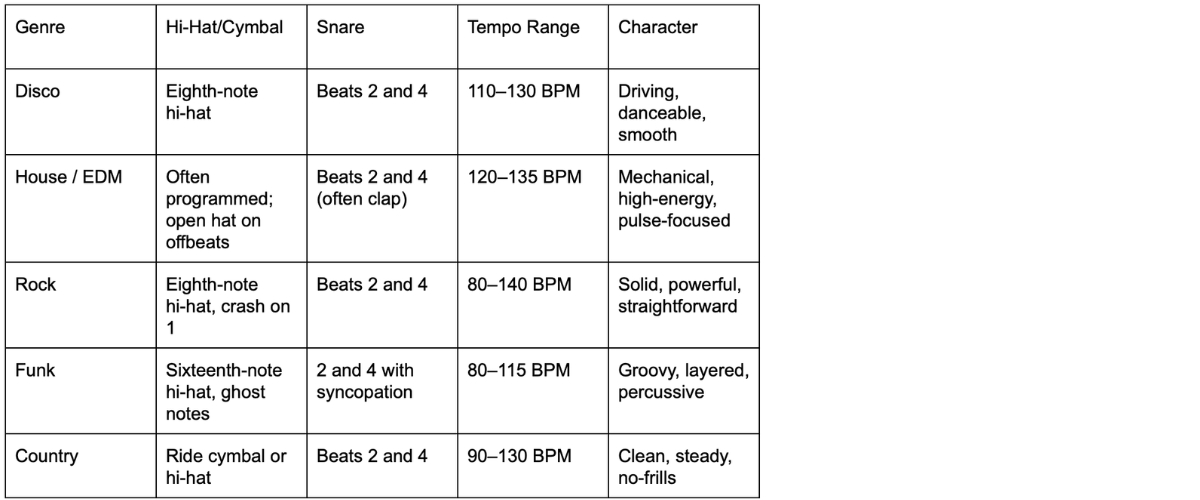
How Four on the Floor Sounds Across Different Genres
The same basic bass drum pattern takes on a completely different character depending on what's around it. Here's a quick reference:
Common Mistakes
These are the problems that make four on the floor sound stiff, weak, or uneven — and how to fix each one.
Burying the Bass Drum Beater
Why it's wrong: Pressing the beater into the head after impact (instead of letting it rebound) muffles the kick and kills its sustain. The drum can't vibrate and produce a full, resonant tone. The result is a dull, thuddy kick that doesn't cut through.
How to fix it: Practice letting the beater rebound naturally off the head after each stroke — the foot motion is similar to tapping your toe. The contact is brief. For a buried beater style (used in some rock and metal), this is a deliberate choice, but for four on the floor in most contexts, a clean rebound gives you a better sound.
Uneven Bass Drum Volume
Why it's wrong: If some kick hits are louder than others, the steady pulse falls apart. The listener's body responds to the consistency of the kick as much as the note itself — an uneven pulse feels uneasy instead of driving.
How to fix it: Practice the bass drum alone with a metronome and really listen to each hit. Your ankle, heel, and leg position all affect consistent power delivery. Find a foot position that lets you hit with the same force on every stroke without strain. Most beginners find that a mid-foot position on the pedal board works well for consistent quarter notes.
Rushing the Hi-Hat
Why it's wrong: When you add the hi-hat, many beginners unconsciously speed up the hi-hat strokes ahead of the click, especially at higher tempos. The kick stays steady but the hi-hat rushes, creating a split feel between the hands and foot.
How to fix it: Slow the metronome down and focus on locking the hi-hat to the click. Every "and" should land exactly between two clicks, perfectly centered. Record yourself and listen back — timing issues are usually obvious on playback.
Playing the Snare Too Hard
Why it's wrong: A hard-hit snare with a steady kick and hi-hat sounds like you're playing three separate, competing parts rather than one cohesive groove. In most musical contexts, the snare backbeat should be confident and clear, but not aggressive.
How to fix it: Think of the snare as accent, not attack. It should be the loudest element of the groove, but by a controlled margin. Practice playing the full beat at a moderate dynamic level, then slowly bring the snare down until all three elements (kick, hi-hat, snare) feel balanced. Let the kick do more of the power work.
Dropping the Kick When Playing Hi-Hat Variations
Why it's wrong: When you try a hi-hat variation (like opening the hat or switching to sixteenth notes), the bass drum often disappears for a beat or two while your brain concentrates on the new thing your hand is doing. The whole point of four on the floor collapses.
How to fix it: Introduce any new variation extremely slowly. Play the basic beat until it's completely automatic, then add the hi-hat change for just one beat, then two, then a full bar. The kick has to be so automatic that it keeps going without conscious effort when your hands are doing something new.
Beginner Tips
- Learn to feel beat 1. In four on the floor, every beat gets the kick, so there's no single "anchor" moment the way there is in other patterns. Train yourself to feel where beat 1 lands even in the middle of playing — it keeps you oriented and helps you know where you are in the measure.
- Use a click and record yourself. Four on the floor is one of the easiest patterns to evaluate on a recording because the timing issues are clear. A recording doesn't lie about whether your kick is landing on the click.
- Play along to music you know. Pick a track with an obvious four-on-the-floor kick (any classic disco track, a straightforward rock song, or a house music track) and play along. Playing with actual music forces you to lock in with a real tempo and hear immediately if you're drifting.
- Don't neglect your hi-hat foot. If you're playing closed hi-hat (foot pedal keeping the cymbals together), make sure your left foot isn't tensing up during the pattern. A relaxed hi-hat foot and a controlled right foot make for a much steadier overall groove. Many beginners lock their hi-hat foot completely and end up with tension that affects everything above it.
- Start with a simple kit layout. When you're working on coordination patterns like this one, a straightforward four or five-piece setup removes unnecessary complexity. Having mastered the basic pattern on a simple setup, you can adapt it to any configuration. Understanding the parts of a drum set and how they relate to each other helps you make deliberate choices about your setup rather than just copying whatever configuration you inherited.
- Combine it with a basic drum beat guide. Four on the floor is one beat pattern — not the only one. Once you have it solid, exploring other basic drum beats will show you how the kick placement changes the entire feel of a groove and give you a broader rhythmic vocabulary.

Final Thoughts
Four on the floor is one of those patterns that seems like it should be easy because it's technically simple — just the kick on every beat. But playing it cleanly, at tempo, with good hi-hat and snare coordination, and with a sound that actually grooves takes real work. The beginner who can lock down a four-on-the-floor beat and hold it for three minutes at 120 BPM without wavering has solved a genuine coordination problem.
Once you have it, you'll start hearing it everywhere — in songs you've listened to a hundred times, in the pulse of electronic music, in classic rock and country. And you'll be able to sit at the kit and play along with all of it from a place of confidence rather than scrambling to keep up. That's what learning the fundamentals actually buys you.
FAQ
What does "four on the floor" mean in drumming?
It means the bass drum hits on every beat in a 4/4 measure — beats 1, 2, 3, and 4 — creating a steady quarter-note pulse. The name comes from putting four hits "on the floor" (the bass drum pedal) per bar.
Is four on the floor hard to learn?
The pattern itself is simple. The challenge is maintaining a steady, even bass drum pulse while simultaneously playing hi-hat and snare with your hands. Most beginners get the basic version working within a few practice sessions; getting it to feel truly locked-in and musical takes a few weeks of consistent practice.
What music uses four on the floor?
A huge range: disco (nearly all of it), house music, techno, EDM, straightforward rock, pop, and country. If a song has a driving, dance-floor energy with a clear pulse, there's a good chance the kick is on all four beats.
What's the difference between four on the floor and a regular rock beat?
A standard rock beat typically has the bass drum on beats 1 and 3 (sometimes with additional kicks on the "and" of 4). Four on the floor adds the kick on beats 2 and 4 as well, doubling the bass drum density. This creates a more relentless, driving pulse — less swinging, more pushing forward.
Should I use a heel-up or heel-down technique for four on the floor?
Both work, and it depends partly on the tempo and the sound you want. Heel-up (playing on the ball of your foot) gives you more power and works better at higher tempos. Heel-down (foot flat on the pedal board) gives you more control at slower tempos and a slightly different tonal character. I'd recommend trying both and seeing which feels more natural for the music you're playing.
Can I use four on the floor in jazz?
Traditional jazz keeps the bass drum very light or uses it only for accents — a driving four-on-the-floor kick would clash with the swing feel. However, in jazz-funk, fusion, and some contemporary jazz contexts, a more active bass drum is appropriate. Know the genre you're playing in and listen carefully to what the music needs.