The main types of cymbals used in drum kits are hi-hats, crash cymbals, and ride cymbals — those three make up a standard setup. Beyond that, you'll also find splash cymbals, china cymbals, and effects cymbals, each with a specific role in shaping your sound and expanding what you can express behind the kit.
Most beginners start with the cymbals that come bundled with their kit and don't think much about it — until they hear a drummer with a great-sounding setup and realize the cymbals are doing most of the talking. The shell pack gets most of the attention, but in many styles of music, your cymbals define your sound more than your drums do. Getting the right ones for how you play makes a real difference.
In this guide, we'll walk through every major cymbal type, explain what it does and how it behaves, cover the key specs that affect tone (size, weight, finish), and help you figure out which ones belong on your kit right now. Whether you're building your first setup or expanding beyond the basics, this is the complete picture.
When you’re done reading, you will be familiar with:
- Why Cymbals Matter More Than Most Drummers Think
- Hi-Hat Cymbals
- Crash Cymbals
- Ride Cymbals
- Splash Cymbals
- China Cymbals
- Effects Cymbals and Specialty Types
- Cymbal Specs That Actually Affect Your Sound
- Common Cymbal Mistakes
- Beginner Tips for Building Your Cymbal Setup
- Final Thoughts
- FAQ

Why Cymbals Matter More Than Most Drummers Think
Walk into any music store and compare two drum kits — one with cheap cymbals and one with quality ones. The shells might be nearly identical, but the cymbals will make you think you're hearing two completely different drummers. That's how much influence they have over your overall sound.
Cymbals are responsible for several core functions in your playing: timekeeping (hi-hats and ride), accents and punctuation (crash and splash), and texture and color (china and effects). Each type is designed to do its job well, and knowing the differences helps you make smart choices rather than just grabbing whatever's on sale.
Understanding cymbal types is also essential for reading other drummers' setups, following gear conversations, and eventually customizing your kit so it sounds like you.
Hi-Hat Cymbals
Hi-hats are two cymbals mounted on a stand that you control with your foot pedal and your stick. They're the most versatile and frequently used cymbal on any kit — in most styles, you'll spend more time playing the hi-hat than anything else on your setup.
How Hi-Hats Work
The top cymbal (thinner, more responsive) sits above the bottom cymbal (heavier, more cupped). When you press the foot pedal, the two cymbals close together. When you release, they open. This gives you three distinct sounds:
- Closed: A tight, controlled "chick" sound — used for tight, precise timekeeping
- Half-open: A washy, sustained "shhh" that adds texture to grooves
- Foot chick: The hi-hat played with just the foot pedal — used to mark beats 2 and 4 in jazz and to add pulse without using your hands
Hi-Hat Sizes
Standard hi-hat sizes range from 13" to 15", with 14" being the most common all-purpose size. Smaller hi-hats (13") respond faster and give a tighter, crisper sound — great for funk and pop. Larger hi-hats (15") are louder, fuller, and sustain longer — popular in rock.
What to Listen For
A good pair of hi-hats should open and close cleanly, produce a clear chick when closed, and offer a usable half-open sound that doesn't go too washy. Cheap hi-hats often sound thin or produce an ugly, uncontrolled trash sound when half-open.
Crash Cymbals
The crash cymbal is your accent — the cymbal you hit to punctuate a musical moment, mark the end of a fill, or add emphasis to a specific beat. It's the one that makes the big, dramatic splash of sound you hear at the climax of a phrase.
How Crash Cymbals Sound
A crash responds immediately and with full volume on impact, blooms into a wash of overtones, and decays relatively quickly — usually within one to three seconds, depending on size and weight. The attack is what gives fills and accents their punch; the decay is what keeps things from bleeding too long into the next phrase.
Crash Cymbal Sizes
Crash cymbals typically range from 14" to 20", with 16" and 18" being the sweet spot for most drummers.
- 14"–15": Smaller, brighter, faster decay — good for accents in tight musical spaces, jazz, and pop
- 16"–17": The most versatile size; works in almost every genre
- 18"–20": Bigger, darker, longer sustain — great for rock, metal, and when you need your crash to fill the room
How Many Crashes Do You Need?
One crash is a starting point. Most drummers add a second crash of a different size fairly quickly — one on the left (often smaller and brighter) and one on the right (often larger and darker). This gives you tonal contrast and lets you reach a crash without a lot of arm travel mid-groove. Some drummers run three or four crashes, though two is the practical standard for most setups.
Ride Cymbals
The ride cymbal is the largest cymbal in a standard kit and one of the most important for timekeeping. Where hi-hats give you a closed, controlled pulse, the ride gives you a more open, resonant one — often used in jazz, rock, and Latin styles to vary the groove feel.
Parts of a Ride Cymbal
Unlike a crash, a ride has three distinct playing surfaces that each produce a different sound:
- The bow: The main body of the cymbal — where you ride for your primary timekeeping pattern. Produces a defined "ping" or a washy shimmer depending on weight and finish
- The bell: The raised dome at the center — produces a bright, clear, cutting "ding" sound often used in Latin and jazz patterns
- The edge: Crashing the ride on its edge gives a large, washy crash sound — not as clean as a dedicated crash, but useful when you need a big accent and don't want to move your hand
Ride Cymbal Sizes and Weights
Rides typically come in 20" to 22", with 20" being the most common. Heavier rides give a more defined ping with less wash (great for complex jazz or fusion patterns where you need articulation). Lighter rides have more wash and sustain — good for rock, where that blanket of overtones fills out the sound.
Splash Cymbals
Splash cymbals are small (usually 6"–12"), thin, and designed to do one thing well: give you a quick, bright accent that decays almost instantly. Think of them as a mini crash with a much shorter lifespan — you get the hit, a brief burst of sound, and then it's done.
When to Use a Splash
Splashes work great in musical contexts where you want an accent without the sustain of a full crash bleeding into what comes next. Funk drumming uses splashes heavily for this reason — you can punctuate a groove without muddying the space. They also work well for quick accent shots between phrases or as a subtle texture layer when you're adding complexity to a pattern.
Where Splash Cymbals Fit on Your Kit
Splashes are typically mounted close in — often above the hi-hat or next to the snare — because their value is in fast, convenient access. A 10" splash is the most popular size for versatility. Anything smaller (6"–8") gets almost percussive in its brevity; anything above 12" starts sounding closer to a small crash.
China Cymbals
The china cymbal (sometimes called a "china type" or "trash cymbal") looks immediately distinctive: the edges are flipped up, the cup is cylindrical rather than domed, and the whole thing is typically mounted upside-down. That unusual shape produces an equally distinctive sound — aggressive, trashy, cutting, with a fast, explosive attack and a harsh decay.
The Sound and Feel of a China
Where crash cymbals have a musical, blooming quality, china cymbals are raw and edgy. The attack is almost violent — immediate and aggressive. They cut through dense mixes, which is why metal drummers have historically loved them. But chinas show up in rock, punk, and even some funk setups where a drummer wants a raw texture that a standard crash can't give them.
China Cymbal Sizes
China cymbals range from around 14" to 20". Smaller chinas (14"–16") are faster, drier, and more controlled. Larger chinas (18"–20") are louder and more aggressive — often used as the main accent cymbal in heavy music rather than as a secondary color.
Effects Cymbals and Specialty Types
Beyond the five standard categories, there's a whole world of specialty cymbals designed to add specific textures and sounds. Most drummers encounter these after building out a solid standard setup first.
Stack Cymbals
A stack is exactly what it sounds like — two or more cymbals stacked together on a single stand. The combination produces a trashy, punchy, short-decay sound that's become popular in modern rock, pop, and electronic-influenced drumming. Stacks can be purpose-built (many manufacturers now sell pre-matched stacks) or cobbled together from old, cracked cymbals. Both approaches work.
Ozone / Hole Cymbals
These are cymbals with holes cut or drilled through the bow. The holes reduce sustain and give the cymbal a drier, slightly trashy character — somewhere between a standard crash and a stack. They're popular in studio settings where you want accents without long decay tails.
Flat Rides and Dry Rides
A flat ride has no bell — the surface is completely flat. This removes the bell overtones and gives a very controlled, dry ping with almost no wash. Dry rides serve a similar function through different construction (often featuring holes or a hammered, unlathed surface). Both are popular in jazz, where articulation and note separation matter more than projection and sustain.
Swish and Pang Cymbals
These are older style cymbals, popular in jazz and big band settings, that produce a long, complex wash of sound with rivets or a looser cup. You'll mostly encounter them in vintage-oriented or jazz-specific setups. They're less common in modern pop and rock contexts.
Cymbal Specs That Actually Affect Your Sound
Cymbal selection isn't just about type — the same type of cymbal can sound completely different depending on how it's made. These are the specs that matter most.
Size
Larger cymbals are louder, lower in pitch, and sustain longer. Smaller cymbals are quieter, higher in pitch, and decay faster. Size is the most immediately noticeable factor in how a cymbal sounds and feels to play.
Weight (Thin / Medium / Heavy)
Weight has a huge impact on both sound and feel. Here's a quick reference:
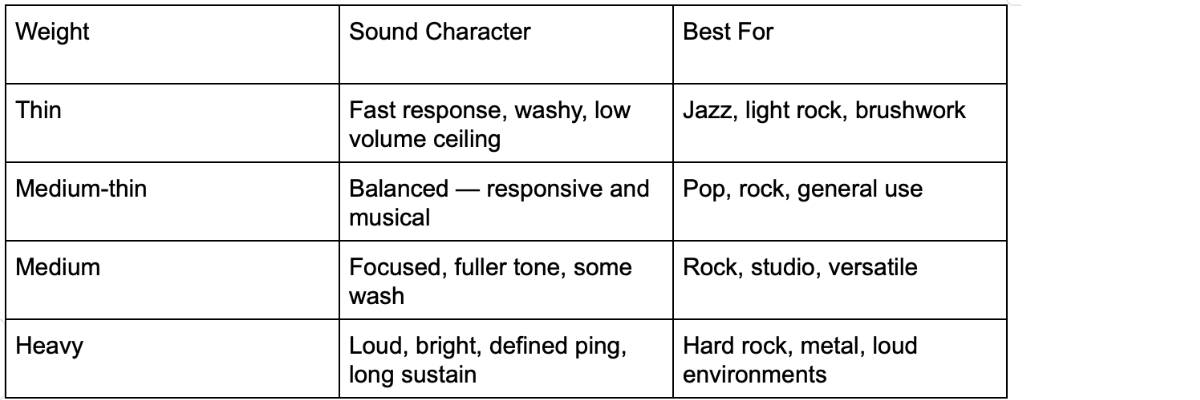
For beginners, medium-thin cymbals give the best all-around response — they're forgiving of technique and sound musical in a wide range of contexts.
Finish: Lathed vs. Unlathed
Most cymbals are lathed — the surface is turned on a lathe to create those concentric grooves you see on a standard cymbal. Lathing brightens the sound and adds clarity. Unlathed areas (often found at the top of the bell or across the entire surface on "raw" cymbals) produce darker, more complex, slightly drier tones.
Bell Size
A larger bell produces a louder, more prominent bell tone. A smaller bell is subtler and blends into the bow sound. For ride cymbals especially, bell size shapes the character of your ride pattern, particularly in jazz and Latin styles where the bell is a primary voice.
Material: B20 vs. B8 Bronze
Most professional and mid-range cymbals are made from B20 bronze (80% copper, 20% tin). B20 has a complex, warm, musical tone with a lot of overtone character. Entry-level cymbals are often made from B8 bronze (92% copper, 8% tin), which is harder and produces a brighter, thinner, more uniform sound. B8 isn't bad — it's consistent and durable — but B20 is where the real tonal complexity lives.
Common Cymbal Mistakes
Most cymbal problems come down to the same handful of errors. Here's what to watch for.
Buying All Your Cymbals in a Pack
Why it's wrong: Cymbal packs are convenient and affordable, but they're designed around the lowest common denominator. Every cymbal in a pack is the same brand, the same series, and often very similar in weight and finish. You lose the tonal contrast that makes a cymbal setup interesting and musical.
How to fix it: If budget is the constraint, start with a pack, then replace cymbals one at a time as you develop preferences. Most drummers swap out the ride first, then the crashes. Mixing series and brands intentionally gives you more personality in your setup.
Mounting Cymbals Too Tight
Why it's wrong: A cymbal that can't swing freely on its stand will crack faster and sound choked. The wing nut should be tight enough that the cymbal doesn't fall off, but loose enough that it gives when you hit it. Overtightening kills the sustain and, over time, cracks the cymbal at the bell hole.
How to fix it: Use a felt washer above and below the cymbal. Tighten the wing nut until it's snug, then back off half a turn. The cymbal should tilt and swing with light pressure from your hand.
Ignoring Cymbal Angle
Why it's wrong: Cymbals mounted too flat get hit edge-on, which causes cracks and an uncomfortable stick rebound. Cymbals mounted too steep are hard to reach and produce an uncontrolled sound when you crash them.
How to fix it: Crashes are typically angled 15–30 degrees from horizontal — steep enough to absorb impact, flat enough to play comfortably. The ride is often flatter than crashes to give you a stable surface for your ride pattern. The hi-hat should be as flat as is comfortable for your left hand technique.
Buying Cymbals That Are Too Heavy for Your Playing Level
Why it's wrong: Heavy cymbals require more force to open up and respond, which can push beginners into hitting harder than their technique warrants — leading to bad habits and faster fatigue. They also make it harder to hear the nuances of your own playing.
How to fix it: Start with medium or medium-thin cymbals. They respond easily at lower volumes, give you dynamic range, and let you focus on technique rather than muscle. You can always go heavier later as your playing develops and you play in louder contexts.
Neglecting Old, Cracked Cymbals
Why it's wrong: A crack in a cymbal will spread. Playing on a cracked cymbal is risky — a piece can break off and cause real injury — and the sound changes significantly as the crack grows.
How to fix it: If a crack is short, you can drill a small hole at the end of the crack to stop it spreading temporarily. But that's a band-aid. Once a cymbal cracks, it's usually better to retire it. Some drummers use cracked cymbals in stacks, which actually works well — the crack adds to the trashy character.

Beginner Tips for Building Your Cymbal Setup
- Start with the essential three. Hi-hats, one crash, and a ride cover almost every musical situation. Don't overcomplicate your setup until you've used those three enough to know what you're missing.
- Listen before you buy. Cymbals vary enormously even within the same series. If you can, try them in person at a music store. Hit them with a stick, not just your hand — hand-testing a cymbal gives you almost no useful information.
- Buy used when it makes sense. Quality used cymbals (Zildjian A, Sabian AA, Meinl HCS, etc.) often sound better than new entry-level cymbals at the same price. Cracks and keyholing (damage around the bell hole) are the things to check for.
- Keep your cymbals clean. Fingerprints and grime affect the sound and can lead to corrosion over time. A soft cloth and cymbal-specific cleaner go a long way. Knowing how to clean drum cymbals properly will keep them sounding their best for years.
- Don't match all your cymbals from the same series. Tonal contrast between your cymbals — different weights, different manufacturers — makes a setup more interesting and more musical.
- Position for comfort and reach. The best cymbal setup is the one you can reach without contorting your body. Your crashes should be close enough to hit naturally after a fill. The ride should sit where your right hand naturally rests without strain.
Final Thoughts
Your cymbal setup is one of the most personal parts of your kit. The same crash that sounds perfect to one drummer will feel wrong to another — and that's exactly how it should be. Start with the fundamentals (hi-hats, a crash, a ride), learn what each one does, and let your musical preferences guide what you add from there. The more time you spend playing different cymbals, the more clearly you'll hear what your setup is missing — and what it doesn't need. That instinct is worth more than any buying guide.
FAQ
What are the three basic types of cymbals?
The three essential cymbal types are hi-hats, crash cymbals, and ride cymbals. These cover timekeeping, accents, and pulse — everything a standard setup needs. Splash, china, and effects cymbals are additions that expand your tonal palette once you've built the foundation.
What size crash cymbal should a beginner get?
A 16" crash is the most versatile starting point. It's loud enough to cut through, decays at a useful speed, and works across genres. If you add a second crash later, pairing a 16" with an 18" gives you good tonal range.
What's the difference between a crash and a ride cymbal?
A crash is designed for quick, loud accents — it responds fast and decays fast. A ride is thicker and designed to sustain a rhythmic pattern, with a more controlled wash and a distinct bell that gives you a secondary sound source. You typically don't swap one for the other — they serve different purposes.
Why does my cymbal crack?
Cymbal cracking usually comes from one of three causes: hitting the edge straight on (rather than at an angle), mounting too tightly, or simple fatigue from years of heavy use. Edge cracks are the most common and almost always come from poor striking angle or technique. Angling your cymbals correctly and letting them flex freely on the stand dramatically reduces cracking.
What's a good entry-level cymbal brand?
For entry-level, Meinl HCS, Sabian SBR, and Zildjian ZBT offer affordable starting points. If your budget stretches a little further, Zildjian A, Sabian AA, Meinl Classics Custom, and Paiste 2002 are excellent mid-range options that will last years and reward your developing ear. Avoid no-name or deeply discounted cymbals — they often don't improve with proper technique and can be fragile.
Can I use any cymbal as a crash?
Technically yes — any cymbal can be crashed on its edge. But purpose-built crashes are thinner and taper toward the edge, which makes them respond faster and with more musical character. A ride crashed on its edge gives a washy, heavy accent; a crash crashed on its edge gives that immediate, blooming sound most drummers want. Use the right tool for the job when you can.