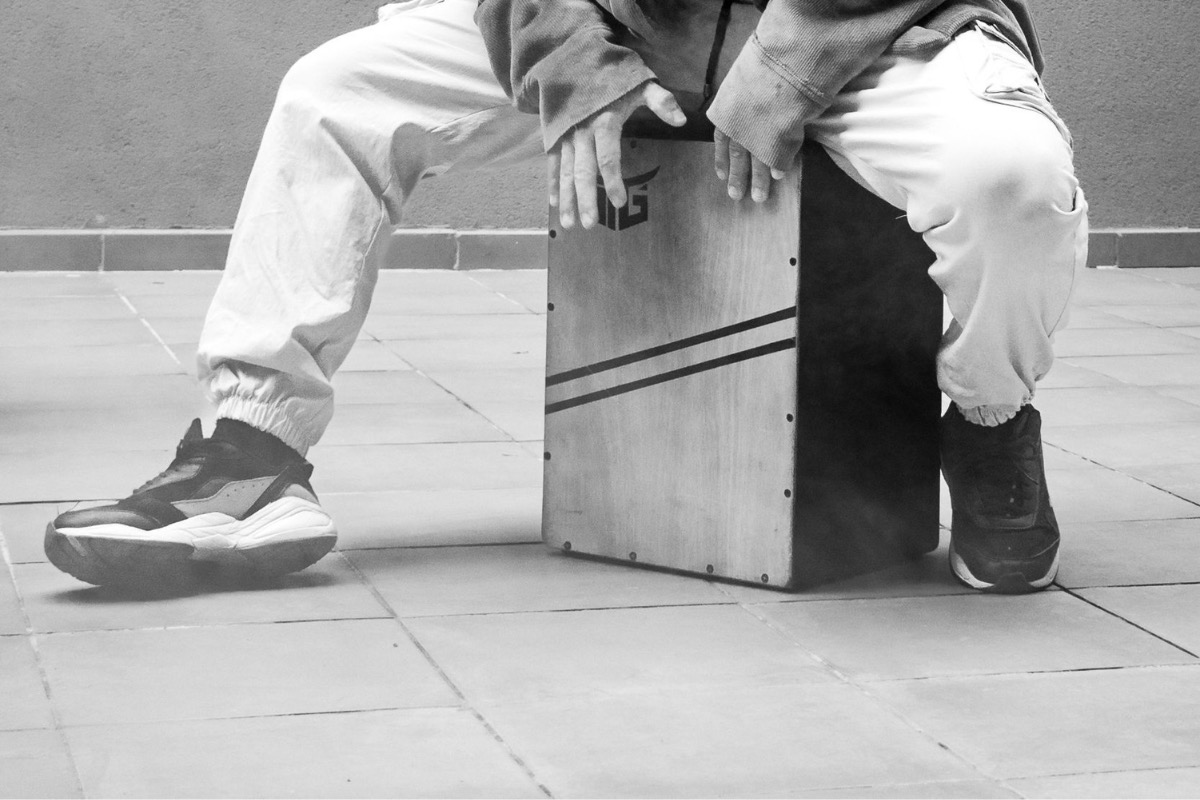
A cajon (pronounced ka-HON) is a box-shaped percussion instrument you sit on and play with your hands — striking the front face (called the tapa) to produce bass tones, slaps, and snare-like sounds from a single wooden box.
That two-sentence description doesn't do justice to how much sound one person can get out of a wooden crate. In the right hands, a cajon can replicate the full feel of a drum kit — bass drum on the low center hits, snare on the upper corners, hi-hat on the softer edge tones — making it one of the most versatile percussion instruments available to a solo musician. You've heard it in acoustic sessions, coffeehouse sets, flamenco performances, and stripped-down studio recordings without necessarily knowing what you were listening to.
This guide covers the cajon's origins and construction, how to sit and position yourself, all three core tones you need to learn, a basic groove to get you started, how the cajon compares to a full drum kit, how to choose the right one, and the most common beginner mistakes. By the end, you'll understand the instrument well enough to start playing and making real decisions about technique and gear.
When you’re done reading, you will be familiar with:
- What Is a Cajon Drum?
- Parts of a Cajon
- How to Sit and Position Yourself
- The Three Core Cajon Tones
- A Basic Cajon Groove to Get You Started
- Cajon vs. Drum Kit: What's the Difference?
- How to Choose the Right Cajon
- Common Cajon Mistakes
- Beginner Tips for Learning Cajon
- Final Thoughts
- FAQ
What Is a Cajon Drum?
The cajon originated in Peru, likely developed by enslaved Africans in the 18th century who were prohibited from playing traditional drums and turned wooden shipping crates into percussion instruments. The instrument became deeply embedded in Afro-Peruvian music before spreading to Spain in the 1970s and early 1980s, where flamenco musicians adopted it as an acoustic complement to guitar. From there, the cajon went global — today you'll find it in folk, jazz, pop, blues, and singer-songwriter settings wherever a drummer wants a full rhythm section feel in an acoustic-friendly package.
The word cajon simply means "box" or "drawer" in Spanish, which describes the instrument perfectly. A standard cajon is essentially a hollow wooden box with a sound hole cut in the back and a front playing face (the tapa) that's slightly thinner than the rest of the shell. Most modern cajons also include internal snare wires or guitar strings stretched against the inside of the tapa — these vibrate against the wood when the drum is struck, producing the buzzy, snare-like tone that makes the cajon sound like a complete percussion setup rather than just a box you're hitting.
Parts of a Cajon
Understanding how the cajon is built helps you understand how to play it — specifically why you get different tones from different parts of the playing face.
- Tapa (front face): The thin front panel you play on. Made from a different (usually thinner) wood than the rest of the box. The tapa is slightly flexible — this flexibility is what allows it to vibrate and produce tone. Birch, beech, and maple are common tapa materials; thinner tapas tend to produce a more resonant, open sound.
- Shell (body): The four sides and back panel of the box. Typically made from 12–18mm plywood — thick enough to be rigid and provide projection. Baltic birch plywood is a common choice at all price points.
- Sound hole: The opening cut into the back panel. Controls how the air moves inside the box and affects the bass response and sustain. Some cajons have additional ports cut into the sides.
- Snare mechanism: Metal snare wires (similar to the wires on a snare drum) or guitar strings stretched against the inside face of the tapa. When the upper portion of the tapa is struck, it vibrates against these wires and produces a crispy, buzzing snare sound. Many cajons allow you to adjust or disengage the snare using an external screw or internal adjustment.
- Feet/rubber pads: Rubber pads or feet on the bottom of the cajon that prevent it from sliding on smooth floors while you're playing. Some players add additional rubber grips or play on a rug.
- Mounting screws: The screws securing the tapa to the shell around the edges. The tapa is deliberately left slightly loose (especially at the top corners) to allow it to vibrate freely — the top corners are where the snare tones are produced. Over-tightening these screws kills the upper-register tones.
How to Sit and Position Yourself
Playing position on the cajon determines your comfort, your endurance, and — significantly — the quality of your tone. Get it wrong and you'll be fighting the instrument.
Basic Sitting Position
Sit on top of the cajon with your feet flat on the floor, roughly shoulder-width apart. The cajon should be tilted slightly backward — the top angled toward you — so the tapa faces forward and upward at about a 10–15 degree angle. This tilt puts the playing surface in a natural position for your hands and allows the sound to project forward and downward, which gives you better bass response.
Tilt comes from leaning slightly forward on the cajon. Your weight should be on the front third of the top surface, not sitting back. If you sit too far back, you'll be muting the sound hole and the bass tones will be choked.
Hand and Arm Position
Your arms should hang relaxed from your shoulders, elbows slightly bent and loose. Hands rest naturally at the lower half of the tapa when not playing. The motion comes primarily from your wrists and forearms — avoid locking your elbows or lifting your shoulders to reach the drum. If your shoulders are tense, you're fighting the instrument.
Foot Position
Feet flat, slightly wider than hip-width. Some players point their toes outward slightly for comfort. Your feet can also play a role in muting the cajon's resonance — pressing the toes of one or both feet against the lower front edge of the tapa slightly mutes the bass tone. This is a deliberate technique, not an accidental position.
The Three Core Cajon Tones
Every cajon groove is built from three fundamental sounds. Master these before trying to play any complete pattern — they're the vocabulary of the instrument.
1. Bass Tone (Low Center Hit)
The bass tone is your kick drum equivalent. Strike the center of the tapa with flat fingers together, about two-thirds of the way down from the top. Let your hand bounce off immediately — don't press in. You should hear a deep, resonant "thud" with some sustain from the shell.
The key to a good bass tone is hitting down the center and allowing the tapa to vibrate freely after impact. If your hand stays on the tapa or you hit too high, the bass is choked. If you hit too low (near the bottom edge), the tone becomes thin.
What to listen for: A round, deep thud with a clean, quick decay. Not a slap, not a thud with no resonance — something in between that carries.
2. Slap Tone (Upper Corner Hit)
The slap is your snare equivalent — bright, cracking, and cutting. Strike the upper corner of the tapa (either top-left or top-right corner, depending on which hand you're using) with the pads of your fingers. Your hand should be slightly cupped and relaxed. Again, bounce off immediately.
The upper corners of the tapa are where the snare wires make contact with the wood. When you hit here, the tapa vibrates against the snare strings and produces that characteristic buzzy crack. The tone is noticeably brighter and shorter than the bass tone — it should sound like a rimshot on a snare drum, but without the ring.
What to listen for: A sharp, dry "crack" with a bit of buzz from the snare strings. If it sounds dull, you're hitting too low or too flat. If the snare buzz is excessive, check the snare tension adjustment inside or underneath the cajon.
3. Open (Tone) Hit
The open tone sits between the bass and slap — brighter than the bass but less cracking than the full slap. Strike the upper third of the tapa with relaxed fingers, away from the corners. This produces a mid-range "pop" with some resonance — it's often used for ghost notes, fills, and softer accents within a groove.
The open hit is the most versatile tone because it can be played at a wide range of dynamics without losing its character. Bass tones and slaps have a narrower dynamic range — they either work or they don't. The open hit works softly as a ghost note and harder as a fill accent.
A Basic Cajon Groove to Get You Started
Once you can produce a clean bass tone and a clean slap tone, you can play a groove. Here's a simple beginner pattern based on a standard rock/pop backbeat feel:

R = right hand, L = left hand. The right hand handles bass tones (beat 1 and 3), the left hand handles slaps on the backbeats (beats 2 and 4) — exactly like a kick/snare relationship on a drum kit. The extra bass hit on the "&" of beat 3 starts to push the groove forward.
Start this pattern at 60–70 BPM with a metronome. The bass tones should feel solid and low; the slaps should crack cleanly. Once you can loop this pattern without thinking, start experimenting by adding open-tone ghost notes on the "and" counts that don't have a hit.
A good test: if you recorded yourself playing this groove and heard it back without knowing the source, it should sound like a full rhythm section, not someone banging on a box.
Cajon vs. Drum Kit: What's the Difference?
The cajon and a full drum kit serve overlapping but distinct purposes. Understanding the difference helps you know when to reach for which.
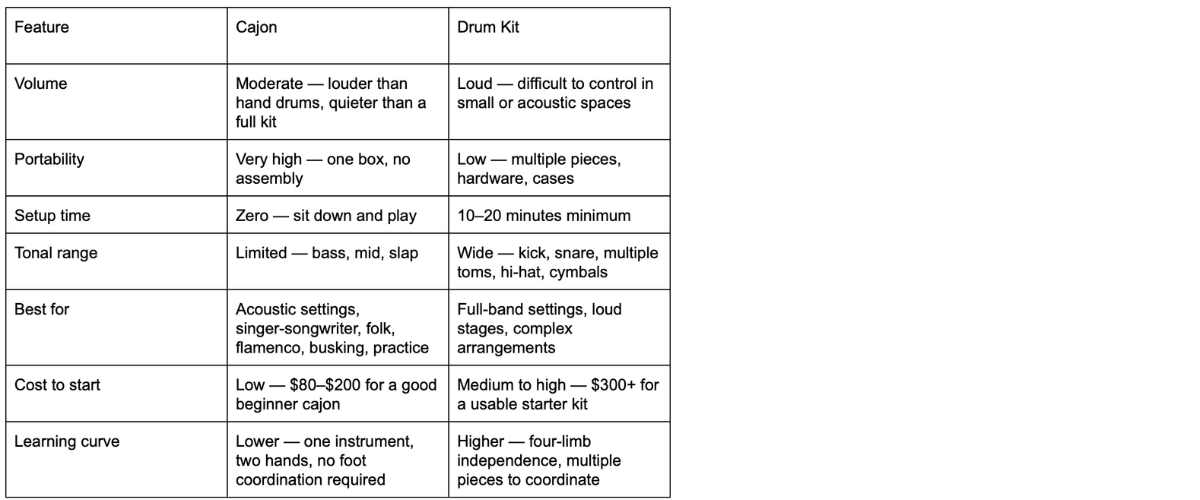
The cajon excels in situations where a full kit is too loud, too large, or too much to set up. It's the natural choice for intimate acoustic performances, coffeehouse gigs, sessions at home, and any setting where you want a full rhythm feel without the production of a full kit.
That said, the cajon is limited by its tonal range. You can't replicate a cymbal, a hi-hat pattern, or a full tom fill on a cajon. Experienced cajon players compensate with technique — ghost notes, dynamic variation, and foot tambourine or stomp boxes — but if the music demands a full kit feel, a cajon won't fully replace it.
For drummers who already play a kit, the cajon is an excellent second instrument. The foundational timing and groove sense transfers directly; you're just learning new physical mechanics. Learning how drum tuning works on a full kit actually helps you understand why cajon tapa setup and snare adjustment matters too — the principles of tension and resonance are the same.
How to Choose the Right Cajon
The cajon market runs from cheap beginner boxes to professional-grade instruments. Here's what actually matters when choosing one.
Shell Material
The shell should be solid plywood — Baltic birch is the standard. Avoid MDF (medium-density fiberboard) shells; they're heavy, acoustically dead, and don't project well. At any decent price point, you should get birch or similar quality hardwood plywood.
Tapa Material and Thickness
The tapa is the most important variable in a cajon's sound. Thinner tapas (3–4mm) produce more resonance and sustain; thicker tapas (5–6mm) are more durable and punchy. Birch, beech, and maple are common. Mahogany tapas produce a warmer tone. Higher-end cajons often let you experiment with different tapa materials.
Snare Type
Standard cajons use metal snare wires — similar to snare drum wires — for a bright, tight buzz. Some cajons use guitar strings instead, which produce a warmer, more mellow snare tone. A few models (notably by Meinl) feature a dual snare system with adjustable zones for both tones. For beginners, snare-wire cajons are the most common and most versatile.
Make sure the cajon you're looking at has an adjustable snare — an external adjustment screw or an internal mechanism that lets you tighten or loosen the snare contact. A non-adjustable snare is either always buzzing or never buzzing; adjustability lets you dial in the right amount of snap for your playing style and the music you're playing.
Size
Standard cajons are approximately 12 inches wide, 12 inches deep, and 18–20 inches tall. This size works for most adults. Smaller "mini cajons" exist for children or portability purposes, but they produce noticeably less bass. Stick with a full-size cajon unless you have a specific reason not to.
Brand and Price Range

For most beginners, a cajon in the $100–$150 range from a reputable brand is the sweet spot. The step up to $200+ is noticeable but not critical until your technique is developed enough to hear the difference
Common Cajon Mistakes
Most beginners make the same handful of errors when starting out. Knowing them in advance saves you weeks of reinforcing bad habits.
Hitting the Same Spot for Everything
Why it's wrong: The cajon only produces its three distinct tones (bass, slap, open) when you hit specific areas of the tapa. Playing everything in the same spot produces one muddy, undifferentiated sound instead of a groove with dynamics and texture.
How to fix it: Before playing any pattern, practice each tone in isolation. Bass hits only — center, lower two-thirds of the tapa. Slap hits only — upper corners. Open hits — upper third, away from corners. Train your hands to go to the right spot automatically before combining them.
Sitting Too Far Back on the Cajon
Why it's wrong: Sitting back on the cajon puts your weight over the sound hole, muting the bass resonance and reducing the overall volume and warmth of every hit. It also puts you in a poor angle for reaching the upper portion of the tapa for slap tones.
How to fix it: Shift your weight forward. Your sit bones should be on the front half of the top surface. Tilt the drum slightly back toward you and lean slightly forward. The sound immediately opens up.
Playing with Tense Hands
Why it's wrong: Tense hands make it impossible to produce a good slap tone, since the snap of the snare buzz requires a fast, bouncing strike rather than a pressed, held-down contact. Tension also causes fatigue within minutes and leads to sloppy, inconsistent hits.
How to fix it: Shake your hands out. Keep your wrists loose and let the motion come from a wrist flick rather than arm force. The slap in particular should feel like a whipping motion, not a hit. If your forearms are getting tired after 5 minutes, you're using too much tension.
Neglecting Dynamics
Why it's wrong: A cajon groove that's played at the same volume throughout sounds flat and unmusical, no matter how technically correct the pattern is. The cajon's strength as an acoustic instrument is its dynamic range — from soft ghost notes to loud slap accents.
How to fix it: Practice the same groove at three volume levels: soft, medium, and loud. Learn to accent the backbeat slap relative to the bass tone. Add ghost notes (very soft open hits) on the beats between bass and slap. Dynamic contrast is what turns a pattern into a groove.
Over-Relying on the Snare
Why it's wrong: Many beginners hit the upper corners constantly because the snare tone is satisfying and easy to produce. But overusing the snare buzz makes everything sound the same — the instrument's dynamic range disappears when every hit has that same crack.
How to fix it: The slap tone (with snare buzz) should land on the backbeats — beats 2 and 4 in most grooves. Bass tones go on beats 1 and 3. Open tones fill in between. Think of the snare buzz as the accent, not the default.
Beginner Tips for Learning Cajon
- Start without a pattern. Spend the first 10–15 minutes of every early session just producing tones — bass hits until they ring cleanly, slaps until they crack cleanly, open hits until they sound distinct. You can't play a good groove with bad individual tones.
- Use a metronome from day one. The cajon is most commonly played in acoustic settings where the timing is exposed — there's no loud electric guitar to hide behind. A loose cajon player is immediately obvious. Set a metronome to 70–80 BPM and practice until your groove locks in with it without thinking.
- Record yourself. The cajon's tones sound different from the audience side than from on top of the instrument. Recording yourself immediately shows whether your bass tones are actually resonant, whether your slaps are cracking, and whether your groove feels solid or rushed.
- Play along to music. Pick acoustic songs you love and play along. The goal is to feel the groove in context, not just in isolation. This is the fastest way to develop musical instincts on the instrument.
- Check your snare adjustment. Most beginner cajons ship with the snare either too tight (excessive buzz on every hit) or too loose (almost no snare response). Adjust it until the snare activates clearly on the upper-corner slap hits but doesn't buzz excessively on bass tones.
- Add foot percussion if you want more range. Cajon players who need more rhythmic complexity often add a foot tambourine, a stomp box, or a hi-hat stand to their setup. This isn't required to start, but it significantly expands what you can do in a full-band acoustic context.
Final Thoughts
The cajon's appeal is straightforward: it's a complete percussion instrument that fits in the trunk of a car, sets up in five seconds, and sounds like a rhythm section in the hands of someone who knows the three basic tones. That combination of portability, accessibility, and musical depth makes it one of the most practical percussion instruments you can pick up.
The technique ceiling is higher than it looks from the outside. Once you've got the basic groove solid, there's a world of flamenco-derived hand patterns, Latin rhythms, jazz brush-style voicings, and creative snare-muting techniques to explore. But none of that matters until bass, slap, and open tones are clean and automatic.
Sit on the box. Tilt it back. Bass in the center, slap in the upper corners. Start slow, use a metronome, and give yourself time to get the tones right before chasing complexity.
FAQ
How long does it take to learn cajon drum?
Most people can produce the three basic tones and a simple groove within a few sessions. Playing musically at tempo with dynamics takes a few weeks of regular practice. Becoming genuinely proficient — with a range of grooves, fills, and dynamic control — takes months of consistent work, just like any instrument.
Can you play cajon without experience?
Yes — the cajon is beginner-friendly. You don't need to read music, coordinate foot pedals, or manage multiple instruments. The basics are accessible quickly, which is part of why it's popular as a first percussion instrument for adults.
Is cajon good for drummers?
Yes, and many kit drummers find the cajon a natural extension of their existing skills. Your groove sense, timing, and dynamic awareness transfer directly. The new learning is the physical mechanics — specific hand positions and strike zones — and thinking in three tones instead of a full kit's vocabulary. If you're comfortable with the parts of a drum set, adapting to the cajon's simpler structure is straightforward.
Does the cajon have different tunings?
The cajon doesn't have adjustable pitch tuning the way a drum head does, but the snare mechanism is adjustable — tighter snare contact produces a crisper, more pronounced buzz; looser contact produces a softer, warmer snare response. Some models allow you to adjust the proximity of the snare wires to the tapa. The tapa's thickness and material also affects the overall tonal register.
Can I use cajon in a band?
Absolutely — the cajon is used in acoustic bands, singer-songwriter settings, jazz trios, flamenco ensembles, and even some rock setups where a full kit would be too loud. In louder settings, it can be mic'd directly (place a microphone in or near the sound hole on the back) for amplification.
What's the best way to mic a cajon?
The most common approach is placing a microphone inside the sound hole on the back of the cajon — a small-diaphragm condenser or dynamic mic works well. This captures the bass resonance and the overall body of the sound. A second microphone placed a foot or two in front of the tapa captures the slap tones and high-end detail. In smaller acoustic settings, the cajon often projects well enough without amplification at all.
How do I stop my cajon from sliding while playing?
Most cajons have rubber feet on the bottom. If yours is still sliding, play on a rug or drum mat, or add self-adhesive rubber feet to the base of the instrument. Some players also add a strip of grip tape or thin foam to the underside. The slightly forward-tilted sitting position also helps keep the cajon stable since your weight is pressing down and forward on the instrument.