Drums are harder to start than most instruments, but easier to make sound good early on. You can play your first basic beat within a few sessions, but developing real coordination — getting all four limbs to do different things simultaneously — takes months of consistent practice.
That's the honest short version. The longer version is that "how hard" depends entirely on what you're measuring. If the bar is "can I keep a steady beat and play along to a song," that's achievable within a few weeks. If the bar is "can I play with the feel, dynamics, and control of a seasoned drummer," you're looking at years. Most instruments work the same way, but with drums the early wins come faster and the ceiling is higher than most people expect.
In this guide, we'll give you a realistic breakdown of the drum learning curve — what's genuinely difficult, what most beginners get wrong, how long different milestones actually take, and what you can do to learn faster without building bad habits that hold you back later. By the end, you'll know exactly what you're signing up for and how to approach it.
When you’re done reading, you will be familiar with:
- What Actually Makes Drums Difficult
- What Beginners Can Pick Up Quickly
- A Realistic Learning Timeline
- Drums vs. Other Instruments: How the Difficulty Compares
- Common Beginner Mistakes That Make Drums Feel Harder
- Tips to Make Learning Drums Easier
- Final Thoughts
- FAQ

What Actually Makes Drums Difficult
The core challenge with drums is limb independence. On a piano, your two hands play different notes but they're doing versions of the same basic motion. On a drum kit, your four limbs are often doing four completely different things at the same time — your right foot drives the kick drum, your left foot controls the hi-hat pedal, your right hand hits the hi-hat or ride, and your left hand hits the snare. None of those things naturally talk to each other at first.
Your brain isn't wired for this out of the box. Learning to play drums is, in a real sense, teaching your nervous system to route motor signals independently to all four limbs simultaneously. That takes time, repetition, and patience — and it's the reason most beginners feel completely lost during the first few weeks even when they're doing everything "right."
The other major difficulty factors:
- Timing and feel. Playing in time isn't just hitting things rhythmically — it's feeling where the beat lives and staying locked to it even when the music moves around you. This develops over months of playing with a metronome and other musicians.
- Dynamics. Controlling how hard you hit, and being able to play softly and loudly on demand without losing time, is a skill most beginners underestimate. Ghost notes — those quiet snare hits that give a groove its texture — require very fine control.
- Reading drum notation. If you want to learn songs from sheet music, you'll need to learn how to read drum tabs or notation. It's not as complex as reading piano music, but it's another layer to work through.
- Physical endurance. Drumming is physically demanding. Your wrists, arms, and legs fatigue quickly when you start. That improves with practice, but early sessions can feel tiring in a way that guitar or piano doesn't.
What Beginners Can Pick Up Quickly
Here's where drums have a genuine advantage over most instruments: you can make a satisfying sound on day one. There's no embouchure to develop like with brass or wind instruments, no calluses to build like with guitar, no complex fingering system to memorize. You pick up sticks and you hit things — and hitting things with sticks already sounds like drumming, even if it's basic.
Things that come relatively quickly for most beginners:
- Basic quarter-note pulse. Keeping a steady beat on a single drum is achievable in the first session. If you can clap in time to music, you can learn to keep a kick-snare pulse within a few hours of practice.
- Simple rock beats. A standard rock beat (kick on beats 1 and 3, snare on 2 and 4, hi-hat on every eighth note) is one of the first things taught, and most people can get a rough version working in their first week or two.
- Basic fills. A simple 4-beat fill around the toms — nothing fancy, just moving your hand from drum to drum — can be learned alongside your first beat. It gives a sense of real musical function early on.
- Enjoyment. Drumming is fun right away. Even a beginner drumbeat played at a slow tempo with a click track sounds musical. That immediate feedback keeps motivation up in a way that's harder to achieve on instruments with a longer "startup cost."
A Realistic Learning Timeline
Everyone progresses differently depending on how much they practice, whether they have instruction, and what their prior musical background is. But here's a rough framework for what to expect:
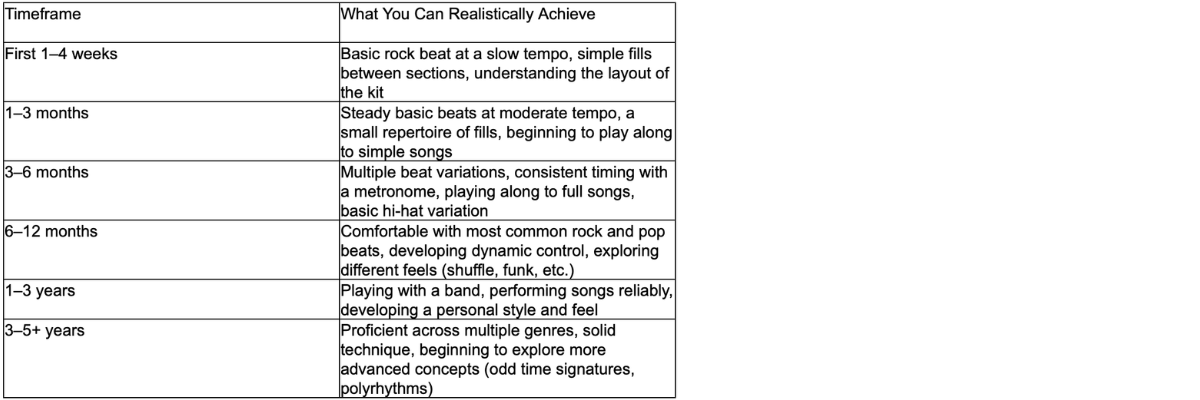
These timelines assume consistent practice — even 20–30 minutes a day makes a significant difference. Someone who practices 30 minutes daily will advance much faster than someone who plays for 3 hours once a week. Regularity matters more than total hours per session.
Prior musical experience helps too. If you already have a strong sense of rhythm, or you play another instrument, you'll move through the early stages faster. But limb independence is a physical skill that has to be developed regardless of musical background — there's no shortcut past the reps.
Drums vs. Other Instruments: How the Difficulty Compares
This comparison is always a bit subjective — every instrument has its own unique challenges. But broadly speaking:
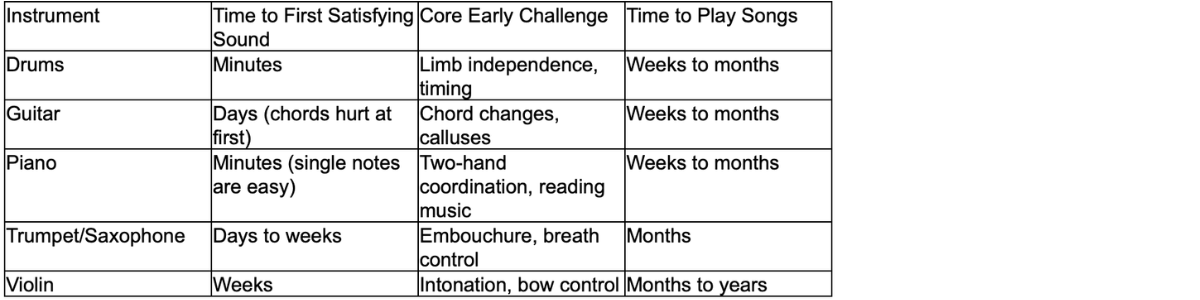
Drums sit in a middle range — easier to start than violin or trumpet, roughly comparable to guitar and piano at the beginner level. Where drums get harder relative to other instruments is in the intermediate-to-advanced range, where the physical demand of limb independence and the complexity of drumming within a band (tempo control, listening, dynamics) creates a long runway for growth.
Common Beginner Mistakes That Make Drums Feel Harder
Skipping the Metronome
Why it's wrong: Playing without a click feels easier in the moment because you can speed up when things get hard and slow down when they don't. But this builds a habit of inconsistent tempo that's very difficult to undo later. When you eventually play with other musicians, rushing and dragging become obvious immediately.
How to fix it: Use a metronome from your very first session. Start slower than you think you need to — if you can't play something cleanly at 60 BPM, you're not ready to play it at 80. Slow practice with a click builds the internal clock that makes playing feel effortless later.
Holding the Sticks Too Tight
Why it's wrong: Gripping the sticks hard feels more in control, but it kills rebound — the natural bounce of the stick off the drumhead. You end up doing all the work with your muscles rather than letting the stick do its job. This leads to faster fatigue and, over time, injury. Understanding how to hold drumsticks properly makes every other aspect of playing easier.
How to fix it: Hold the stick like you'd hold a bird — firm enough that it can't escape, loose enough that you're not hurting it. The last three fingers guide the stick; the thumb and index finger are the pivot point. Feel the stick rebound off the head and let it come back naturally.
Trying to Learn Too Many Things at Once
Why it's wrong: New drummers often want to learn fills, different beats, hi-hat variation, and dynamics all at the same time. Spreading attention across too many things at once means none of them get developed properly. The brain can only integrate one new motor pattern at a time.
How to fix it: Master one beat completely before moving on. "Complete" means you can play it in time, without thinking, for 2–3 minutes straight without breaking. Only then add a new element. This feels slow but produces far faster real-world progress.
Practicing Too Fast
Why it's wrong: Playing fast feels impressive but teaches your hands and feet bad habits at full speed. Mistakes played at 120 BPM get locked in at 120 BPM. You then have to unlearn them before you can actually improve.
How to fix it: Practice at a tempo where you can play without any mistakes, every single rep. Increase speed by 5 BPM only when you can consistently nail it for a full minute. This approach — called "slow to go fast" — is how professional drummers actually practice.
Neglecting the Bass Drum and Hi-Hat Foot
Why it's wrong: Beginners naturally focus on their hands because that's where the sound comes from most obviously. But the two feet — kick pedal and hi-hat pedal — are doing just as much work in any real groove. Ignoring foot technique early means you hit a wall when you try to play more complex patterns.
How to fix it: Spend dedicated practice time on foot coordination alone. Practice kick patterns without using your hands at all. Then practice the hi-hat foot alone. Only combine once each foot feels independent. This focused isolation work pays off faster than trying to practice everything together from the start.
Tips to Make Learning Drums Easier
- Use a practice pad if you don't have a full kit. A good drum practice pad gives you the rebound feel of a real drumhead without the volume. You can work on stick control, rudiments, and hand technique anywhere — on a desk, on your lap, while watching TV. Daily pad practice builds the hand control that makes full-kit playing feel easier.
- Learn basic rudiments early. Drum rudiments are foundational patterns — single stroke roll, double stroke roll, paradiddle — that build your stick control and create the building blocks for fills and more complex beats. Even 5 minutes of rudiment practice per session makes a measurable difference over weeks.
- Play along to music you actually like. Playing to a click in silence is useful, but playing along to songs you love is more fun and teaches musical context — how the beat sits in the song, how fills connect sections, how dynamics change between verse and chorus. Pick songs that are slightly within your current ability and play them repeatedly.
- Record yourself. Your phone propped against a music stand is enough. Watching yourself play reveals things you can't feel in the moment — rushing, uneven hi-hat strokes, posture problems. Five minutes of review after a 20-minute session is worth more than an extra 20 minutes of blind practice.
- Get at least a few lessons from a real teacher. Even a handful of sessions with an experienced drummer at the start can prevent months of bad habits. A teacher will spot technique problems immediately that you'd never notice on your own. You don't need ongoing weekly lessons indefinitely, but a few early sessions are a worthwhile investment.
- Be patient with the coordination wall. Almost every beginner hits a point around 2–4 weeks in where progress feels stuck. Your hands are improving but your feet aren't keeping up, or vice versa. This is normal — it means your brain is actively integrating new patterns. Keep practicing consistently and it breaks through.
Final Thoughts
Drums are genuinely challenging, and anyone who tells you otherwise hasn't really played them. But the difficulty is rewarding — the coordination, timing, and physicality you develop as a drummer are skills that carry across music and beyond. Most beginners make more audible progress in their first few months than they expected, and hit a deeper level of satisfaction than they anticipated.
The honest answer to "how hard is it to play drums" is: hard enough to be worth learning, and forgiving enough that you'll be having real fun within your first month. The rest is just consistent practice and time in the chair.
FAQ
How long does it take to learn drums?
Most beginners can play a basic beat within a few weeks of consistent practice. Playing full songs with confidence usually takes 3–6 months. Developing real fluency — comfortable across multiple styles with solid technique — takes 1–3 years of regular playing. Progress depends heavily on how consistently you practice and whether you have any instruction.
Is it harder to learn drums than guitar?
They're different kinds of hard. Guitar has a painful physical startup (fingertip soreness, chord-change difficulty) but the coordination challenge is smaller. Drums are physically easier to start but demand four-limb independence, which is a more complex neurological challenge. Most people find them comparable in overall difficulty over the first year.
Can I learn drums without lessons?
Yes — many excellent drummers are self-taught. But a few lessons at the beginning are very valuable for catching technique problems early. Bad habits (tight grip, bad posture, rushed tempo) are much harder to fix after they're established. At minimum, use quality video resources and be honest with yourself when something feels wrong.
Do I need a full drum kit to learn?
No. A drum practice pad and a pair of sticks let you work on stick control, rudiments, and hand technique — which is a significant portion of drum skill. Electronic kits with headphones are excellent for home practice with full kit coordination. A full acoustic kit is ideal eventually, but not required to start learning.
Is drumming physically demanding?
Yes, more than most people expect. Drumming engages your arms, wrists, legs, and core simultaneously, and sessions can be genuinely tiring. This physical demand decreases as your technique improves — good technique is efficient and doesn't require as much muscular effort. Beginning drummers often work much harder physically than experienced ones playing the same patterns.
What's the hardest thing to learn on drums?
For most beginners, it's the kick drum and hi-hat foot independence — learning to keep a consistent pattern with both feet while the hands do something completely different. Developing genuine dynamic control (playing very softly and precisely) is another challenge that takes years to fully develop.