To choose a drum throne, look for one with a height range that puts your thighs parallel to the floor (or slightly angled downward), a stable tripod or tractor-style base, and a seat cushion firm enough to support your weight without sinking. Round, saddle, and tractor-style seats each suit different body types and playing styles — and the right choice depends on how long you play and what feels natural for your posture.
Most beginners treat the drum throne as an afterthought — the last thing on the checklist after the kit, cymbals, and sticks. That's a mistake. The throne is the single piece of hardware that affects everything else: your posture, your pedal reach, your hi-hat positioning, how your back feels after an hour of playing, and even your timing. A bad throne makes your whole setup feel off without you realizing why.
In this guide, we'll walk through the main types of drum thrones, what to look for in terms of height, seat shape, and build quality, how to set the height correctly for your body, the most common throne-related mistakes beginners make, and what actually matters when you're shopping on a budget. By the end, you'll know exactly what kind of throne you need and why.
When you’re done reading, you will be familiar with:
- Why Your Drum Throne Matters More Than You Think
- Types of Drum Thrones
- Seat Styles: Round, Saddle, and Tractor
- How to Set Your Throne Height Correctly
- What to Look for When Buying a Drum Throne
- Drum Throne Options at Every Budget
- Common Drum Throne Mistakes
- Beginner Tips for Throne Setup and Comfort
- Final Thoughts
- FAQ

Why Your Drum Throne Matters More Than You Think
Your throne is the foundation of your entire physical relationship with the kit. Every reach, every pedal stroke, every cymbal hit starts from the position your throne puts you in. Get it wrong and you'll be fighting your setup on every stroke — not because your technique is bad, but because your body is working from a compromised base.
A throne that's too low forces your knees up above your hips, cutting off circulation to your legs and making bass drum and hi-hat pedal control harder. Too high and you're perching on the front edge, losing stability and putting strain on your lower back. A seat that's too soft lets you sink unevenly, which throws your balance off mid-session. A wobbly base means part of your brain is always managing stability instead of focusing on playing.
I've seen players spend hours on their snare tuning and five minutes on their throne setup. It should be the other way around. The throne is where your body lives while you play — it's worth understanding what makes a good one.
Types of Drum Thrones
Drum thrones are built on one of three base designs, each with different stability and portability characteristics.
Tripod Base
The most common type — three legs extending outward from a central column. Tripod thrones are stable, compact, and easy to fold up and transport. The downside is that the legs can sometimes get in the way of bass drum pedal positioning, especially on smaller kits or compact setups. Most beginner-to-mid-range thrones use a tripod base. For most players, it's all they'll ever need.
Four-Leg Base
A square four-leg base offers extra lateral stability, which matters if you tend to shift around a lot while playing. These thrones are heavier and bulkier than tripod designs but feel more planted. Drum corps and marching setups sometimes use these for maximum stability. They're less common on standard acoustic kits but worth considering if you play with high energy and find yourself sliding around on your throne.
Hydraulic and Spindle Height Adjustment
Within the tripod and four-leg base category, thrones use either a spindle (screw) mechanism or a hydraulic cylinder to adjust height. Spindle thrones are adjusted by spinning the seat up or down on a threaded rod — simple, reliable, and inexpensive. Hydraulic thrones use a gas-lift mechanism for faster adjustment, similar to an office chair. Hydraulic thrones are easier to adjust on the fly but add cost and have one more mechanical component that can eventually fail.
Seat Styles: Round, Saddle, and Tractor
The seat shape is where personal preference plays the biggest role. The three main styles feel and function differently — and which one is "best" depends on your body type, how long you play, and what feels natural for your posture.
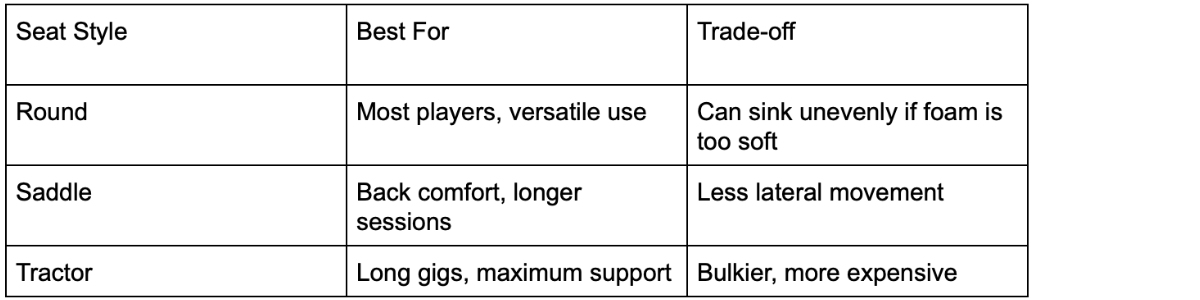
Round Seat
The classic drum throne seat — a circular cushion, typically 12–14 inches in diameter. Round seats are the most common and give you freedom to shift your weight and position slightly in any direction. They're versatile and work well for most players. The downside is that some players find them less stable for long sessions, particularly if the cushion is too soft and allows sinking on one side.
Look for a round seat with a firm, dense foam core. The fabric covering should be grippy (not slippery) so you stay put. A slightly contoured top — where the edges are slightly higher than the center — helps keep your weight centered.
Saddle Seat
Shaped like a bicycle or horse saddle, wider at the back and narrowing toward the front. Saddle thrones naturally position your hips in a forward-tilting stance, which opens up your hip angle and can reduce lower back strain. Many drummers find the saddle shape more comfortable during long playing sessions because it actively encourages better posture rather than relying on you to maintain it.
The saddle shape does reduce your ability to move laterally, so if you like to shift your weight from side to side during playing, a saddle might feel restrictive at first. It takes a session or two to adjust.
Tractor Seat
The tractor seat looks like exactly what it sounds like — a wider, contoured seat similar to a tractor or motorcycle seat. It supports more of your upper leg and provides the most surface area of the three styles. For heavier players or drummers with back issues, tractor seats often provide the most support over long sessions.
They're bulkier than round and saddle options, less portable, and tend to cost more. But if you're playing 2–3 hour gigs or long rehearsal sessions and back pain is a real issue, the extra support is worth it. Brands like Roc-n-Soc build their reputation largely on tractor-style designs that drummers swear by for heavy playing schedules.
How to Set Your Throne Height Correctly
This is the most important practical step — and the most commonly ignored. The correct throne height makes everything else on the kit easier to reach and control. The wrong height makes everything harder, even if you don't realize it's the problem.
The Thigh Angle Method
Sit on the throne with your feet flat on the floor (not on the pedals yet). Your thighs should be roughly parallel to the floor or angled very slightly downward — meaning your knees are at or just below hip level. This is the neutral position for most drummers and the starting point for any height adjustment.
If your knees are higher than your hips, the throne is too low. If your feet barely touch the floor or you're perching on the edge of the seat to reach your pedals, it's too high.
Finding Your Bass Drum Pedal Position
Once you're at a comfortable height, place your right foot on the bass drum pedal in your natural playing position. Your knee should be bent at roughly 90 degrees, with your heel down (for heel-down technique) or your foot at a natural angle (for heel-up). The pedal shouldn't require you to fully extend your leg or pull your foot back awkwardly to reach it — if it does, the throne may be in the wrong position relative to the pedal, or you need to slide the throne closer to or further from the bass drum.
Hi-Hat and Cymbal Reach
After pedal position feels right, check your reach to the cymbals. You should be able to reach your hi-hat comfortably without leaning or twisting. If your cymbals feel too far away at a comfortable throne height, it likely means the kit needs adjustment rather than the throne — cymbal stands and tom mounts are adjustable for reach. Understanding all the parts of your drum set and how they adjust will help you dial in your full setup around the correct throne position.
A Note on Height Preferences
Some drummers prefer to sit slightly higher or lower than the neutral position. Jazz drummers often sit higher to improve hi-hat reach and wrist angle. Rock drummers sometimes sit lower for a more "planted" feel and to maximize bass drum power. These are personal preferences built around technique and style — the neutral position is the best starting point, but don't be afraid to experiment once you're comfortable there.
What to Look for When Buying a Drum Throne
Beyond seat style and base type, there are a few specific features that separate a good throne from a frustrating one.
Weight Capacity
Check the manufacturer's weight rating. Budget thrones often have lower limits, and exceeding them leads to wobbly hardware and a seat that compresses and loses shape quickly. If you're on the heavier side, look for thrones rated for 250 lbs or more — they're built sturdier across the board and will last longer regardless of your weight.
Height Range
Most standard thrones adjust from about 17" to 24" at the seat. Taller players (over 6 feet) may need a throne with a higher maximum, or a spindle extension. Check the full height range before buying — this is a spec that doesn't always make it to the headline but matters a lot.
Cushion Firmness
This is subjective, but as a general rule: firmer is better for long sessions. A soft, pillowy throne feels nice for five minutes and then creates the kind of uneven support that leads to back soreness and wobbling. Look for high-density foam — not memory foam, which conforms to your body but gives you no rebound support.
Lock Mechanism
The height adjustment lock needs to hold firmly and not slip during playing. Spindle thrones should tighten securely enough that they don't rotate or drop under load. Hydraulic thrones should lock at the chosen height without creeping. Test this specifically if you're buying in-store: sit on it, bounce slightly, and check that the height doesn't shift.
Base Spread and Stability
Wider-set legs mean more stability but more floor footprint. Make sure your throne base doesn't conflict with your bass drum legs, hi-hat stand, or double pedal if you use one. On tight stage setups, a compact tripod is often more practical than a wide four-leg base, even if the four-leg is theoretically more stable.
Drum Throne Options at Every Budget
You don't need to spend a lot to get a functional, comfortable throne — but the cheapest options do have real trade-offs.
Under $50 — Budget Entry Level
At this price point you'll find basic round-seat tripod thrones with thin foam and lighter hardware. They're functional for beginners, but the foam compresses quickly and the height lock can slip over time. Fine for casual practice at home. Not ideal for regular gigging or 2+ hour sessions.
$50–$120 — Mid-Range
This is where you start getting genuinely solid thrones. Better foam density, more robust hardware, and more reliable height adjustment. Brands like Gibraltar, Pacific (PDP), and Pearl offer good options in this range that will last years of regular use. This is the sweet spot for most beginners and intermediate players.
$120–$250 — Upper Mid-Range
Saddle seats, tractor-style seats, hydraulic adjustments, and higher weight ratings enter the picture here. Roc-n-Soc builds some of the most respected thrones in this range — their Nitro seat is a go-to for touring drummers who want comfort without spending over $200. DW also has strong offerings here.
$250+ — Professional
At this level you're buying maximum build quality, premium foam, and usually a tractor or custom contoured seat. DW's 9000 series throne and Roc-n-Soc's Lunar models land here. These are lifetime-purchase items for working drummers — overkill for a beginner but worth it if you're playing regularly and back comfort is a priority.
Common Drum Throne Mistakes
Setting the Throne Too Low
Why it's wrong: A too-low throne drives your knees up above your hips. This cuts off blood flow to your lower legs, strains your hip flexors, and makes your bass drum pedal feel heavy and awkward to control. It's the most common throne mistake beginners make, often because lower "feels safer" or "more stable."
How to fix it: Follow the thigh-parallel method — your knees should be at or slightly below hip level. If your throne doesn't go high enough to achieve this, it may not be the right fit for your height, or you need a spindle extension.
Setting the Throne Too High
Why it's wrong: If you're perching on the front edge of the seat to reach your pedals, you've lost the stable base that the throne is supposed to provide. Your weight is unsupported, your balance is precarious, and you'll be generating less power from your bass drum foot because your leg is overextended.
How to fix it: Lower the throne until your foot can sit naturally on the bass drum pedal with your knee at a comfortable bend. If you feel like you're falling backward at the correct height, move the throne slightly closer to the bass drum before adjusting the seat down.
Ignoring the Throne in Your Setup Routine
Why it's wrong: If you adjust your kit without first locking in your throne position, every other measurement is relative to a position you haven't confirmed yet. Cymbal heights, snare height, tom angles — all of it flows from where you're sitting.
How to fix it: Set the throne first, every time. Sit in your natural playing position and let the throne height be the anchor point from which you adjust everything else. Thinking through your full drum set setup with this approach makes every adjustment faster and more consistent.
Buying the Cheapest Option Without Checking Foam Quality
Why it's wrong: Very cheap thrones use low-density foam that compresses within months of use. Once the foam goes flat, the throne feels hard, your body sits unevenly, and back soreness creeps in. You end up buying a replacement sooner than if you'd spent a little more initially.
How to fix it: Press firmly on the seat in-store or find reviews that specifically mention long-term foam durability. $70–$100 buys genuinely better foam than $30 thrones. If budget is tight, a used mid-range throne is often a better value than a new budget one.
Letting the Height Slip During Playing
Why it's wrong: If your throne height slowly sinks during a session, your pedal dynamics shift without you realizing it — your bass drum technique gradually changes to compensate for the lower seat position. It's subtle but real, and it interrupts the muscle memory you're trying to build.
How to fix it: Check and tighten the height lock before every session. Spindle thrones in particular can loosen over time — it takes 10 seconds to check and could save you a half-hour of confused troubleshooting later.
Beginner Tips for Throne Setup and Comfort
- Set the throne first, always. Before you touch a cymbal stand or tom mount, sit on your throne and lock in the height. Everything else in your kit setup flows from your seated position.
- Give yourself 15 minutes to break in a new throne. Cushions settle under your body weight during the first few sessions. Your "correct" height after 15 minutes of sitting may be slightly different than when you first sat down. Adjust accordingly.
- Mark your height with tape. Once you've found the right height, put a small piece of tape or a permanent marker line on the post. Next session, you can set it in 5 seconds rather than readjusting from scratch.
- Try the throne at a drum shop, not just online. Throne comfort is highly personal. If you have access to a music store, sit on a few different styles before committing. A 5-minute test drive tells you more than any review.
- Don't skip back stretches. Even a perfect throne setup doesn't replace the need for regular stretching. Drumming uses your lower back heavily. A simple post-practice routine of hip flexor and lower back stretches will make a noticeable difference if you play long sessions regularly.
- Check stability on carpet vs. hardwood. Throne legs can slide on hardwood floors, especially during energetic playing. If your practice space is uncarpeted, a drum rug (placed under your entire setup) is a cheap fix that also stops the bass drum from creeping forward.
Final Thoughts
A drum throne isn't glamorous gear, and it doesn't show up in anyone's "dream kit" photos. But ask any working drummer who's spent time on a bad one and they'll tell you it's the first thing they invest in when they're serious about playing.
The right throne height alone can fix posture problems, improve pedal technique, and make a two-hour rehearsal feel manageable instead of uncomfortable. The right seat style can mean the difference between playing with a relaxed back and leaving practice sessions in pain. And the right stability means one less thing pulling your attention away from actually playing.
Start with a mid-range tripod throne in the $70–$120 range, choose a seat style that suits your body type, set the height using the thigh-parallel method, and adjust from there. It doesn't need to be complicated — and once you've found what works, it becomes one of those things you never have to think about again.
FAQ
What height should a drum throne be set at?
The standard starting point is to set the throne so your thighs are roughly parallel to the floor when your feet are flat — meaning your knees are at or just below hip level. From there, adjust based on your pedal comfort and reach. Taller players will typically sit a little higher; shorter players a little lower. The key is that your foot should sit naturally on the bass drum pedal without overextending your leg.
What's the difference between a drum throne and a drum stool?
They're the same thing — "drum throne" is the term most commonly used by manufacturers and drummers, while "drum stool" is an older and more casual term. Both refer to the adjustable seat a drummer sits on while playing.
Is a saddle drum throne better than a round one?
For many players, especially those who play long sessions or have lower back sensitivity, saddle thrones are more comfortable because they naturally tilt your hips forward and open up the hip angle. Round thrones are more versatile and feel familiar if you're used to a standard seat. Neither is objectively "better" — it's a personal fit decision. Try both if you can before buying.
How much should I spend on a drum throne?
For a beginner, $70–$120 gets you a solid, durable throne that will last years. Under $50 is functional but often involves foam that compresses quickly or a height lock that slips. Over $150 gets you premium build quality and more seat style options — worth it if you play frequently or have back comfort concerns, overkill if you're just starting out.
Can a bad drum throne affect my playing?
Yes — significantly. A throne that's too low, too high, or unstable changes your posture, your pedal reach, and your balance on every stroke. It can cause fatigue and back soreness that you'd otherwise avoid, and it can subtly throw off your bass drum dynamics and hi-hat control without you realizing the cause. It's one of the most underrated equipment decisions a drummer makes.
How do I stop my drum throne from sinking during playing?
Tighten the height lock mechanism before every session — spindle thrones can loosen over time. If tightening doesn't hold, the threaded post or lock may be worn and the throne needs replacing. As a temporary fix, some drummers add a small rubber washer to the spindle to increase friction. A quality mid-range throne shouldn't have this problem if the lock is properly maintained.