To play a blast beat, alternate rapid single strokes between your kick drum and snare while your other hand keeps the same fast pulse going on a crash or ride cymbal, sustaining that pattern at high speed for multiple bars without breaking time.
It sounds simple written out like that, and rhythmically it is — a blast beat is really just a single stroke pattern split across your limbs. What makes it hard is speed, endurance, and control at tempos most drummers never practice at outside of this specific technique. Grindcore and death metal drummers built entire careers on this pattern, and it shows up constantly in black metal, thrash, and metalcore too.
In this guide, we'll cover the three main blast beat variations you'll actually encounter, walk through a step-by-step process for building the pattern up from a manageable tempo, show you how to build the speed and stamina blast beats demand, flag the mistakes that make a blast beat fall apart under pressure, and give you practice tips that get this technique under your hands faster and safer. By the end you'll have a clear path from "I can't play this at all" to holding a blast beat steady for an entire song section.
When you’re done reading, you will be familiar with:
- What Is a Blast Beat?
- The Three Main Blast Beat Variations
- Step-by-Step: How to Play a Basic Blast Beat
- Building Speed and Endurance
- Where Blast Beats Show Up in Metal
- Common Mistakes When Playing Blast Beats
- Beginner Tips for Learning Blast Beats
- Conclusion
- FAQ
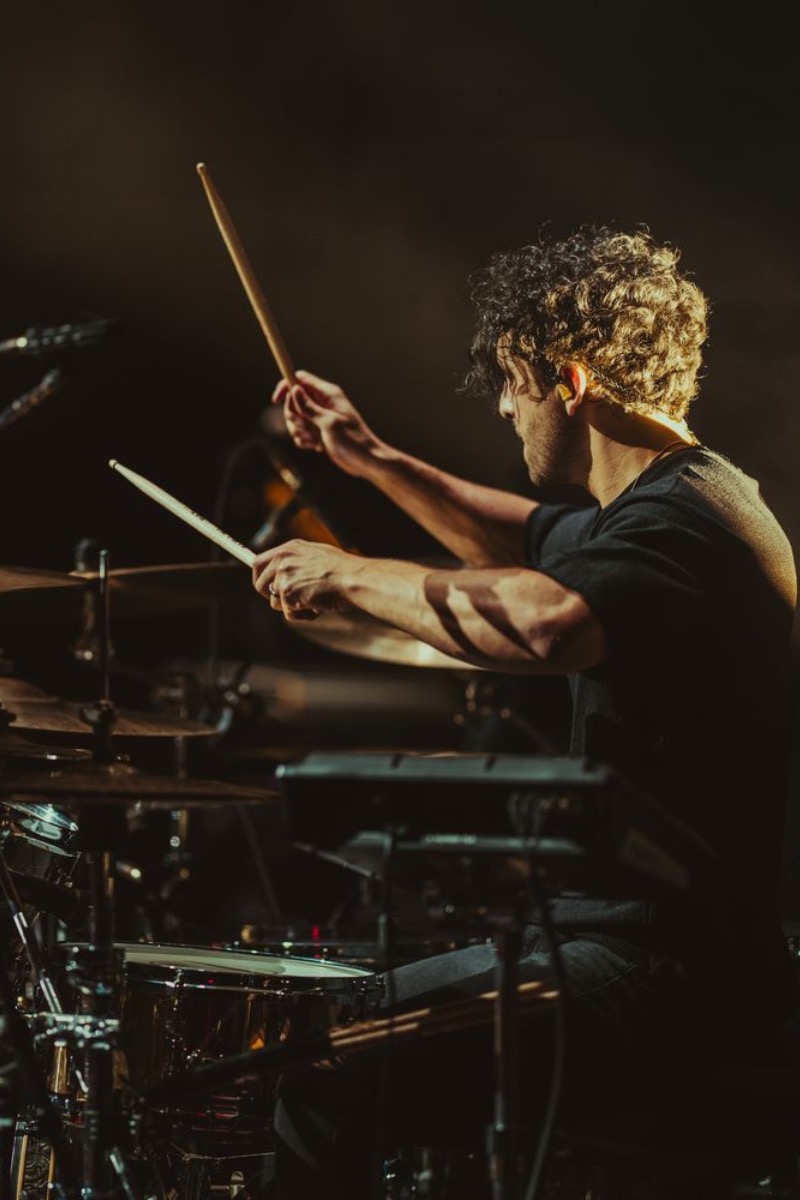
What Is a Blast Beat?
A blast beat is a fast, sustained drum pattern built from single strokes distributed across the kick, snare, and a cymbal (usually a crash or ride), all landing on the same subdivision at the same time. Instead of the kick and snare trading off on different beats the way they do in a standard rock groove, everything hits together in a relentless, machine-gun pulse.
The technique first showed up in hardcore punk and early grindcore in the 1980s — bands like Napalm Death are often credited with popularizing it — and it quickly became a defining feature of extreme metal. Today you'll hear blast beats across death metal, black metal, grindcore, metalcore, and even in brief bursts within more mainstream heavy music, used as a sudden jolt of intensity.
Unlike most grooves that rely on independence between limbs, a blast beat's difficulty comes almost entirely from speed and stamina. Your hands and feet are doing something rhythmically simple — they just have to do it very fast, very evenly, for a long time.
The Three Main Blast Beat Variations
"Blast beat" isn't one single pattern — it's a family of techniques that all produce the same wall-of-sound effect through different limb combinations. Knowing the differences helps you pick the right one for your hands, your kit, and the song.
Traditional (Alternating) Blast Beat
In the traditional blast beat, your kick and snare alternate — kick, snare, kick, snare — while one hand plays a steady stream of the same subdivision on the crash or ride. The snare and cymbal hand typically move together, so you're really coordinating two things: the alternating kick/snare pulse under one hand's steady cymbal pattern.
CR|x-x-x-x-x-x-x-x-|
SD|-o-o-o-o-o-o-o-o|
BD|o-o-o-o-o-o-o-o-|
This is usually the first variation drummers learn because the foot pattern is straightforward — a steady single-stroke pulse on the kick, same as a fast single stroke roll on a practice pad.
Hammer (Chokey) Blast Beat
The hammer blast beat keeps both hands playing the snare and crash/ride together in unison on every subdivision, while the kick drum fills in the same steady pulse underneath. Instead of alternating, your hands "hammer" the snare and cymbal at the same time on every hit.
CR|x-x-x-x-x-x-x-x-|
SD|o-o-o-o-o-o-o-o-|
BD|o-o-o-o-o-o-o-o-|
This version tends to feel more physically demanding on the hands since both are striking together rather than trading off, but many drummers find the coordination easier because there's no alternating pattern to track — everything lines up on the same beat.
Gravity Blast
The gravity blast is a technique rather than a strict pattern — it uses the rebound and gravity of the stick against the rim of the snare or a second cymbal to generate extra strokes without additional arm movement, letting one hand produce what sounds like two hands' worth of speed. It's an advanced technique that takes real time to develop and is often used to push blast beat tempos beyond what traditional or hammer technique can sustain.
Most beginners should master the traditional and hammer variations first. The gravity blast is worth exploring once you're already comfortable playing blast beats for extended periods, since it changes your entire stick grip and motion.
Step-by-Step: How to Play a Basic Blast Beat
Start with the traditional (alternating) blast beat — it's the most widely used version and the best entry point for learning the technique safely.
1. Warm Up With Single Strokes
Before touching the kit, play single stroke rolls on a practice pad for a few minutes. A blast beat is fundamentally a single stroke pattern split across your limbs, so your hands need to already be comfortable with fast, even single strokes. If single strokes still feel shaky, spend more time with our drum rudiments guide before adding the speed and coordination a blast beat demands.
2. Isolate the Kick and Snare Alternation
Set a slow metronome — around 80 BPM in eighth notes is a reasonable starting point. Play kick, snare, kick, snare in a steady alternating pattern with no cymbal yet. This is the core engine of the traditional blast beat, and it needs to feel completely even before you add anything else.
3. Add the Cymbal Pattern
Bring in a steady stream on the crash or ride with whichever hand lines up with the snare. Both that hand and the snare foot pattern should land together — you're essentially playing the same single stroke pattern with two limbs simultaneously while the opposite hand and foot fill the gaps.
4. Practice in Short Bursts
Blast beats are physically taxing. Play the pattern for four or eight bars, then stop and rest. Trying to sustain it for minutes at a time before your muscles are conditioned is how bad habits and injuries start.
5. Gradually Increase Tempo
Once the pattern feels clean and relaxed at your starting tempo, nudge the metronome up in small increments — five BPM at a time. Don't move up until the current tempo feels completely under control. Most metal blast beats sit well above 180 BPM in eighth notes (or the sixteenth-note equivalent at half that tempo), but there's no rush to get there.
6. Try the Hammer Variation
Once the traditional blast beat is solid, work through the same process with the hammer variation — both hands hitting together on the snare and cymbal, kick filling in underneath. Having both versions under your hands gives you flexibility depending on the song and your own physical comfort.
Building Speed and Endurance
Speed on a blast beat comes from relaxed technique, not tension. Gripping the sticks tighter or hitting harder as you speed up almost always backfires — it tires you out faster and makes the pattern less even, not more.
- Use rebound, not muscle. Let the stick bounce off the drum head naturally rather than lifting and forcing every stroke. This is the same principle behind a clean single stroke roll, just applied at higher intensity.
- Train your feet separately. If you're using a double kick pedal or two feet on separate pedals for the kick pattern, spend dedicated practice time on foot speed alone. Our double bass drum pedal guide covers foot technique and exercises that transfer directly to blast beat stamina.
- Build stamina gradually. Add a few extra bars to your practice runs each week rather than jumping straight to song-length bursts. Endurance for blast beats is built the same way cardio fitness is — incrementally, not all at once.
- Rest between reps. Blast beats fatigue your forearms and ankles quickly. Short, focused practice sessions with real rest in between beat one long, grinding session that just reinforces tension and fatigue.
Where Blast Beats Show Up in Metal
Blast beats aren't used constantly through a song — they're typically deployed for specific sections where the music calls for maximum intensity.
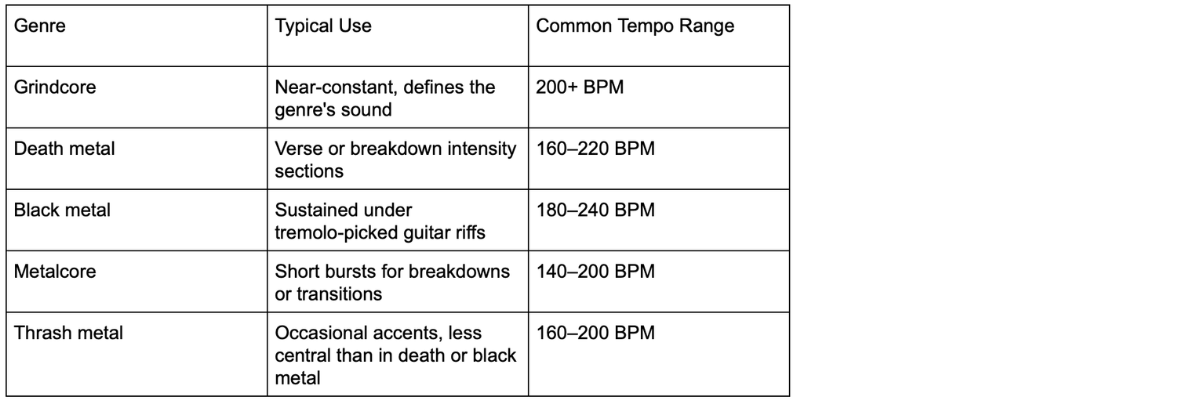
Listening to records in each of these genres will train your ear for how blast beats function musically — as a texture and an intensity tool, not just a technical exercise.
Common Mistakes When Playing Blast Beats
These are the mistakes that show up most often when drummers are first learning this technique.
Tensing Up as Speed Increases
Why it's wrong: Gripping harder and hitting with more force as tempo climbs burns out your muscles fast and actually caps how quickly you can play. Tension is the enemy of speed, not the solution to it.
How to fix it: Focus on staying loose and using stick rebound at every tempo, including slow practice tempos. Build the relaxed technique first, then add speed — not the other way around.
Uneven Kick and Snare Timing
Why it's wrong: If your kick and snare alternation isn't perfectly even, a blast beat starts to sound like a stumble instead of a wall of sound. At high speed, small timing inconsistencies become very audible.
How to fix it: Slow down and isolate just the kick/snare alternation against a metronome until it's metronomically even before adding the cymbal layer back in.
Practicing at Full Speed Too Soon
Why it's wrong: Jumping straight to fast tempos before your technique is solid reinforces sloppy habits and significantly increases injury risk in the wrists and forearms.
How to fix it: Build up gradually from a comfortable tempo. There's no shortcut here — every fast, clean blast beat you hear on a record was built the same slow way.
Ignoring Foot Technique
Why it's wrong: Drummers often focus entirely on hand speed and treat the kick pattern as an afterthought, which caps how fast and how long you can sustain the pattern.
How to fix it: Dedicate specific practice time to foot speed and stamina, whether you're playing single kick, double kick, or a double pedal setup. Foot technique is just as trainable as hand technique.
Beginner Tips for Learning Blast Beats
- Start slower than feels necessary. A blast beat at 80 BPM might feel almost too easy at first — that's exactly the point. Speed comes after control, not before it.
- Use a metronome for every practice rep. Blast beats fall apart quietly at first — a metronome catches drift before it becomes a habit.
- Practice both traditional and hammer variations. Different songs and different drummers favor different versions. Having both under your hands makes you more versatile.
- Record yourself regularly. Speed and evenness are hard to judge accurately in the moment. A recording exposes rushing, dragging, or uneven dynamics immediately.
- Take real rest between practice bursts. Blast beats are one of the most physically demanding techniques in drumming. Pushing through fatigue trains bad habits, not good ones.
- Listen to drummers known for this technique. Studying players from grindcore, death metal, and black metal records gives you a reference for tone, dynamics, and musical placement that practice alone won't teach you.
Conclusion
A blast beat is one of the more physically demanding techniques you'll add to your drumming, but it isn't rhythmically complicated — it's a single stroke pattern pushed to speed and split across your limbs. Build it slowly, keep your technique relaxed, and let your endurance grow over weeks rather than forcing it in one session. Once it's solid, you'll have a tool that instantly adds intensity to metal, grindcore, or any heavy section that calls for it.
FAQ
How fast do you need to play a blast beat?
There's no single required speed — grindcore and black metal often push well past 200 BPM, while metalcore breakdowns might use a blast beat closer to 140–160 BPM. Start slow and build speed gradually rather than chasing a specific number early on.
Do I need a double bass pedal to play blast beats?
No. Many classic blast beats use a single kick drum with one pedal, keeping the same steady pulse as the snare and cymbal. Double bass setups are common in extreme metal but aren't required to learn or play the core technique.
What's the difference between a blast beat and a double bass roll?
A double bass roll uses two feet (or a double pedal) to play a fast, sustained pattern on the kick drum alone, often under a separate hand pattern. A blast beat distributes the same fast pulse across the kick, snare, and cymbal together, creating a fuller wall-of-sound effect rather than just a fast kick pattern.
Can blast beats cause injury?
Like any high-speed, high-repetition technique, poor form and pushing tempo too quickly can lead to strain in the wrists, forearms, and ankles. Building speed gradually with relaxed technique is the best way to avoid this.
Which bands are known for blast beats?
Napalm Death is widely credited with popularizing the technique in grindcore. It's also a defining feature of death metal and black metal drumming broadly, used by countless bands across those genres rather than being tied to just one act.
Is the gravity blast harder to learn than a traditional blast beat?
Yes, generally. The gravity blast relies on a specific grip and rebound technique that takes time to develop and feels unfamiliar even to drummers who already play traditional or hammer blast beats comfortably. It's worth learning once your basic blast beat technique is solid, not before.