A double bass drum pedal attaches to a single bass drum and gives you two beaters — one driven by your right foot, one driven by your left — so you can play kick drum patterns with both feet independently. To set one up, you clamp the primary pedal to the bass drum hoop the same way you would a single pedal, then connect the secondary pedal via a driveshaft that runs alongside the kit to a slave beater on the same drum head.
That's the mechanism. The bigger picture is that double bass playing is a genuine technique discipline — not just "two feet going fast" — and learning it properly from the start will save you months of developing bad habits that are hard to undo later. Done right, double bass opens up grooves, fills, and patterns that are simply impossible with one foot. Done poorly, it leads to stiff, uneven playing and a lot of frustration.
In this guide, we'll walk through how a double pedal works and what to look for when buying one, how to set it up on your kit, heel-down vs. heel-up technique, beginner exercises for building foot coordination and speed, the most common double bass mistakes, and tips for making real progress. Whether you're just curious about double kick or actively working on it, this guide gives you the full picture.
When you’re done reading, you will be familiar with:
- What Is a Double Bass Drum Pedal?
- Single vs. Double Pedal: When to Make the Upgrade
- How to Set Up a Double Bass Drum Pedal
- Double Bass Technique Fundamentals
- Heel-Down vs. Heel-Up
- Beginner Exercises for Double Bass
- Common Double Bass Mistakes
- Beginner Tips
- What to Look for When Buying a Double Pedal
- Final Thoughts
- FAQ
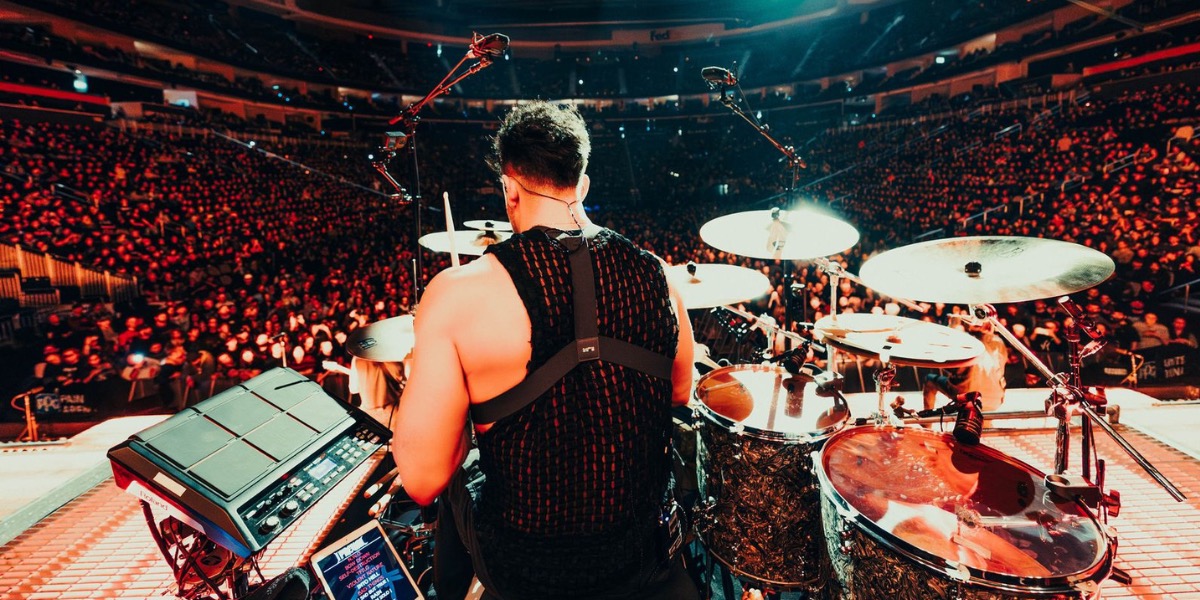
What Is a Double Bass Drum Pedal?
A double bass drum pedal is a mechanism that lets one drummer play two beaters on a single bass drum using both feet. It consists of:
- Primary pedal (right side): Clamps to the bass drum hoop, directly in front of the drum. This is the main footboard, played by the right foot.
- Slave pedal (left side): Positioned where your left foot would otherwise rest on the hi-hat pedal. Connected to the primary unit by a driveshaft — a metal rod that runs along the floor in front of your kit.
- Driveshaft: Transfers the motion of the slave pedal to a second beater arm on the bass drum. When your left foot presses the slave footboard, the driveshaft turns and drives the left beater into the drum head.
- Two beaters: Both hit the batter head of the same bass drum. The result sounds identical to two separate bass drums from the listener's perspective.
The alternative to a double pedal is a true double bass drum setup — two full bass drums side by side, each with its own single pedal. This is what you see on large rock and metal kits from the 1970s and 80s (John Bonham, for example, often used two 26-inch kick drums). The double pedal achieves the same result with one drum, which is more practical for most drummers. The sound is essentially the same since both beaters hit the same head.
Single vs. Double Pedal: When to Make the Upgrade
A double pedal is a specialized tool, not an automatic upgrade. It makes sense when the music you're playing genuinely requires it — not just because it looks impressive or because a favorite drummer uses one.
Good reasons to add a double pedal:
- You're playing metal, hard rock, or progressive styles where fast, alternating kick patterns are part of the core vocabulary.
- You've developed solid single-bass technique — consistent timing, good dynamics, clean ghosting on the kick. A double pedal with weak single-foot fundamentals just doubles your problems.
- You want specific grooves and fills that alternate feet or use the left foot to add kick notes around backbeats.
Reasons to wait:
- You're still building basic coordination between your hands and single foot
- The music you're playing doesn't call for rapid alternating kick patterns
- Your single-bass technique isn't consistent yet
If you can play a clean, even single-bass rock beat for several minutes with dynamics and control, you're probably ready to start exploring double bass. If your single-foot control is still variable, the double pedal won't fix it — it'll just expose it in both feet.
How to Set Up a Double Bass Drum Pedal
Getting the physical setup right matters. A poorly positioned double pedal creates mechanical inefficiency and makes even basic patterns harder than they need to be.
1. Clamp the Primary Pedal to the Bass Drum
Slide the clamp jaw onto the bass drum hoop and tighten it so the pedal sits directly in front of the drum's center. The beater should be positioned to strike the batter head at roughly the center-to-lower-center of the head. Too high and the beater brushes the head; too low and you're hitting below the optimal strike zone.
2. Position the Slave Pedal
Place the slave pedal to the left of the hi-hat stand. This shifts the hi-hat stand further left than its standard position to make room — you'll need to adjust your overall kit setup. How far left the slave pedal sits depends on your leg length and comfort. Your left foot should reach it comfortably without straining your hip or thigh.
3. Connect the Driveshaft
The driveshaft runs from the primary pedal (right side) across to the slave beater mechanism on the bass drum. It connects via a universal joint at each end. Lay it out flat and connect both ends, then check that the driveshaft doesn't bind or flex when the slave pedal is pressed. A binding driveshaft creates lag between your foot motion and the beater strike, which kills your timing.
4. Adjust the Beater Angle
Both beaters should hit at the same angle and strike the head at the same point. If one beater is angled differently than the other, your two feet will produce different sounds — one will hit harder, one softer — and your patterns will sound uneven even when your footwork is accurate. Take the time to set both beaters to the same angle.
5. Adjust Spring Tension
The spring tension controls how quickly the beater snaps back after striking the head. Most pedals have a tension adjustment knob on the spring. Set both pedals to identical tension — this is important. Different spring tensions on the two pedals means the rebound feels different under each foot, which makes developing even technique much harder.
6. Reposition the Hi-Hat
With the slave pedal occupying the space where the hi-hat pedal usually sits, your hi-hat stand needs to move further left. You'll also now need to open and close the hi-hat with your left foot, but less frequently — in double bass playing, the left foot is primarily on the slave pedal. Many double-bass players use a hi-hat riser or trigger system so the hi-hat stays at a usable position without the foot doing continuous hi-hat work.
Double Bass Technique Fundamentals
Playing double bass well is about coordination and consistency, not speed. Speed comes later, once the fundamentals are embedded. Rush the speed and you build in sloppiness that gets harder to undo the faster you go.
The fundamental goal is to make both feet interchangeable in feel and dynamics. Your right foot has likely been playing kick drum for your entire drumming life. Your left foot hasn't been asked to do much beyond hi-hat pedaling. The first phase of double bass training is building the left foot up to match the right.
Key principles:
- Even dynamics. Both feet should hit the head with the same force and produce the same volume. Listen critically — most beginners hit harder with the right foot and ghost the left. Record yourself and listen back; your ears catch things your playing doesn't notice.
- Even timing. Alternating kick notes should be exactly evenly spaced. Use a metronome. If you can't play a clean alternating eighth-note pattern at 60 BPM, don't try to play it at 120.
- Relaxation. Tense legs lose speed and endurance fast. The motion should come from the ankle and foot, not the whole leg. Raising the entire thigh for every kick stroke is a recipe for fatigue within minutes.
Heel-Down vs. Heel-Up
These are the two main approaches to bass drum technique, and both are used for double bass playing.
Heel-Up
The ball of the foot rests on the pedal footboard, heel raised. Power comes from the ankle and a slight downward leg drive. Heel-up is the go-to technique for speed and volume — it lets you generate more force and plays faster notes more easily. Most metal and hard rock drummers play heel-up because the music demands both speed and impact. The trade-off is that fine dynamic control is harder, and sustained heel-up playing is more tiring than heel-down.
Heel-Down
The entire foot rests flat on the footboard, heel touching the board. Motion comes from flexing the ankle to push the toe down. Heel-down produces a softer, more controlled note — useful for lighter genres, quiet kick notes, or ghosting the bass drum under a groove. It's also less tiring for long playing sessions. Most jazz drummers play heel-down on a single kick; heel-down double bass is less common but entirely valid for moderate tempos.
In practice, many drummers switch between heel-up and heel-down within a performance depending on the dynamic needs of the music. Building both techniques gives you the full range.
Beginner Exercises for Double Bass
These exercises build the coordination and consistency that double bass requires. Work through them in order — each one prepares you for the next.
Exercise 1: Single-Stroke Alternating Eighth Notes
Set a metronome to 60 BPM. Play: right, left, right, left — one note per click, alternating feet throughout. No hand pattern yet. Just feet. Listen for evenness of volume and spacing. Do this for 5 minutes without stopping. When it feels completely automatic at 60, bump the metronome to 65 and repeat. This exercise alone — done consistently at slow tempos — builds more usable double bass technique than any amount of fast sloppy playing.
Exercise 2: Eighth Notes with a Basic Hand Pattern
Once the alternating feet are solid at moderate tempo, add a simple hand pattern on top. Right hand plays the hi-hat on every eighth note; left hand hits the snare on beats 2 and 4. Feet continue alternating kick eighth notes. This four-limb pattern is the double bass equivalent of the basic rock beat — it trains the coordination you'll actually use in real playing.
Exercise 3: Sixteenth-Note Kick Patterns
Now bring the feet into sixteenth-note territory (four notes per beat at your chosen BPM). Start at 50 BPM and work up slowly. A clean sixteenth-note double bass roll at 80 BPM is worth far more than a sloppy roll at 150. The pattern: R L R L R L R L — four cycles per measure in 4/4 time. Hand pattern optional to start; add it once the feet are locked in.
Exercise 4: Doubles and Singles Mixed
This one builds musical phrasing rather than raw speed. Mix single-foot notes (just right foot) with double notes (right-left or left-right pairs) within a measure. For example: kick on beat 1 (single), kicks on the "and" of 2 and beat 3 (double), kick on beat 4 (single). This kind of rhythmic variety is what double bass sounds like in actual rock and metal grooves — not just a continuous roll, but kick patterns with different groupings.

Common Double Bass Mistakes
Rushing Straight to Speed
Why it's wrong: Fast and sloppy doesn't build technique — it just bakes sloppiness in at a faster rate. Your motor patterns form around whatever you practice, and practicing inaccurate patterns at high speed teaches your feet to play inaccurately at high speed. The speed you're trying to achieve will actually arrive faster if you build it slowly and correctly.
How to fix it: Use a metronome. Start at a tempo where both feet are completely even and comfortable. Add 5 BPM per session, only once the previous tempo is clean. This feels frustratingly slow at first but produces real, usable speed within a few weeks.
Neglecting the Left Foot
Why it's wrong: The left foot has spent years doing very little (mostly hi-hat closing). It has far less coordination and strength than the right. Ignoring this gap by always leading with the right foot produces uneven patterns where the left foot's notes are quieter, later, or both.
How to fix it: Practice leading with the left foot. Run the same exercises left-right instead of right-left. Specifically practice single-foot patterns with the left foot alone to build its independence and strength. This feels awkward for a while — that's expected and normal.
Mismatched Spring Tension Between Pedals
Why it's wrong: If the primary and slave pedals have different spring tensions, each foot is working against a different resistance. You'll unconsciously compensate, and the compensation creates inconsistency that's very hard to hear or identify as a setup issue rather than a technique issue.
How to fix it: Match the spring tension on both pedals at setup. Many players set both to the lightest usable tension — enough rebound to assist the foot but not so heavy it creates resistance at fast tempos.
Burying the Beater in the Head
Why it's wrong: Pressing the beater into the head after striking (not letting it rebound) kills the volume and muffles the sound. It also slows your foot down dramatically because the beater has to travel away from the head before it can come back and strike again.
How to fix it: Let the beater rebound freely off the head after each stroke. The motion should be a strike and a return, not a push. Think of it like a snare stroke — you don't press the stick into the head; you let it bounce back. The same applies to your feet.
Skipping the Warm-Up
Why it's wrong: Double bass playing puts real strain on the ankles, calves, shins, and hip flexors. Jumping straight into fast playing on cold muscles increases injury risk and reduces the quality of your playing in the session.
How to fix it: Before any double bass session, spend a few minutes on slow, relaxed alternating kick at very low volume — just waking the muscles up. Then run through Exercise 1 at a comfortable tempo before pushing into harder patterns.
Beginner Tips
- Use a drum mat under the slave pedal. The slave pedal tends to slide on hard floors. A non-slip mat (or a full drum rug under the kit) keeps the slave pedal in position and stops you from fighting your setup while you're trying to concentrate on technique.
- Record your kick drum in isolation. Put on headphones, record just the bass drum channel (or use a metronome app and record on your phone near the kick), and listen back. The evenness issues you can't hear in real-time playing become very obvious on playback.
- Practice without hands first. Run your kick patterns with your feet alone before adding any hand pattern. This isolates the challenge and lets your feet develop without the distraction of coordinating four limbs simultaneously.
- Don't overlook your single bass drum technique. Solid single-foot control — dynamics, ghosting, foot control at slow tempos — is the foundation that double bass builds on. If you don't have it on one foot, two feet won't help. The work you've put into understanding your kick drum's sound and response pays dividends when you start working both feet.
- Be patient with the left foot. It typically takes 3–6 months of consistent practice before the left foot starts to feel remotely as natural as the right for kick drum work. That timeline is normal. Don't judge your progress by week two.
- Check your beater angle regularly. Driveshafts can shift slightly over time, changing the slave beater's angle relative to the primary. Once a month, visually check that both beaters sit at the same angle and hit the same point on the head.
What to Look for When Buying a Double Pedal
Double pedals vary significantly in quality and price. Here's what actually matters:
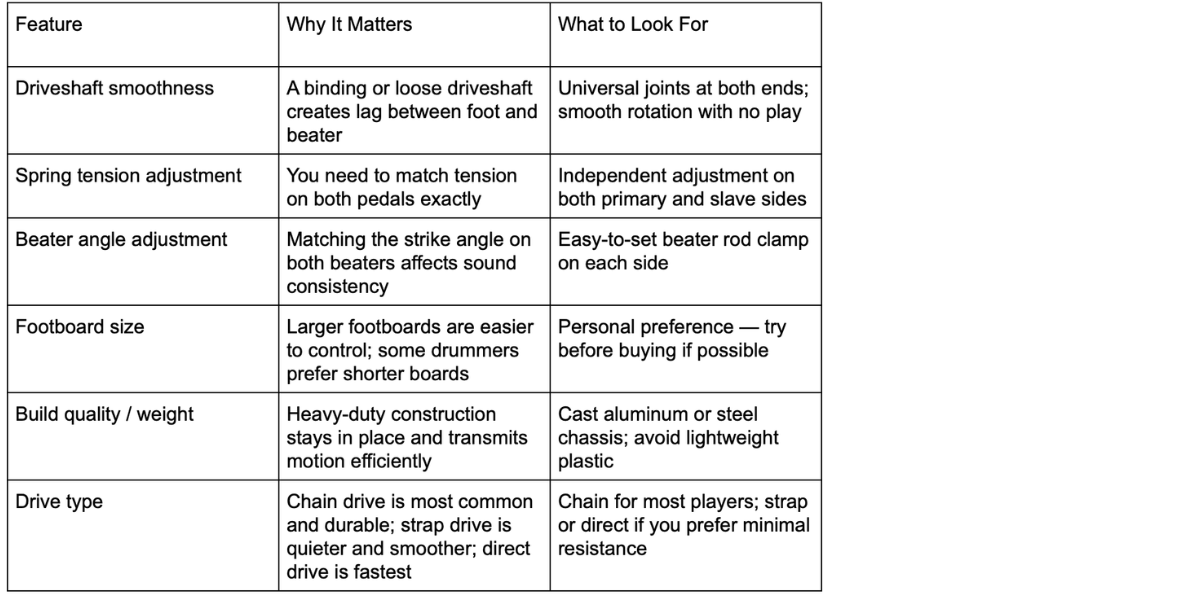
Reliable brands at different price points: DW (5000 and 9000 series), Pearl (Eliminator), Tama (Speed Cobra, Iron Cobra), and Gibraltar all make solid double pedals. Entry-level models from these brands are usable and will last through years of practice. The ultra-premium models add refinements in feel and adjustability that you'll appreciate more once your technique is developed enough to notice them.
Final Thoughts
Double bass is one of the most satisfying techniques to develop on the kit, but it demands the same approach as every other drumming skill: slow it down, make it even, and build from there. The players who develop fast, musical double bass technique aren't the ones who tried to play at full speed from day one — they're the ones who spent weeks getting their alternating eighth notes perfectly even at 60 BPM, then 70, then 80, building a foundation that held up at every tempo above it.
Set up the pedal carefully, match the spring tension on both sides, and start with simple patterns at slow tempos. The speed and complexity you're working toward will arrive naturally once the foundation is there.
FAQ
Do I need two bass drums or can I use one with a double pedal?
One bass drum with a double pedal is the standard for most modern drummers. The sound from the listener's perspective is essentially the same — both beaters hit the same head. True double bass drum setups (two drums) are still used by some players but require significantly more kit space and setup complexity.
How long does it take to learn double bass?
Getting basic alternating eighth notes even and controlled typically takes 2–4 weeks of consistent daily practice. Playing usable musical double bass patterns — clean sixteenth-note runs, groove-based patterns in actual songs — takes most players 3–6 months. Speed development is ongoing and varies widely by individual.
Can I learn double bass without a teacher?
Yes, though having someone watch your technique occasionally helps catch bad habits early. The main risk of self-teaching is embedding technical problems (burying the beater, tension in the leg, uneven footwork) that slow your progress. Video recording yourself and watching it critically compensates for a lot of what in-person instruction provides.
Does double bass work on an electronic drum kit?
Yes. Electronic kits with mesh kick drum pads support double pedals the same way acoustic kits do. The slave pedal attaches to the kick pad the same way. Some electronic kits include a dedicated double-kick module; others use a trigger on the existing pad. Check your kit's specifications before buying a double pedal.
Is double bass only for metal?
No — double bass is most associated with metal and hard rock because of how those genres use rapid alternating kick patterns, but the technique appears in progressive rock, jazz fusion, drum and bass, and even some gospel and R&B playing. Any music that benefits from complex or rapid bass drum patterns can make use of double bass technique.
Will a double pedal damage my bass drum head?
Not if it's set up correctly. Two beaters strike the head in different positions, distributing wear across a larger area compared to a single beater. The same rules apply as for any bass drum playing — use an appropriate batter head and replace it when it shows significant wear or denting around the strike zone.