To practice drums effectively, combine a short physical warm-up with targeted exercises that isolate the specific skills you're working on — rudiments, coordination, independence, or songs — and always use a metronome, starting slower than feels necessary and only increasing tempo once the pattern feels completely controlled at the current speed.
That's the framework, but most drummers — beginners especially — sit down at the kit without any clear structure and just play around until the time runs out. That kind of session can be fun, but it rarely produces real improvement. The difference between drummers who improve quickly and those who stay stuck at the same level almost always comes down to one thing: how they practice, not how long.
In this guide, we'll cover how to warm up your hands and body properly before playing, the most useful drum exercises for building coordination, speed, and independence, how to structure a practice session that actually gets you somewhere, common practice mistakes that slow you down, and tips for making faster progress even with limited time. By the end, you'll have a clear, actionable practice plan you can use starting from your very next session.
When you’re done reading, you will be familiar with:
- Why Practice Structure Matters
- Drum Warm-Ups: How to Prepare Your Hands and Body
- Core Exercises for Beginner Drummers
- Building Coordination and Independence
- How to Structure a Practice Session
- Common Practice Mistakes That Slow You Down
- Tips for Getting Better Faster
- Final Thoughts
- FAQ

Why Practice Structure Matters
Random, unstructured playing is the most common reason drummers plateau. When you sit down and just jam without a goal, you naturally gravitate toward things you're already good at — the patterns that feel comfortable, the tempos you can already nail, the beats you know by heart. It feels productive because you're playing, but you're not actually making your weaknesses stronger.
Structured practice works differently. It deliberately puts you in situations where you struggle just a little — just outside your current comfort zone — which is exactly where improvement happens. Fifteen focused minutes with a metronome, working on a specific weakness, will advance your drumming faster than an hour of playing whatever comes naturally.
It also applies to physical preparation. Playing without warming up doesn't just risk injury — it means your first 10–15 minutes of playing are below your actual ability level, because your muscles haven't reached their optimal coordination and responsiveness yet. A good warm-up shortens that window and sets you up to practice at your real level from the first stroke.
Drum Warm-Ups: How to Prepare Your Hands and Body
A proper drum warm-up does two things: it loosens your muscles and joints to reduce injury risk, and it wakes up the neural pathways that control stick control and coordination. It doesn't need to take long — 5 to 10 minutes is plenty for most practice sessions. Here's what to include:
Stretch Before You Pick Up the Sticks
Drumming is a physical activity, and your wrists, forearms, shoulders, and neck take the most load. A 2–3 minute stretch routine before sitting down at the kit makes a real difference — especially in longer sessions or when playing with intensity.
Focus on:
- Wrist circles: 10 rotations each direction, both wrists. This loosens the joint that takes the most impact in stick rebound.
- Forearm stretch: Extend one arm, point fingers up, and gently pull back with the other hand. Hold 15–20 seconds each side. This targets the extensors that fatigue first in playing.
- Shoulder rolls: 10 forward, 10 back. Drumming often causes tension to build in the shoulders, especially when playing hard or for extended periods.
- Neck side-tilts: Gently tilt your head to each side, holding for 10 seconds. Sitting at a kit for an hour with poor posture puts strain on the neck and upper back.
Start on a Practice Pad at Low Intensity
Don't launch straight into a full kit. Begin on a practice pad — or just one snare drum — with slow, controlled strokes. The goal is to feel the stick rebound, check your grip, and get blood flowing into your hands without any urgency or tempo pressure.
Play single strokes (alternating RLRL) at 50–60 BPM, focusing on even note spacing and consistent stick height. Both sticks should rise to the same height on every stroke. If one hand is higher or louder than the other, you're already identifying something worth working on. A good drum practice pad gives you a responsive surface close to a real snare feel for this kind of controlled warm-up work.
Wrist and Finger Exercises
Spend 2–3 minutes on exercises that specifically activate wrist rotation and finger control. These are the mechanics behind rebounding strokes and ghost note control.
- Full stroke to tap: Alternating between a high-velocity full stroke (stick comes up to 90°) and a low tap (stick stays close to the surface, 2–3 inches). This develops dynamic control from the first minutes of your session.
- Finger bounces: With your stick held loosely, let it bounce repeatedly using only your fingers — no wrist. This builds the rebound sensitivity that makes ghost notes and delicate playing possible.
A Note on Grip During Warm-Ups
Warm-ups are a good moment to check your grip. Hold the stick correctly — whether you use matched grip or traditional grip — and make sure your hold is relaxed, not white-knuckled. A tense grip absorbs the stick's rebound instead of using it, which makes your playing louder and less controlled. Grip the stick firmly enough that it won't fly out of your hand, loosely enough that you can feel the rebound bouncing back against your palm.
Core Exercises for Beginner Drummers
Once you're warmed up, move into the actual exercises that build skill. These core drills cover the most important fundamentals: stroke evenness, rudiments, and basic coordination.
Single Stroke Roll
The single stroke roll — RLRLRLRL — is the most fundamental pattern in all of drumming. Alternate strokes between your right and left hand, keeping every note equally loud and equally spaced.
Start at 60 BPM playing eighth notes (two strokes per beat). Your goal is perfect evenness. If one hand is louder than the other, or if certain strokes rush slightly, slow down until it evens out. This isn't about going fast — it's about building an even, reliable alternating stroke that your more complex playing will be built on top of.
Double Stroke Roll
Two consecutive strokes with the same hand — RRLLRRLL — before switching. At slow tempos, both strokes in each pair are intentional, played one at a time. At faster tempos, the second stroke becomes a controlled rebound.
Doubles are the basis of the buzz roll and a huge number of rudiments. Practice them slowly (40–60 BPM) as controlled single strokes first. The goal is that both strokes in a pair are the same volume and feel. Once you can do that cleanly, gradually increase tempo until the second stroke starts to use rebound naturally.
Paradiddle
The paradiddle (RLRR LRLL) is one of the most useful rudiments a drummer can know. It combines single and double strokes in a way that develops hand independence and fills out the technical vocabulary you'll draw on when playing fills and transitions.
Practice it slowly and deliberately. Accent the first note of each group to give it shape: RLRR LRLL. Once it's clean at 60–70 BPM, try moving it around the kit — play the accented notes on the snare and the unaccented notes on a tom. The full drum rudiments guide expands on the paradiddle and other essential patterns in detail.
Hi-Hat Eighth Notes with Snare and Kick
The foundational drum beat: constant eighth notes on the hi-hat, snare on beats 2 and 4, kick on beats 1 and 3. This is the exercise that moves you from individual hand/foot exercises into actual drum coordination.
HH: x - x - x - x -
SD: - - x - - - x -
BD: x - - - x - - -
Play it at 70 BPM and focus on the relationship between the parts, not any single limb in isolation. Everything should feel effortless and locked together. If one limb pulls at your attention more than the others, that's the one that needs more isolated practice.
Ghost Notes on the Snare
Ghost notes are very soft, quiet snare hits played between the main backbeats. They're what give funk and R&B drumming its texture and feel. Practice them by playing the basic rock beat, then adding extremely quiet snare hits on the off-beats (the "and" of 1, "and" of 2, etc.).
The challenge is controlling the volume — ghost notes should be nearly inaudible, just a soft brush against the head. If your ghost notes are almost as loud as your main snare hits, you need to slow down and focus on reducing the stick height on those notes. Stick height controls volume more than force does.
Building Coordination and Independence
Four-limb independence — each limb doing something different simultaneously — is what separates drumming from other instruments in terms of physical and neurological demand. Building independence takes consistent repetition over time, but there are specific approaches that make it faster.
Start Two Limbs at a Time
Don't try to add all four limbs at once. Start by combining two that you find challenging together. For many beginners, it's the right hand and right foot (hi-hat + kick) that need practice coordinating, or the left hand and right foot (snare + kick). Isolate that pairing and drill it until it feels automatic before adding the other limbs.
Use the "Anchor" Method
Choose one limb to be the anchor — typically the hi-hat, since it usually plays the most consistent part. Keep the anchor running no matter what, and practice adding other limbs one at a time against it. This prevents you from stopping and restarting every time one limb breaks down.
Practice Patterns That Challenge the Weaker Limbs
Most drummers have a noticeably stronger side, and the weaker limbs compensate in ways that create coordination problems. Deliberately practice patterns that put demands on your weaker hand or foot. Left-hand led rudiments, left-foot hi-hat patterns, or kick exercises using heel-up technique will all build the weaker side in a way that general playing won't.
Slow Down When Coordination Breaks
If one limb consistently falls apart at a certain tempo, that's the tempo ceiling for that pattern right now. Don't push through it — slow down to a speed where the coordination holds cleanly, stay there for several reps, then gradually increase again. Forcing coordination that isn't ready creates sloppy habits that are much harder to undo later.
How to Structure a Practice Session
Here's a practical template for a 45-minute practice session. Adjust the time blocks to fit your available time — the ratios matter more than the exact minutes.
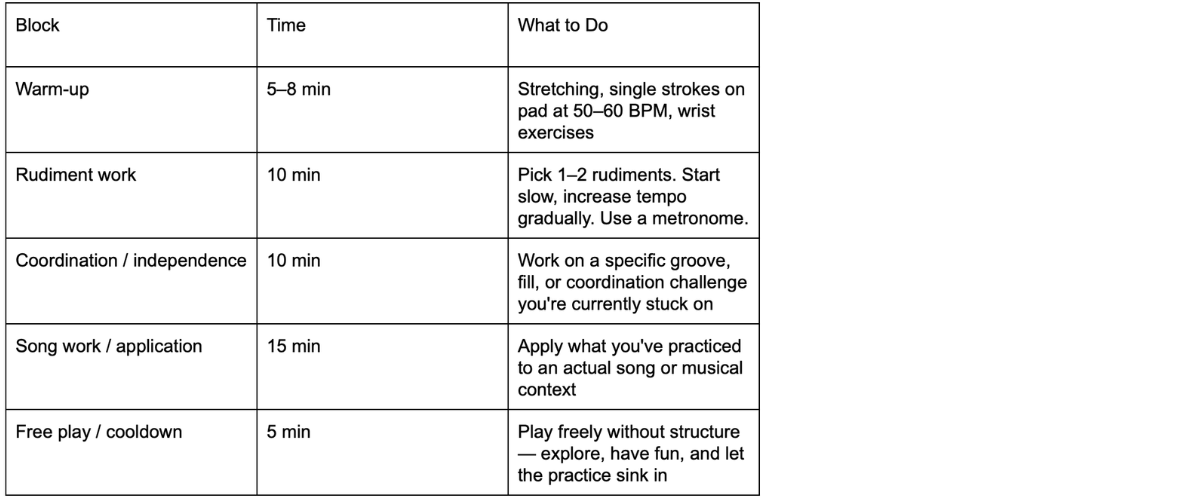
The "song work" block matters as much as the technical drills. Practicing exercises in isolation is useful, but the goal is musical drumming — playing patterns in context, with feel, at the service of a song. Even if you only work on a two-bar groove from one track, it ties your exercises to something real.
Setting Weekly Goals
At a higher level, your practice sessions should be working toward specific weekly targets. For example:
- This week: Get the paradiddle clean at 90 BPM. Add snare on 2 and 4 to the four-on-the-floor pattern. Learn the chorus beat of a specific song at full tempo.
Without specific goals, every session becomes vague, and vague practice produces slow improvement. Write your goals down before the week starts and assess at the end of the week whether you hit them. Adjust based on what took longer or shorter than expected.
Common Practice Mistakes That Slow You Down
These are the habits that most reliably prevent improvement — and most drummers don't realize they're doing them.
Practicing Without a Metronome
Why it's wrong: Your internal clock drifts when you play without a reference. You rush when a pattern is easy, slow down when it gets hard, and never fully feel the inconsistency because there's nothing to compare against. Every session without a metronome reinforces irregular timing as your "normal."
How to fix it: Use a metronome for every exercise, every rudiment, every pattern — especially slow ones. Free-time playing (jamming, song application) doesn't need a click, but structured practice always does.
Playing at Full Speed Too Soon
Why it's wrong: When you attempt a pattern at a faster tempo than you can execute cleanly, you're not practicing the pattern — you're practicing a messy version of it. Muscle memory doesn't know the difference between a clean stroke and a rushed one; it just reinforces whatever you repeat.
How to fix it: Start at 60–70% of the target tempo for any new pattern. Only increase tempo when the current speed feels effortless for multiple full reps in a row. "Effortless" is the key word — not just possible, but easy.
Skipping Warm-Ups
Why it's wrong: Playing without warming up means your first 10–15 minutes are below your actual current ability. You're working out the stiffness during time you could be using productively. Over time, skipping warm-ups also contributes to wrist and forearm overuse injuries.
How to fix it: Build the warm-up into the routine until it's automatic. If you're short on time and have to cut something, cut the free-play block — not the warm-up.
Only Practicing What You're Good At
Why it's wrong: Playing patterns you already know feels satisfying but produces almost no growth. Your weaknesses don't improve by accident — they need direct attention.
How to fix it: Identify one specific weakness at the start of each week and make sure at least one practice block per session addresses it directly. If your left hand is weaker, lead with your left on exercises you'd normally start right-handed. If your kick foot timing is inconsistent, isolate it and work it before adding your hands.
Inconsistent Practice Schedules
Why it's wrong: Drumming improvement is cumulative. Five days off followed by a three-hour marathon session doesn't produce the same results as 30 minutes a day for seven days. The motor skills and coordination involved in drumming are built through repetition over time, not volume in a single sitting.
How to fix it: Commit to a daily minimum — even 20 minutes a day is more effective than weekend-only sessions. On days when you don't have access to a kit, a practice pad is enough to maintain the hand technique and rudiment work. Keeping the habit going even in small doses beats irregular high-intensity sessions.
Tips for Getting Better Faster
- Record yourself regularly. Play a beat or pattern into your phone, then listen back. You'll hear timing inconsistencies, unevenness between hands, and rushing or dragging that you can't catch in real time. Even a 2-minute recording once a week gives you genuinely useful feedback.
- Play along to songs — slowly. Most digital music players and apps like YouTube or Spotify let you slow down tracks without changing the pitch. Use this to play along to songs at 70–80% speed. Your timing has to match the song's original groove, which forces your internal clock to work in a musical context.
- Keep a practice journal. Jot down what you worked on, what tempo you hit for each exercise, and what felt difficult. It's easy to forget your progress week-to-week, and a journal shows you concretely how much you've improved. It also helps you notice when you've been avoiding something for too long.
- Rotate your rudiment focus. Rather than practicing all 40 standard rudiments every session, pick 2–3 and work them deeply for a week. Depth beats breadth when building muscle memory. Rotate to new rudiments once the current ones feel comfortable at target tempos.
- Don't overlook dynamics. Playing everything at the same volume is a practice habit that makes you sound mechanical in real musical situations. Build dynamics into your exercises — play each pattern once at piano (soft), once at mezzo-forte (medium), once at forte (loud). Controlling volume is a real skill that takes deliberate practice.
- Learn songs you actually want to play. Technical exercises are tools, not goals. The motivation to practice consistently comes from working toward music that excites you. Pick songs in styles you genuinely love, break down their drum parts, and make playing those songs part of your regular practice. Knowing how to read drum tabs makes finding those drum parts for virtually any song fast and simple.
Final Thoughts
The drummers who improve consistently aren't the ones who practice longest — they're the ones who practice most deliberately. A focused 30-minute session with a clear goal, a metronome, and attention to what's actually going wrong will advance your playing faster than an hour of playing whatever feels comfortable that day.
Start with the warm-up. Pick your weaknesses intentionally. Use the metronome without exception. Apply what you learn to real music. And keep the sessions short enough that you look forward to them, rather than treating practice like a chore you have to get through. Consistency over intensity is the fastest path to real improvement.
FAQ
How often should I practice drums?
Daily practice — even 20–30 minutes — produces better results than longer, infrequent sessions. Motor skills and coordination are built through consistent repetition over time. If daily isn't possible, aim for at least 4–5 sessions per week, with at least one longer session of 45–60 minutes to work on songs and more complex material.
Can I practice drums without a drum kit?
Yes. A practice pad handles all your rudiment and stroke development. Pillows and drum practice books work as a quiet supplement for hand exercises. You won't develop foot technique or coordination between all four limbs, but keeping your hand technique sharp on a pad during kit-less periods prevents regression significantly.
What should a beginner practice first?
Start with single strokes and basic stick control on a practice pad, then move to the fundamental rock beat (hi-hat eighth notes, snare on 2 and 4, kick on 1 and 3) once you're at the kit. These two things — even stroke technique and basic four-limb coordination — are the roots that everything else grows from.
How long does it take to get good at drums?
With consistent, structured practice, most beginners can play a basic rock beat confidently within a few weeks and have a repertoire of 5–10 songs within 3–6 months. "Getting good" is an ongoing process — most working drummers still feel there's more to work on after years of playing. The milestones that matter early are: playing in time, playing with feel, and learning songs you love.
What is a good drum practice routine for beginners?
Warm up for 5 minutes (stretches + slow single strokes on a pad), spend 10 minutes on rudiments with a metronome, 10–15 minutes on a specific groove or coordination challenge, and 10–15 minutes applying it to a song. End with 5 minutes of free playing. Total: 40–45 minutes. Adjust the blocks based on available time, keeping the warm-up non-negotiable.
Should I use a metronome when I practice?
Yes, for all structured exercises and rudiment practice. A metronome is the most direct tool you have for building consistent timing. The discomfort of feeling like you're fighting the click is exactly the feedback you need — it means your timing has room to improve, and the metronome is showing you where.