A drum practice pad is a small, low-noise surface designed to replicate the feel of a snare drum head, giving you a place to work on stick technique, rudiments, and hand coordination without a full kit. It's one of the most useful tools in a drummer's toolkit — and one of the most underused.
A lot of drummers buy a practice pad, hit it a few times, and then leave it collecting dust next to the kit. That's a missed opportunity. A practice pad used intentionally — with a metronome and a focused goal — can improve your technique faster than the same amount of time on a full kit, because there's nothing to hide behind. No crashes, no snare crack, no bass drum filling in the gaps. Just your hands and your timing.
In this guide, we'll cover what a practice pad is and why it's worth using seriously, how to pick the right one for your situation, what to actually practice on it, and the most common mistakes drummers make when they do bother to use one. By the end you'll know exactly which pad fits your needs and how to make every practice session count.
When you’re done reading, you will be familiar with:
- Why Every Drummer Needs a Practice Pad
- Types of Practice Pads
- How to Choose the Right Practice Pad
- What to Actually Practice on a Pad
- Using a Practice Pad With a Metronome
- Common Practice Pad Mistakes
- Beginner Tips for Getting the Most Out of Your Pad
- Final Thoughts
- FAQ
Why Every Drummer Needs a Practice Pad
The obvious benefit is noise. A practice pad is dramatically quieter than a snare drum — manageable in an apartment, a dorm, or any space where a full kit isn't an option. But that's not the main reason to use one.
The real benefit is isolation. On a full kit, it's easy to compensate for weak hands with your feet, mask rhythmic inconsistency with dynamics, or rush through a problem spot because the groove carries you along. On a practice pad, none of that works. Every technique issue becomes audible and tactile. Your stick heights, your rebound control, your accent consistency — it's all right there in plain sight (and plain sound).
Three reasons to take pad practice seriously:
- You can practice anywhere, anytime. A practice pad on a desk, on your lap, on a hotel nightstand — the kit doesn't come with you, but the pad can. Any 20 minutes of focused pad work is better than zero minutes waiting for kit access.
- It builds the foundational technique that makes everything else easier. Rudiments, rebound control, dynamic range — these are pad skills that transfer directly to the kit. A drummer who spends serious time on a pad usually outperforms one who doesn't, even with less total kit time.
- It slows your practice down productively. Without the full kit to play with, you naturally focus on the details. That slower, more deliberate practice creates muscle memory faster than running patterns on the kit at tempo.
Types of Practice Pads
Not all practice pads are the same. The surface material, construction, and design affect feel, rebound, and what kind of practice they're best suited for.
Standard Rubber Pads
The classic design — a circular disc of rubber mounted on a wooden or plastic base. Rubber pads are durable, consistent, and available at every price point. The feel varies between manufacturers, but most rubber pads give a firm, controlled rebound similar to a medium-tight snare head.
These are the pads most beginners start with, and for good reason. They work well for rudiment practice, stick control exercises, and anything that benefits from a consistent, predictable surface. The main downside is that they sound nothing like an actual drum — the rubber impact sound is distinct and some drummers find it monotonous over long sessions.
Gum Rubber (Soft) Pads
Some pads use softer gum rubber rather than the firmer compound used in standard pads. Softer surfaces give a slightly slower, more forgiving rebound — closer to a loosely tuned snare head. These pads are popular for players working on ghost notes and subtle dynamic control, where a forgiving surface makes fine technique more perceptible.
Mesh Pads
Mesh heads are the same material used in electronic drum kits. They're among the quietest practice surfaces available and give a different feel to rubber — slightly more giving, with a rebound that varies based on mesh tension. Some drummers prefer them for their electronic-kit feel; others find the reduced feedback makes technique development harder to gauge.
Dual-Zone and Multi-Surface Pads
These pads offer two different playing surfaces on a single pad — typically a rubber zone and a harder rim zone, or two different rubber compounds side by side. They're useful for players who want to practice rim shots, cross-sticking, or transitioning between different surfaces in a single session.
Full Practice Pad Kits
Some manufacturers build multi-pad setups that simulate a full drum kit layout — a snare pad in center, a kick trigger, hi-hat controller, tom pads arranged around it. These are quieter than acoustic kits but more expensive than a single pad, and they're essentially a budget substitute for an electronic kit rather than a focused technique tool. If your main goal is pure technique development, a single pad is more effective and far more affordable.
How to Choose the Right Practice Pad
With dozens of options out there, here's how to cut through the noise and pick the right pad for where you are in your playing.
Feel First
The most important quality in a practice pad is feel — specifically, how the rebound matches what you experience on a real drum head. A pad that feels too stiff or too dead gives you feedback that doesn't transfer well to the kit. If possible, try a few pads before buying. Hit them with a stick at normal playing volume and feel how the rebound behaves. It should feel natural, not like you're fighting it.
For most players, a pad that replicates a medium-tuned snare drum (responsive but controlled) is the most useful starting point. Knowing how a snare drum feels when tuned correctly gives you a benchmark to judge a pad's rebound against.
Size
Standard practice pads come in sizes from around 6" to 12", with 12" being the most common and practical. A 12" pad gives you enough surface to practice between strokes without constantly hitting the edge. Smaller pads (6"–8") are more portable but restrict your striking area, which can actually reinforce bad habits if your technique needs more physical space to develop.
Surface Sound Level
If noise is a significant concern, mesh pads or rubber pads with internal foam dampening are the quietest options. Standard rubber pads have a distinctive "thwack" that carries through walls and ceilings more than you'd expect. If your neighbors or family are part of the equation, it's worth paying attention to noise level specs before buying.
Stand Compatibility
Some pads are designed to be used on a snare stand; others come with their own legs or are used flat on a desk. Practicing on a snare stand puts the pad at playing height, which is important for developing proper technique — the angle and height of the pad affect how your arms and wrists move. A pad on a desk is fine for casual practice but isn't ideal for building good technical habits over the long term.
Budget
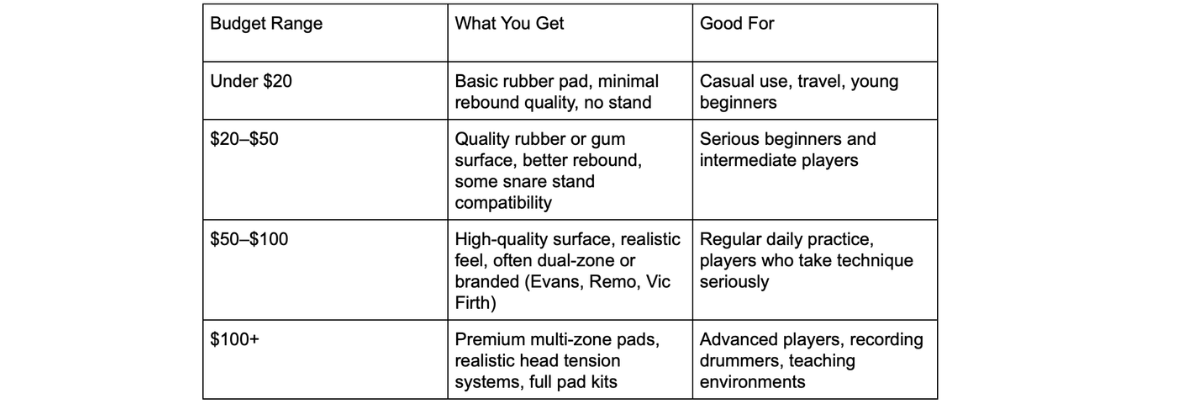
For most drummers, the $30–$60 range hits the sweet spot. Pads like the Evans RealFeel, Remo Practice Pad, and Vic Firth Heavy Hitter all offer realistic rebound at a price that's easy to justify.
What to Actually Practice on a Pad
A practice pad is only as useful as the exercises you do on it. Here are the most productive areas to focus on.
Rudiments
Rudiments are the foundational patterns of drumming — the same way scales are foundational to piano or guitar. The 40 Standard American Drum Rudiments (defined by the Percussive Arts Society) cover single strokes, double strokes, paradiddles, flams, rolls, and more. The practice pad is the ideal tool for drilling these because the consistent surface lets you focus purely on hand mechanics.
Start with the single stroke roll (RLRL) and double stroke roll (RRLL). Build them from slow and deliberate to fast and controlled. Then add the paradiddle (RLRR LRLL) and its variations. Even spending 15 minutes a day on three rudiments will noticeably improve your hands within a few weeks. If you want a full breakdown of what to work on and in what order, our guide to drum rudiments covers the complete set.
Stick Control
George Lawrence Stone's book Stick Control is the most referenced practice resource in drumming, and it's designed entirely for single-pad practice. The exercises isolate accent patterns, dynamic variations, and sticking combinations in ways that directly improve your control on the kit. If you're serious about technique, this book plus a good pad is the most efficient practice combination available.
Dynamic Range
Most drummers play too loud, too consistently. A practice pad gives you the space to work on playing softly — ghost notes, pianissimo strokes, controlled taps — without the acoustic bleed of the kit masking what you're doing. Try playing a single stroke roll where the right hand is loud and the left is barely audible, then switch. The challenge of controlling dynamics precisely is one of the most valuable technical skills you can develop.
Rebound Control
Rebound control is the foundation of efficient stick technique. Every stick stroke has a natural rebound off the surface — how you use that rebound determines whether you're playing efficiently or fighting the stick. Practice letting the stick rebound freely (the "free stroke" or "Moeller stroke"), then practice controlling it low (the "down stroke"). These two stroke types, plus the tap stroke and up stroke, make up the complete vocabulary of stick motion.
Timing and Subdivision
With a metronome (more on this below), practice subdividing the beat into 8th notes, 16th notes, and triplets. The pad gives you instant feedback on whether your subdivisions are landing consistently. This kind of timing work directly improves your groove feel on the kit — and it's nearly impossible to do on a full kit at low volumes without losing the subdivision in the mix.
Using a Practice Pad With a Metronome
A practice pad without a metronome is a warm-up tool. A practice pad with a metronome is a technique development tool. The difference matters.
Set the metronome to a tempo where you can play the exercise cleanly — that usually means slower than feels comfortable. If you're working on 16th note single strokes, start at 60 BPM. The goal is perfect execution at every tempo before moving faster, not sloppy execution at fast tempos. Rushing the tempo increase is the most common reason pad practice doesn't transfer to the kit.
A useful exercise: set the metronome to 60 BPM and play the click as beat 1 of a four-beat measure. Count the other three beats yourself. Then move the click to beat 2, then beat 3, then beat 4. Playing against a sparse click forces your internal clock to do more of the work, which is exactly how timing feels in a band context.
Most smartphone metronome apps work perfectly well. If you want a dedicated tool, a clip-on or standalone metronome you can set and forget without touching your phone during practice is worth the small investment.
Common Practice Pad Mistakes
Practicing Without a Goal
Why it's wrong: Hitting a pad aimlessly for 20 minutes might maintain some hand muscle memory, but it won't develop anything new. Without a target — a specific rudiment, a specific tempo, a specific technique — there's nothing to measure progress against.
How to fix it: Before you pick up the sticks, decide what you're working on. Write it down if it helps. "Today I'm working on double stroke rolls from 60 to 100 BPM, and I'm starting at 70." That's a session with an arc. Do that every day and you'll see improvement week over week.
Always Practicing at Full Speed
Why it's wrong: Fast, sloppy practice reinforces fast, sloppy playing. Muscle memory doesn't care whether you're doing something right or wrong — it just learns the pattern you repeat most often. Practicing rudiments at a tempo where your technique breaks down bakes mistakes into your hands.
How to fix it: Use the metronome and slow down until you can play the exercise perfectly — clean strokes, consistent heights, even dynamics. Then increase the tempo in small increments (5 BPM at a time). If the technique breaks down, slow down again. Speed is a side effect of good technique, not a shortcut to it.
Using the Pad as a Warm-Up Only
Why it's wrong: Many drummers use the practice pad for a quick warm-up before sitting at the kit, then put it away. That's better than nothing, but it wastes most of the pad's potential. Warm-up strokes don't push technique forward — deliberate, focused exercises do.
How to fix it: Designate specific practice pad sessions that are separate from kit time. Even 20 minutes of focused pad work with a metronome three times a week will develop your technique significantly faster than the same time spent warming up casually.
Neglecting Your Non-Dominant Hand
Why it's wrong: Most drummers unconsciously favor their dominant hand. Over time, this creates a gap in technique between the two hands that becomes obvious in rudiments, fills, and ghost note sensitivity. On a full kit, the dominant hand often covers for the weaker one. On a pad, there's nowhere to hide.
How to fix it: Spend extra time on your non-dominant hand. Play the same exercise leading with your left (or right, if you're left-handed) for twice as long as you lead with your dominant hand. Closing that gap is one of the biggest improvements a beginner or intermediate drummer can make.
Beginner Tips for Getting the Most Out of Your Pad
- Put it somewhere you'll see it. A practice pad on your desk, nightstand, or coffee table gets used. One stuffed in a gig bag doesn't. Visibility drives habit.
- Keep sessions short and focused. Twenty minutes of deliberate pad practice beats an unfocused hour. Pick two exercises per session and own them before adding more.
- Record yourself occasionally. Even a phone propped up against a book will show you things about your technique that you can't feel or hear in the moment — stick heights, body position, rushing patterns. A quick review once a week is informative.
- Match your practice pad height to your snare height. If you practice with the pad on a stand, set it at the same height as your snare drum. The muscle memory you build should transfer directly without adjustment.
- Use a practice schedule you'll actually keep. Five days a week at 15 minutes is more effective than one day a week at an hour. Consistency builds technique; frequency builds muscle memory.
- Don't ignore dynamics. Play your exercises at multiple volume levels — full forte, medium, and pianissimo. Playing quietly on a pad with good rebound is genuinely challenging and builds control that pays off every time you sit at the kit.
Final Thoughts
A practice pad doesn't make drumming more complicated — it strips it down to the essentials. Sticks, surface, and time. Used consistently with a metronome and a clear goal, it's the most efficient technique tool available to any drummer at any level. Buy one that feels good to play, put it somewhere visible, and give it 15 focused minutes a day. You'll notice the difference at the kit within weeks.
FAQ
Is a drum practice pad worth it?
Yes, without question. A quality practice pad costs less than a pack of name-brand drumsticks and will last years. The technique improvement from consistent pad practice with a metronome is one of the best returns on investment in drumming.
What size practice pad should I get?
A 12" pad is the most practical size for most drummers — large enough to give you comfortable striking area, small enough to travel with or use at a desk. Beginners especially benefit from the full 12" surface, which allows for proper stick path development.
Can I use a practice pad as a substitute for a drum kit?
Not completely. A practice pad can develop your hand technique, rudiment fluency, timing, and dynamic control — but it can't replicate foot coordination, kit transitions, or the physical experience of playing multiple surfaces simultaneously. It's a supplement to kit practice, not a replacement.
How long should I practice on a pad each day?
15–30 minutes of focused, deliberate practice is more effective than longer unfocused sessions. Quality over quantity is especially true with pad practice. If you're working with a metronome and pushing your technique, 20 minutes will feel like enough.
What's the best practice pad for beginners?
The Evans RealFeel and Remo Practice Pad are the most recommended starting points — both offer realistic rebound, snare stand compatibility, and durability at a reasonable price. If you want something quieter, the Vic Firth Heavy Hitter Silent Pack includes a mesh pad option.
Should I practice rudiments on a practice pad every day?
Yes, if technique development is a priority. Daily rudiment practice — even just 10–15 minutes — builds the hand independence, rebound control, and dynamic range that make everything else on the kit easier. Think of it like a musician doing scales: not glamorous, but foundational.