To play a polyrhythm on drums, you layer two different note groupings — like 3 against 4 — between your limbs, so each hand or foot keeps its own repeating subdivision while both patterns line back up at the start of the cycle. The skill is holding two separate pulses at once without either one bending toward the other.
If you've ever tried to figure out what Danny Carey is doing on a Tool record, or how Meshuggah's grooves feel like they're constantly shifting even at a steady tempo, you've run into polyrhythms. They're one of the defining tools of progressive metal and prog rock drumming — the reason those bands sound mathematically tight and slightly off-kilter at the same time.
In this guide, we'll break down what a polyrhythm actually is (and how it's different from an odd time signature), the most useful ratios to learn first, a step-by-step method for building a 3-over-4 polyrhythm from scratch, how to apply that skill to double bass patterns and full-kit grooves, the mistakes that make polyrhythms fall apart, and practical tips for training your limbs to hold two pulses independently. By the end you'll have a repeatable process for adding any polyrhythm to your playing, not just the ones covered here.
When you’re done reading, you will be familiar with:
- What Is a Polyrhythm?
- Common Polyrhythm Ratios and How They Sound
- Step-by-Step: Building a 3-Over-4 Polyrhythm
- Applying Polyrhythms to a Full Kit
- Common Mistakes When Playing Polyrhythms
- Beginner Tips for Training Polyrhythms
- Final Thoughts
- FAQ
What Is a Polyrhythm?
A polyrhythm is two different rhythmic groupings played at the same time, where each grouping keeps its own even subdivision instead of borrowing from the other. The most common example is 3 against 4: one limb plays a steady group of three notes while another plays a steady group of four, both fitting into the same span of time and lining up again at the start of the next cycle.
Polyrhythms are easy to confuse with odd time signatures, but they're not the same thing. An odd time signature like 7/8 changes how many beats are in a bar. A polyrhythm keeps the underlying pulse steady and instead stacks two conflicting groupings on top of it — the tempo doesn't change, but the way you subdivide it does. Bands like Tool, Meshuggah, Rush, and Dream Theater lean on both techniques, which is part of why their grooves feel so dense and unpredictable while still locking in tight with the rest of the band.
For metal and rock drummers specifically, polyrhythms are what separate a groove that just sounds heavy from one that sounds genuinely sophisticated. Meshuggah in particular built an entire rhythmic language around overlaying odd groupings on top of a steady pulse, and plenty of modern metal drumming vocabulary traces directly back to that approach.
Common Polyrhythm Ratios and How They Sound
Not all polyrhythms are equally useful to learn first. These are the ratios that show up most often in metal and prog rock, roughly ordered from easiest to hardest:
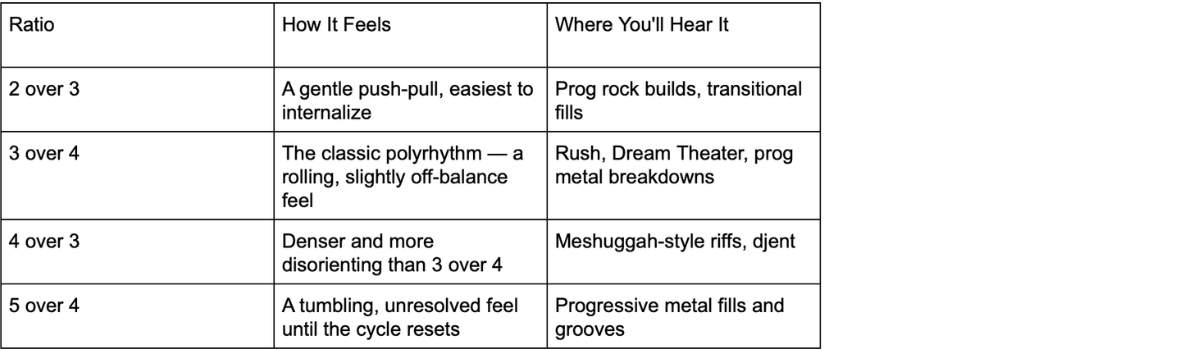
Start with 3 over 4. It's the foundation most other polyrhythms build on, and once your limbs can hold it independently, the more complex ratios become variations on the same skill rather than entirely new problems.
Step-by-Step: Building a 3-Over-4 Polyrhythm
Don't try to play both groupings with your hands right away. Building this pattern slowly, limb by limb, is the only way it sticks.
1. Play the Group of 4 Alone
Set a metronome and play four even quarter notes per cycle on your dominant hand (or bass drum, if you're building toward a foot-based version). This is your reference pulse — it should feel completely automatic before you add anything else.
2. Learn the Group of 3 Separately
On its own, play three evenly spaced notes across the same span of time it takes to play the four. These notes won't land on the same subdivisions as the group of 4 — that's the point. Loop this alone until it's steady without a click guiding every note.
3. Say It Before You Play It
A classic trick for internalizing 3 over 4 is the phrase "pass the goddamn butter" — the four syllables of "pass-the-god-dam" land on the group of 4, while "but-ter" style three-syllable phrases (or simply counting "1-2-3, 1-2-3, 1-2-3, 1-2-3" against "1-2-3-4") help you feel where the two groupings diverge and reconverge. Say both groupings out loud, one per hand tapping your knees, before you bring sticks into it.
4. Combine Both Limbs Slowly
Once each grouping is solid on its own, play the group of 4 on one hand (or the bass drum) and the group of 3 on the other hand at a slow tempo. Expect this to fall apart the first several times — that's normal. The two patterns will only start to feel locked in once you stop consciously counting and let muscle memory take over.
5. Increase Tempo Gradually
Once the pattern is stable slow, raise the tempo in small increments. Rushing this step is the fastest way to lose the independence between your limbs — if the pattern starts blurring together, drop back down and rebuild it at the slower tempo.
Applying Polyrhythms to a Full Kit
Once you can hold a basic polyrhythm between two limbs, the next step is spreading it across a full metal or rock kit setup.
Layering Polyrhythms Onto Double Bass Patterns
A common approach in progressive metal is playing a steady group on the hands (hi-hat, ride, or a riff-tracking pattern) while the feet play a polyrhythmic grouping underneath on double bass. If you haven't built solid independent foot control yet, our guide on the double bass drum pedal covers the technique and exercises that make this kind of foot-based polyrhythm possible in the first place.
Using Polyrhythms in Fills
Polyrhythmic fills work well as a way to signal a section change without breaking tempo. A short burst of a 5-over-4 or 3-over-2 grouping across the toms, landing back on the downbeat with the rest of the band, creates the kind of tension-and-release moment that defines a lot of prog metal songwriting.
Combining Polyrhythms With Riff-Tracking
Many metal drummers use polyrhythms specifically to track odd guitar riff groupings rather than as a standalone drum pattern. If the guitar is playing a riff grouped in 5s over a 4/4 pulse, matching that grouping on the kit — rather than defaulting to a straight backbeat — is what makes the drums and guitar feel like one locked-in unit instead of two separate parts.
Common Mistakes When Playing Polyrhythms
These are the mistakes that trip up most drummers learning polyrhythms for the first time, and how to fix each one.
Counting Both Groupings the Same Way
Why it's wrong: If you try to count "1-2-3-4" for both limbs, you'll unconsciously nudge the group of 3 toward the group of 4's subdivisions, and the polyrhythm collapses into something that isn't actually a polyrhythm anymore.
How to fix it: Learn each grouping with its own counting method — spoken phrases, separate counting patterns, or isolating each limb with the metronome — before combining them.
Starting at Full Tempo
Why it's wrong: Polyrhythms require genuine limb independence, and that independence breaks down fastest under tempo pressure. Starting too fast just builds bad habits into muscle memory.
How to fix it: Build every polyrhythm well under your target tempo and increase gradually, the same way you'd approach any new rudiment or double bass pattern.
Losing the Downbeat
Why it's wrong: A polyrhythm only makes musical sense if both groupings realign at a clear point — usually the downbeat. If you lose track of where that reset happens, the pattern turns into noise instead of a controlled rhythmic device.
How to fix it: Keep the metronome or a simple pulse audible while practicing, and always know exactly which note in each grouping is the "1." Practice starting and stopping cleanly on that beat.
Treating Polyrhythms as a Party Trick Instead of a Musical Tool
Why it's wrong: It's tempting to drop a polyrhythm into a song just to show it off. Used without context, it usually just sounds like a mistake to anyone not counting along.
How to fix it: Use polyrhythms where they serve the music — tracking an odd riff, building tension into a breakdown, or signaling a section change. If it doesn't add something the listener can feel, even without knowing the theory, reconsider whether it belongs there.
Beginner Tips for Training Polyrhythms
A few habits that speed up the learning curve:
- Isolate each limb completely before combining them. Trying to learn both groupings simultaneously is the single biggest reason polyrhythms feel impossible at first.
- Use a metronome app that can click subdivisions, not just the beat. Hearing both the group of 3 and the group of 4 as separate click patterns (many metronome apps support polyrhythmic click tracks) makes the target sound concrete instead of abstract.
- Practice away from the kit. Tapping the two groupings on your knees or a table removes the pressure of stick control and lets you focus purely on the rhythmic independence.
- Start with your hands before moving to hands-and-feet combinations. Hand-to-hand polyrhythms are easier to feel and correct than hand-to-foot ones, so build the skill there first.
- Reference the songs that use them. Learning the theory alongside a real Tool, Meshuggah, or Rush part gives your ear a target to aim for, which makes the abstract math feel like actual music.
Final Thoughts
Polyrhythms aren't a trick you either have or don't — they're a trainable skill built the same way any other independence exercise is: isolate, internalize, then combine slowly. The 3-over-4 ratio is the doorway into everything else, and once your limbs can hold it without thinking, the more complex groupings that show up in prog metal and prog rock stop feeling like a different category of playing.
Give this the same patient, isolated practice you'd give a new rudiment or a double bass exercise, and it'll become part of your natural vocabulary rather than something you have to force into a song.
FAQ
What's the difference between a polyrhythm and an odd time signature?
An odd time signature changes how many beats are in a bar, like 7/8 instead of 4/4. A polyrhythm keeps the underlying pulse the same but layers two different groupings on top of it at once, like 3 against 4. They're often combined in progressive metal, but they're separate techniques.
What's the easiest polyrhythm to learn first?
3 over 4 is the standard starting point. It's complex enough to be genuinely useful but simple enough to internalize with focused practice, and most other common polyrhythms build directly on the skill it teaches.
Do I need double bass pedals to play polyrhythms?
No — polyrhythms can be practiced entirely with your hands, and that's actually the recommended starting point. Applying them to double bass patterns is a natural next step once the hand-based version feels solid.
Why do Meshuggah's rhythms feel so disorienting?
Meshuggah frequently combines polyrhythms with riffs that repeat over unusual note-length groupings, so the riff and the underlying pulse only realign after several bars instead of one. That extended cycle is what makes their grooves feel like they're constantly shifting even though the tempo never changes.
How long does it take to learn a basic polyrhythm?
A steady 3-over-4 pattern at a slow tempo is achievable within a few focused practice sessions for most drummers. Getting it comfortable at performance tempo and applying it musically in a song takes longer and depends on how much isolated limb-independence work you've already done.
Can polyrhythms be used in straightforward rock songs, not just prog metal?
Yes. Even a brief polyrhythmic fill can add a moment of tension to an otherwise straightforward rock arrangement. You don't need a full Meshuggah-style riff to use the technique — a short polyrhythmic phrase going into a chorus or breakdown can be just as effective.