To dampen a bass drum, place a small amount of material — a pillow, foam, or a commercial dampener — inside the shell so it lightly touches one or both heads. How much material you use and where you position it determines how much ring and sustain you reduce, and how much attack and punch remains.
That's the short answer. The longer answer is that bass drum dampening is one of the most misunderstood parts of drum setup, and getting it wrong is the difference between a kick that sounds full and punchy and one that sounds either like a cardboard box or like a distant explosion with no definition. It's also one of the easiest things to improve once you know what you're actually trying to achieve.
This guide covers how bass drum dampening works, the materials you can use (free DIY options and commercial products), what different dampening levels actually sound like, how to set it up for live playing versus recording, and the most common mistakes drummers make when trying to control their kick drum tone. By the end, you'll be able to tune your dampening setup by ear to get exactly the sound you're after.
When you’re done reading, you will be familiar with:
- Why Bass Drum Dampening Matters
- How Dampening Works
- Dampening Methods: From DIY to Commercial
- How to Set Up Your Dampening
- Dampening for Different Sounds and Contexts
- Dampening the Batter Head vs the Resonant Head
- Common Bass Drum Dampening Mistakes
- Beginner Tips for Dialing In Your Kick Sound
- Final Thoughts
- FAQ

Why Bass Drum Dampening Matters
The bass drum is the largest drum on your kit, which means it produces more sustain and more low-frequency overtones than any other drum. In a large rehearsal space or outdoors, that natural sustain can sound warm and full. In a small room, a recording booth, or a live venue with a PA, it often turns into an uncontrolled boom that muddies the mix and makes it hard for the kick to "speak" with definition and attack.
Dampening lets you control how much of that sustain remains after the initial attack. Remove too much and the kick sounds dead and thuddy — no resonance, no life. Remove too little and the kick washes out and loses punch. The sweet spot is different for every drum and every context, which is why understanding the mechanics matters more than following a single formula.
Three situations where dampening makes a real difference:
- Recording. In the studio, a boomy kick with long sustain will bleed into other mics and make mixing difficult. A well-dampened kick gives the engineer a clean, defined transient (the initial attack) that sits clearly in the mix.
- Live sound. The kick needs to cut through a PA system, often competing with bass guitar. Controlled sustain and a focused attack makes the kick audible in the mix without requiring excessive EQ from the sound engineer.
- Practice rooms. Reflective walls and low ceilings amplify the kick's natural sustain and boom. Even modest dampening can make a practice session significantly more comfortable and less fatiguing on the ears.
How Dampening Works
When you hit the batter head of a bass drum, it vibrates and sends sound waves in all directions. Those waves bounce off the resonant head, reflect back, and set up a sustained tone that rings on after the initial hit. The shell also vibrates, contributing additional overtones.
Dampening works by absorbing some of that energy before it has time to sustain and build. Placing material against the head interrupts the vibration cycle — the material absorbs the wave energy rather than allowing it to bounce freely between the heads. The more material in contact with the head, and the more densely packed it is, the more sustain you eliminate.
This also means dampening affects the entire frequency range of the drum, not just the low-end boom. Heavy dampening removes high-frequency attack too, which is why an over-dampened kick sounds dead — the initial transient is muffled along with the sustain. Effective dampening finds the amount of absorption that controls the unwanted sustain while preserving the attack.
Dampening Methods: From DIY to Commercial
There are more ways to dampen a bass drum than most drummers realize, and some of the most effective methods cost nothing.
The Old Pillow Method
This is the most common DIY approach and the one used by professional drummers for decades before commercial dampeners existed. Take a small pillow, cushion, or rolled-up blanket and place it inside the bass drum shell. It should rest against the bottom of the drum and lightly touch one or both heads — not press firmly against them.
The key word is "lightly." The pillow should barely graze the heads. If it's pressing firmly against the batter head, you've killed the attack along with the ring. Think contact, not pressure.
Advantages: free, easily adjustable, available in different sizes for different amounts of dampening. Disadvantages: can shift during playing if not secured, and the amount of contact is hard to control precisely.
Foam Inserts
Strips or blocks of open-cell acoustic foam placed inside the shell work on the same principle as the pillow but are easier to position consistently. Foam is available in hardware stores and home improvement outlets. A strip about 2 inches wide and 3–4 inches tall running along the bottom of the shell interior, touching both heads lightly, is a good starting configuration.
Foam gives you more control over contact surface area — you can cut it to exactly the shape and size you need. It's also lighter than a pillow, which means it's less likely to affect the drum's natural resonance when it's not touching the heads.
Commercial Bass Drum Dampeners
Several companies make dedicated bass drum dampening products. The most popular are:
- Evans EQ Pad and EQ3 head combo. Evans makes a foam ring pad (the EQ Pad) designed to sit inside the kick and touch the resonant head. Many drummers also use the Evans EQ3 resonant head, which has a built-in foam ring around the inner edge that provides dampening without any interior material at all.
- Remo Muff'l Bass Drum Controller. A strip of felt-and-foam material that attaches to the inside of the shell and rests against the batter head. Available in different sizes for different amounts of dampening.
- RTOM Moongel for kick. Moongel is better known as a small adhesive gel pad for snare and tom dampening, but a strip applied near the edge of the batter head provides subtle high-frequency damping without affecting the fundamental tone.
- Pearl Bass Drum Muffler. A built-in mechanical dampening system found on some Pearl drum kits — a spring-loaded pad that presses against the batter head when engaged. Adjustable via a knob on the outside of the drum.
Commercial products are convenient and repeatable — once you find the right setting, you can replicate it exactly at every gig or session. The downside is cost, and many drummers find that a well-placed pillow produces results that are hard to distinguish from a $30 commercial product.
External Dampening: Tape and Patches
For more subtle dampening — just taming a slight ring without reducing sustain significantly — a small strip of gaffer tape applied to the outer edge of the batter head can reduce high-frequency ring without affecting punch or attack. This works on the same principle as Moongel: damping the head's vibration at the edge slightly shortens the ring without touching the main resonating area in the center.
This is a good option when the kick is already mostly right but has a slightly harsh overtone that's bothering you in the mix.
How to Set Up Your Dampening
Here's the process I use when dialing in dampening on an unfamiliar kit or after changing heads. It takes about 10 minutes and saves a lot of trial and error.
Step 1: Start with No Dampening
Hit the bass drum with nothing inside it. Listen to the natural tone. Note how long the sustain is, where the ring sits frequency-wise (is it a low boom, a mid-range thud, a high-pitched overtone?), and how much attack you can hear in the initial hit. This is your baseline.
Step 2: Add Minimal Contact
Place your dampening material (pillow, foam, or commercial product) inside the drum so it just barely touches the batter head. Play the kick again. You're looking for the sustain to shorten slightly without the attack softening. If the attack softened, pull the material back — it's pressing too hard.
Step 3: Adjust Gradually
Increase contact incrementally until the ring and sustain are at a level that works for your context. For recording, you typically want a fairly dry, focused sound. For live playing, you have more room to leave sustain in, since the PA will handle some of the low end management. For practice, somewhere in between.
Step 4: Test with the Rest of the Kit
Play the kick in context — a full groove with all the other drums and cymbals going. A kick that sounds great in isolation sometimes disappears in the full kit sound. If that happens, you may need slightly less dampening (more attack) or may need to address the tuning alongside the dampening.
Step 5: Tune Before Dampening, Not After
Dampening doesn't fix bad tuning. If the kick is poorly tuned, adding more material is just layering one problem on top of another. Tune both heads first — get the batter head at a tension that gives you the attack you want, and the resonant head at a tension that complements it — then add dampening to address the sustain. Knowing how to tune your drums properly makes dampening much more effective and targeted.
Dampening for Different Sounds and Contexts
Different musical contexts call for different kick sounds. Here's a general guide for how much dampening to use in each:
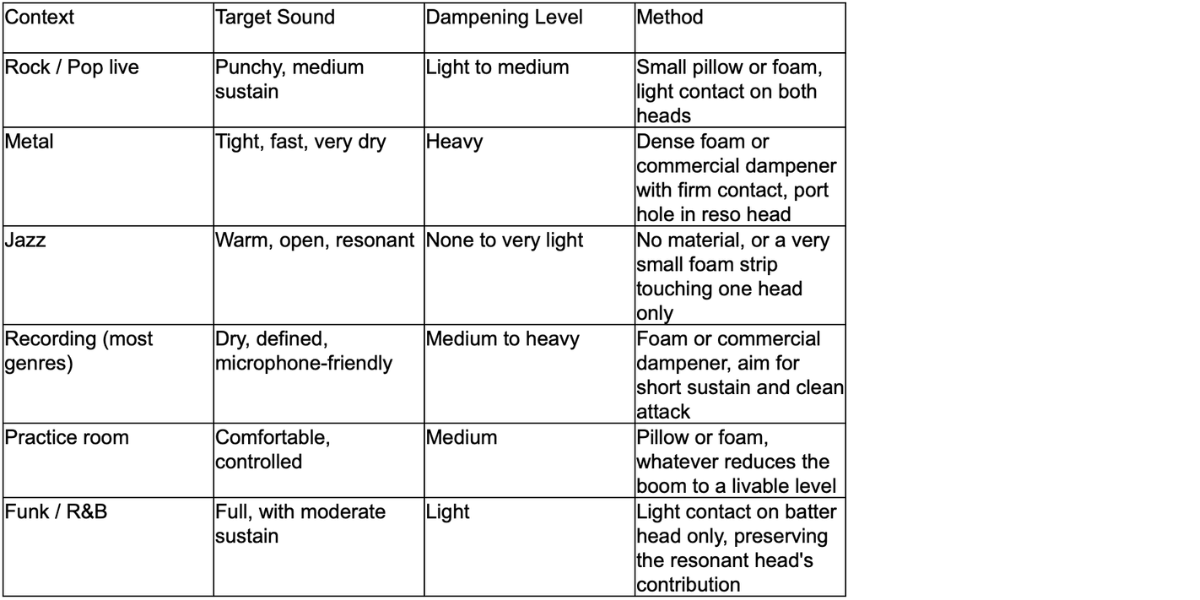
These are starting points. Your specific drum — its size, wood type, head selection, and shell depth — will interact with dampening differently than another kit. Use the table as a starting direction, then adjust by ear.
Dampening the Batter Head vs the Resonant Head
Most discussions of bass drum dampening focus on internal material, but you can also affect the sound by what's happening at each head independently.
Batter Head Dampening
Material pressing against the batter head primarily affects the sustain — how long the drum rings after you hit it. It also softens the attack slightly if contact is firm. This is where most dampening setups focus, because it has the most dramatic effect on the kick's overall sound.
Resonant Head Dampening
The resonant head (the front head of the kick) is also a contributor to the drum's sustain. Many drummers cut a port hole in the resonant head — typically a 4–6 inch circle offset from center — to allow air to escape and reduce sustain. The port hole also makes it easier to place a microphone inside the drum for recording.
Some resonant heads, like the Evans EQ3, have a built-in foam ring that dampens from the resonant side. This approach tends to give a slightly different character than dampening from the batter side — the attack is less affected, and the overall sound is a bit more open.
For a fully open, resonant sound (jazz or acoustic settings), consider a ported or fully removed resonant head. For a tight, controlled sound, keep the resonant head on and use internal material to do the work.
Do You Need to Dampen Both Sides?
Not necessarily. In many setups, internal material touching the batter head is all you need. Adding resonant head dampening on top of internal material can quickly make the kick sound over-dampened. Start with one approach and only add a second if the single approach isn't getting you where you want to be.
Common Bass Drum Dampening Mistakes
Using Too Much Material
Why it's wrong: Over-dampening removes the life from a kick drum. When the material is packed tightly against the head or fills most of the shell interior, you lose the fundamental tone and sustain that give the kick its body. What's left sounds like someone hitting a cardboard box — lots of click, no weight underneath it.
How to fix it: Remove all material and start over from nothing. Add material back one small piece at a time, playing the drum after each addition and stopping as soon as the ring reaches a level you can work with.
Trying to Fix Tuning Problems with Dampening
Why it's wrong: A bass drum that has an annoying ring or unpleasant overtone is almost always also a bass drum that isn't tuned well. Piling on dampening to cover up a tuning issue makes the drum duller and deader without actually solving the underlying problem — and you've now got two problems instead of one.
How to fix it: Tune first. Even a brief, even tension check around both heads (tapping near each lug and listening for consistent pitch) and a small adjustment to the batter head tension can eliminate a surprising amount of ring without any dampening at all.
Not Checking the Drum in Context
Why it's wrong: A kick drum that sounds great when you hit it in isolation can completely disappear when the full kit is playing, or can sound completely different through a PA or in a recording. Dampening set up in isolation often needs adjustment once you hear the drum in its actual musical context.
How to fix it: Always test your dampening setup in context — at minimum, with the full kit playing. Ideally, at a rehearsal or soundcheck, listen to the kick through the PA and adjust accordingly. What sounds like too much sustain in the room often sounds perfectly natural in the mix.
Pressing Material Against the Head Too Firmly
Why it's wrong: The dampening material should touch the head, not press it. Firm pressure on the head muffles the attack (the initial click of the beater) and makes the kick feel sluggish and unresponsive. It also wears down the head faster where the material contacts it.
How to fix it: The contact should be light enough that if you lifted the drum slightly, the material would fall away from the head under gravity. It's resting against the head, not wedged into it. Adjust the position or size of your material until you can achieve that light contact.
Beginner Tips for Dialing In Your Kick Sound
- A cheap pillow from a thrift store beats an expensive commercial dampener used incorrectly. The method matters more than the material. A pillow lightly touching the head is always better than a commercial product jammed against it.
- The beater matters too. A hard felt beater and a soft felt beater sound dramatically different — the hard beater gives more attack (click), the soft beater gives more warmth. If dampening isn't getting you the attack you want, try a harder beater before adding more material.
- A ported resonant head is worth trying. Many drummers are surprised by how much cleaner and more defined the kick sounds once there's a port hole in the resonant head, even without any internal material. It's free and reversible — try it before buying anything.
- Different head weights change the baseline. A heavy two-ply batter head (like an Evans EQ4 or Remo Powerstroke 3) already has some dampening built into its construction. If you're using a thin single-ply head and fighting lots of ring, switching heads might be a better solution than adding more dampening material. The choice of drum head affects your starting point significantly.
- Document what works. Once you find a dampening setup you like, take a photo of how the material is positioned inside the drum. Next time you change heads or move the kit, you can replicate it exactly rather than starting from scratch.
- Check your bass drum periodically. Material shifts during playing, especially if it's not secured. A pillow that was lightly touching the head at soundcheck can be firmly pressed against it by the end of a set as it gets knocked forward. A quick check before you play is a good habit.

Final Thoughts
Bass drum dampening is a simple concept with a lot of nuance in the execution. The goal is always the same: preserve the attack and fundamental tone while controlling the sustain and ring to a level that works for your context. That level is different for a jazz gig, a metal recording session, and a practice room in your basement.
Start light, add gradually, test in context, and tune your drum properly before touching the dampening. Those four principles will get you a usable kick sound in most situations without needing to buy anything. Once you understand what the drum wants to do naturally, dampening becomes a precise tool rather than a problem-solving band-aid.
FAQ
How much should a bass drum ring?
There's no universal answer — it depends on the music and context. For rock and pop in a live or studio setting, most engineers prefer a moderately dampened kick with short to medium sustain. For jazz, a more open, resonant sound is appropriate. The ring should serve the music, not distract from it.
Do I need to dampen a bass drum for practice at home?
Usually yes, for two reasons: comfort and realism. An undampened bass drum in a small, reflective room can be uncomfortably boomy and fatiguing. Modest dampening makes practice sessions easier on your ears and gives you a more realistic sense of what the drum will sound like in a proper room or PA.
Should I use a pillow or a commercial dampener?
Either works. A pillow is free and highly adjustable. Commercial dampeners are convenient and repeatable. Most working drummers have used both at various times. Start with a pillow and only buy a commercial product if you find the pillow's inconsistency frustrating.
What's a port hole and do I need one?
A port hole is a circular opening cut into the resonant (front) head of the bass drum. It reduces sustain and makes it easier to mic the kick. Many drummers and virtually all recording engineers prefer a ported resonant head. You don't need one for practice or casual playing, but it's worth considering if you play live or record regularly.
Can I dampen a bass drum without putting anything inside?
Yes. External options include a patch of gaffer tape on the batter head near the strike zone (reduces high-frequency ring), Moongel on the head surface (more precise dampening), or a built-in head dampening ring (as found on heads like the Evans EQ3 or Remo Powerstroke). These are more subtle than internal material and work well when you only need a small reduction in ring.
Does bass drum dampening affect how the drum sounds acoustically vs through a mic?
Yes, and often significantly. A bass drum that sounds full and balanced in the room can sound boomy and undefined through a microphone, which picks up the low-frequency sustain more prominently than your ears do in the room. When setting up dampening for recording or live sound, ask the engineer to give you feedback through the PA or headphones rather than adjusting by ear from the drum stool.