The best beginner drum set is one that fits your space, suits your budget, and won't fight you every time you sit down to play — acoustic if noise isn't a problem, electronic if it is, and at least a 5-piece configuration so you have room to grow without immediately outgrowing the kit.
That's the short answer. The longer answer is that buying your first drum kit is a decision that has a real effect on whether you stick with drumming or quit after three months. A kit that's too flimsy, too cramped, or constantly out of tune chips away at your motivation. A kit that's properly set up and reasonably well-made makes every practice session something you look forward to.
electronic question, what configurations and features to look for, the common mistakes first-time buyers make, and how to get the most out of whatever kit you end up with. By the end you'll know exactly what to look for and what to ignore.
When you’re done reading, you will be familiar with:
- Acoustic vs. Electronic: The First Decision
- What to Actually Look for in a Beginner Kit
- How Many Pieces? Kit Configurations Explained
- Evaluating the Key Components
- What to Expect at Different Price Points
- Common Mistakes First-Time Buyers Make
- Tips for Setting Up and Getting the Most Out of Your First Kit
- Final Thoughts
- FAQ
Acoustic vs. Electronic: The First Decision
Before you look at any specific kit, you need to settle the acoustic vs. electronic question — because the right answer completely changes what you should buy. This isn't a matter of preference; it's a matter of your actual situation.
Acoustic Drum Kits
Acoustic kits are real drums with real heads, shells, and cymbals. They produce the natural sound and feel that most drummers are trying to develop. Playing an acoustic kit teaches you proper technique — how to use stick rebound, how dynamics feel on a real head, how different surfaces respond differently. There's nothing like it.
The problem is volume. A played acoustic kit runs somewhere between 90–105 dB — roughly the volume of a lawn mower. That's loud enough to disturb everyone in your house, and anyone in neighboring apartments. Unless you have a dedicated space (a basement, a garage, a rehearsal room) or neighbors who genuinely don't mind, an acoustic kit in a typical residential setting creates real problems.
Electronic Drum Kits
Electronic kits use rubber or mesh pads instead of heads, and produce very little acoustic noise. The "sound" comes through headphones or a small amp. Quality electronic kits have improved dramatically in the last decade — mesh head pads in particular have a rebound feel that's much closer to a real drum head than the rubber pads of older e-kits.
The trade-offs are real, though. Good electronic kits cost more than comparable acoustic kits at the entry level. They require some digital setup (module configuration, triggering sensitivity). And they feel different — not bad, but different. Players who start on electronic kits and move to acoustic sometimes need time to adjust.
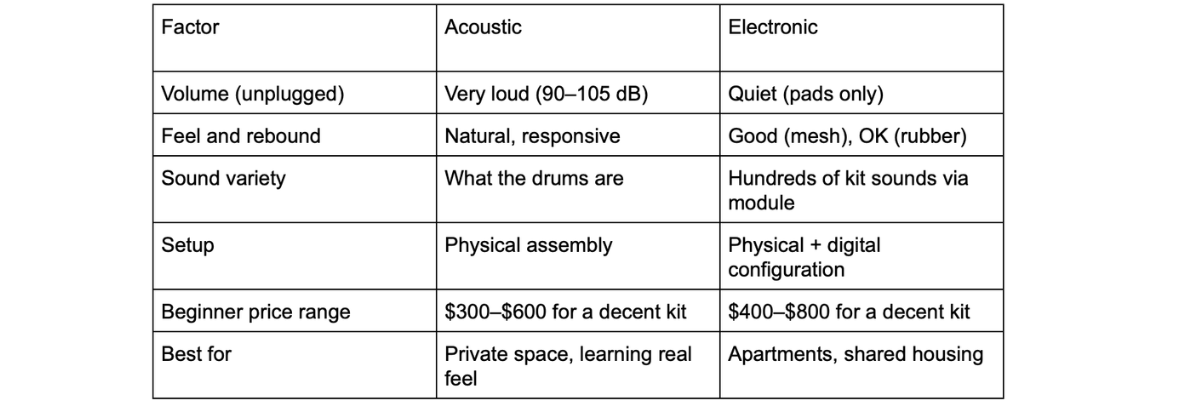
The simple rule: If you have a private space and noise isn't a concern, acoustic. If you live in an apartment or shared housing, electronic. Don't try to make an acoustic kit work in a noise-sensitive environment — it's a fight you'll lose and it'll make you resent playing.
What to Actually Look for in a Beginner Kit
Drum kit marketing is full of meaningless spec-sheet language. Here's what actually matters when evaluating a starter kit.
Hardware Quality
The stands, pedals, and hi-hat clutch are the parts of a kit that beginners consistently underestimate. Cheap hardware wobbles, slips mid-session, and requires constant re-adjustment. Nothing disrupts practice focus like a snare stand that drifts or a hi-hat that won't stay at your preferred height. When comparing kits, look at whether the hardware is double-braced (more stable, heavier) or single-braced (lighter, less stable). For a beginner kit, double-braced stands on at least the hi-hat and snare stand are worth prioritizing.
Shell Material and Construction
Entry-level kits use poplar, basswood, or a combination of both. Neither is better or worse for a beginner — both produce a perfectly usable sound at this price range. The thing to watch for is shell construction: how many plies (layers) the shell has, and whether the bearing edges (the rim where the head sits on the shell) are cut cleanly. Poorly cut bearing edges make drums almost impossible to tune consistently, which becomes a source of constant frustration. You usually can't verify bearing edge quality from a product listing, so buying from established brands with a known quality track record matters here.
Included Cymbals
Most beginner kits bundle hi-hats and a crash/ride cymbal in the package. These entry-level cymbals are generally thin, slightly harsh-sounding, and not what you'll want forever — but they're functional for getting started. The main thing to check is that all the cymbal hardware (hi-hat stand, boom arm for the crash/ride) is included in the price.
Bass Drum Pedal
Included pedals in beginner kits range from barely functional to surprisingly decent. A loose, slippery pedal with poor spring tension makes the kick drum frustrating to play and can ingrain bad technique. If the kit you're looking at includes a very budget pedal, it's often worth spending an extra $40–60 on a mid-range single pedal separately. Your kick drum foot will thank you.
How Many Pieces? Kit Configurations Explained
When a kit is described as a "5-piece" or "4-piece," that number refers to the drums only — not the cymbals, stands, or pedal. Here's what the most common configurations actually include:

For most beginners, a 5-piece kit is the right starting point. It gives you a standard configuration that matches how most songs are played and how most drum education is structured. A 4-piece is a fine option if space is tight, but you'll hit the ceiling faster — most fills and basic patterns assume at least two rack toms. Going to a 6-piece or larger is usually unnecessary for a first kit; the extra drums don't add much at the learning stage and add cost and complexity.
Once you have the kit set up, getting comfortable with how to set up a drum set properly is just as important as the kit itself. A poorly set-up kit is harder to play and easier to quit.
Evaluating the Key Components
Beyond the overall kit spec, here are the components worth evaluating individually.
Drum Heads
Most beginner kits ship with basic stock heads that are functional but not exceptional. They're typically single-ply coated or clear heads — fine for learning, but the first thing most intermediate players replace. What actually matters at the beginner stage is that the heads are in good condition (no factory dents or warping) and that the bass drum batter head is appropriately thick for that drum's size.
Knowing how to choose drum heads will become more relevant after a few months when you start noticing how the stock heads sound and whether you want to change the tone or feel.
Snare Drum
The snare is the most played drum in your kit and deserves disproportionate attention. Entry-level kits often include a thin-shelled steel snare — these are usable but can sound a bit ringy. Check that the snare wires (the metal coils stretched across the bottom head) sit evenly across the resonant head and that the strainer (the mechanism that engages or disengages the wires) works smoothly. A snare where the strainer sticks or the wires are uneven will sound off regardless of how well you tune it.
Hi-Hat Stand
The hi-hat is one of your primary timekeeping tools and you'll use it constantly. The stand needs to hold its height adjustment firmly and have a pedal mechanism that opens and closes the hats cleanly. An unstable or sticky hi-hat stand is a serious daily annoyance. If the kit's included hi-hat stand feels wobbly, upgrading it is a worthwhile early expense.
Throne (Drum Seat)
Some kits include a throne; many don't. Either way, the throne is one of the most physically important pieces of gear you own — your posture, reach, and foot technique all depend on getting your seat height right. Don't sit on a barstool or kitchen chair and expect to develop good drumming technique. A proper round throne with height adjustment is a basic requirement. A padded seat that lets you sit comfortably for 45 minutes without discomfort is the standard to aim for.
What to Expect at Different Price Points
Here's an honest look at what you get at each price bracket for acoustic beginner kits. Electronic kit pricing runs slightly higher at each tier for comparable quality.
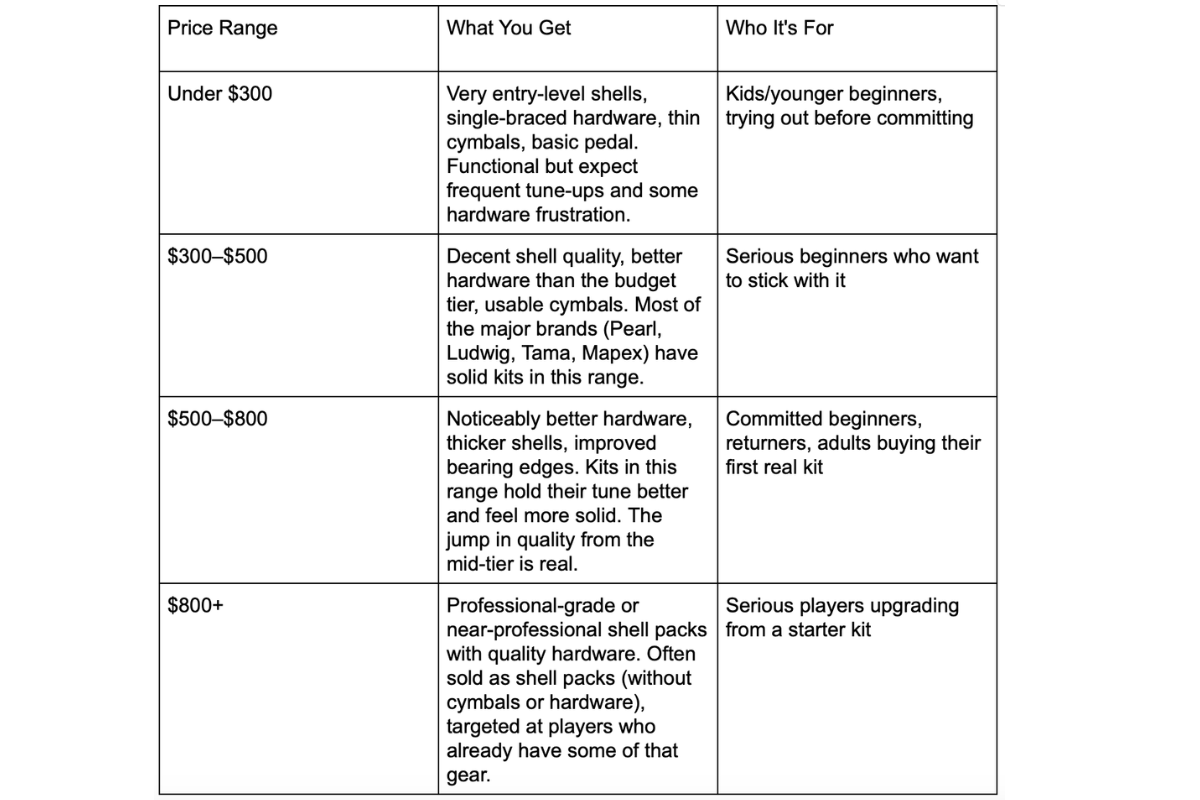
The $300–$500 range is where most beginners get the best value. At that price you get a kit that won't embarrass you and won't constantly need re-adjustment, without overspending on a first instrument you may end up upgrading in a year or two. Brands to look at in this range include Pearl Export, Mapex Tornado, Ludwig Accent, and Tama Imperialstar — all have established reputations for reliable beginner kits.
Common Mistakes First-Time Buyers Make
These are the buying and setup errors that come up again and again with beginners. Knowing them upfront saves real money and frustration.
Buying the Cheapest Kit Available
Why it's wrong: Sub-$200 kits look like a bargain but often have hardware so flimsy that maintaining a usable setup becomes a constant chore. Wobbly stands, a pedal that slips, cymbals that crack within months — these problems chip away at the experience of playing and make it harder to stay motivated.
How to fix it: Spend the extra $100–150 to get into the $300–400 range. The quality difference is significant. If budget is genuinely tight, buying a used mid-range kit from a reputable brand is usually a better choice than a new budget kit.
Ignoring the Hardware
Why it's wrong: Many beginners focus on the shells and cymbals and ignore the stands and pedal. Cheap hardware doesn't just wobble — it can drift mid-session, scratch your floors, and wear out the drums themselves faster. The hardware is what holds everything in place.
How to fix it: When comparing kits, look at the hardware spec explicitly. Double-braced stands and a quality bass drum pedal are worth spending for, even if it means compromising slightly on the shell spec.
Skipping the Throne
Why it's wrong: Sitting at the wrong height or on an unstable seat affects your entire playing posture, reach, and foot technique. Playing from a kitchen chair with the hi-hat too far left and the snare too high makes everything harder than it needs to be.
How to fix it: Budget for a proper drum throne from the start. It doesn't need to be expensive — a $40–60 throne with height adjustment does the job. Set it so your thighs are parallel to the floor or slightly angled downward; that's your ideal baseline height.
Not Learning to Tune the Kit
Why it's wrong: Beginner kits often come with the heads roughly tensioned from the factory — not tuned. Many beginners never bother tuning properly and then wonder why their drums sound dull or ring uncontrollably. An untuned kit doesn't represent what that kit actually sounds like.
How to fix it: Learn to tune your drums properly. Even basic tuning — even tension around each head, bottom heads tuned higher than batter heads — makes a dramatic difference. Knowing how to tune your drums is one of the most practical skills a beginner can develop early.
Buying Without Considering Space
Why it's wrong: A standard 5-piece acoustic kit with cymbals and hardware requires roughly 6–7 feet of width and 5–6 feet of depth when fully set up. Plenty of beginners buy a kit and then discover it barely fits in their intended space — or doesn't at all.
How to fix it: Measure your space before you buy. If you're tight on room, a 4-piece configuration or a compact electronic kit will serve you much better than a full 5-piece squeezed into a corner you can barely sit in.
Tips for Setting Up and Getting the Most Out of Your First Kit
- Put a drum rug down first. A non-slip rug under your kit keeps the bass drum and hi-hat from creeping forward while you play. Even a basic yoga mat works. A kit that drifts during practice makes every session slightly more frustrating than it needs to be.
- Set everything to neutral first, then adjust. Start with all stands at their midpoint adjustments and the throne at a height where your thighs are level. Then make small adjustments based on what feels awkward. Don't try to set up your ideal ergonomics on day one — let your setup evolve over the first few weeks.
- Tune before your first real session. Take 15–20 minutes to tune all the drums properly before you start playing in earnest. The stock tension from the factory almost never sounds good. A basic even tune-up will transform how the kit sounds.
- Tighten everything periodically. Hardware bolts and wing nuts loosen with playing. Once a week, give everything a quick check — tighten anything that's drifted. A loose cymbal wing nut at the wrong moment is a minor annoyance; a loose snare drum leg is a genuine safety issue.
- Start with the basics before expanding. Don't add more cymbals, extra toms, or triggers to your kit in the first few months. Master the standard configuration first. More gear before you have the fundamentals just creates more variables to manage. Your drum set's parts should all be familiar before you start adding to them.
- Protect your ears. Acoustic drums are loud — loud enough to cause cumulative hearing damage at close range over repeated sessions. Foam ear plugs or a basic pair of drummer's ear protection are a $10–20 investment that protects your hearing for life. Start the habit on day one.
Final Thoughts
The best beginner drum set isn't necessarily the most expensive one, or the one with the most impressive feature list. It's the one that fits your space, works with your living situation, holds up to daily practice, and doesn't create constant friction between you and the act of playing.
Get the acoustic vs. electronic decision right for your environment. Spend in the $300–500 range if you can. Prioritize hardware quality and don't skip the throne. Tune it properly before the first real session. And then just play — the kit is a means to an end, and the end is drumming. The sooner you're actually sitting behind a functional kit and working on beats and technique, the sooner you'll improve.
Once you have the kit, a solid first session starts with a few basic beats. Your first beginner drum beats lesson gives you 20 patterns to work with from the start.
FAQ
How much should I spend on a beginner drum set?
$300–$500 for acoustic is the sweet spot for most beginners. At that range you get a kit that's genuinely usable, holds its tune, and has hardware that won't constantly need re-adjustment. Under $250 starts to introduce quality compromises that erode the practice experience. Over $600 is usually more than a first kit warrants — save that investment for when you know you're committed and have a better idea of what you specifically want from a kit.
Is an acoustic or electronic drum set better for beginners?
It depends entirely on your living situation. Acoustic kits offer better feel and a more natural learning experience. Electronic kits are the only realistic option if you live in an apartment or anywhere noise is a genuine constraint. Don't try to compromise by keeping an acoustic kit under-tuned to reduce volume — it produces bad technique and still makes significant noise.
What size drums do beginners need?
A standard 5-piece kit typically includes a 22" bass drum, 12" and 13" rack toms, a 16" floor tom, and a 14" snare. These are the most common sizes in beginner kits and match the standard setup most drum education uses. Some fusion-sized kits use a 20" bass drum and smaller toms — also fine for beginners, slightly easier to fit in smaller spaces.
Can I learn drums on an electronic kit?
Yes, and many great drummers started on electronic kits. The technique you develop transfers to acoustic drums, though some adjustment is needed when you make the switch — the rebound and feel are different. Modern mesh-head electronic kits are substantially better than older rubber pad kits and provide a much more realistic playing experience.
Do beginner drum kits come with everything I need?
Most complete beginner packages include the shells, cymbals (hi-hat, crash/ride), hardware (stands, pedal), and sometimes a throne. Check the product listing carefully — some kits are sold as shell packs only (no hardware or cymbals) and some throne-less packages require you to buy a seat separately. Always verify what's included before you buy.
How long does a beginner drum kit last?
A mid-range beginner kit played regularly should last 3–5 years before you start wanting to upgrade components. Heads wear out and need replacing every 6–18 months depending on how hard you play. Hardware and shells last much longer. Most players upgrade cymbals and then shells as they advance, rather than replacing the whole kit at once.