To play the gallop rhythm on drums, you play a "long-short-short" triplet pattern on the kick drum — one note held for two triplet counts followed by two quick single notes — while keeping a steady eighth-note pulse on the hi-hat or ride and hitting the snare on the backbeat, giving you that driving, horse-hooves feel behind classic metal riffs.
If you've ever headbanged to Iron Maiden's "The Trooper," Metallica's "Master of Puppets," or pretty much any NWOBHM or thrash track, you've heard the gallop. It's one of the most recognizable rhythmic devices in metal, and while it started as a bass technique, drummers lock into it constantly to drive the riff forward. It looks simple on paper — three notes per beat — but getting it to feel tight, fast, and even under your foot takes real practice.
In this guide, we'll cover where the gallop rhythm comes from, exactly how the pattern breaks down note by note, a step-by-step approach for building it up with your kick, hands, and full kit, the difference between single-pedal and double-pedal gallops, common mistakes that make a gallop sound sloppy, and answers to the questions beginners ask most. By the end you'll be able to lock into a gallop rhythm at speed without your foot falling apart.
When you’re done reading, you will be familiar with:
- What Is the Gallop Rhythm?
- Breaking Down the Gallop Pattern
- Step-by-Step: Learning the Gallop Rhythm
- Single Pedal vs. Double Pedal Gallops
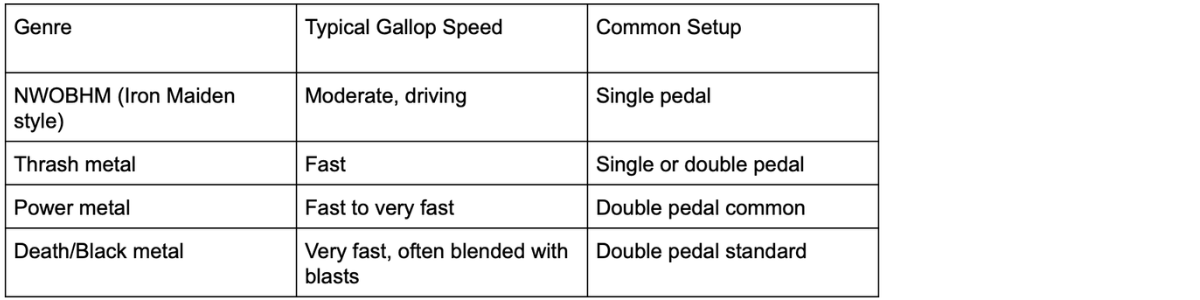
- Variations and Where You'll Use the Gallop
- Common Mistakes When Playing the Gallop
- Beginner Tips for a Tighter Gallop
- Final Thoughts
- FAQ
What Is the Gallop Rhythm?
The gallop rhythm is a triplet-based pattern that splits each beat into a long note followed by two short notes — the same rhythmic shape as a cantering horse, which is exactly where the name comes from. It's most associated with Steve Harris's bass playing in Iron Maiden, but it's just as much a drumming technique. When the kick drum locks into the gallop underneath a riff, it gives the music that unmistakable driving, propulsive energy that defines a huge chunk of NWOBHM, thrash, and power metal.
You'll hear the gallop everywhere once you know what to listen for: Iron Maiden's "The Trooper" and "Run to the Hills," Metallica's early thrash records, Megadeth, Iced Earth, and countless power metal bands all lean on it. It's one of the defining rhythmic fingerprints of metal drumming, right alongside the blast beat and the double bass pedal.
Breaking Down the Gallop Pattern
Musically, the gallop is a triplet subdivision where you play the first note, skip (or rather, hold through) the second, and play the third. Written as a triplet, it looks like: long-short-short, or in note values, a quarter-note triplet followed by two eighth-note triplets. Counted out loud, it's "1-trip-let, 2-trip-let" where you play on "1," skip "trip," and play on "let" and the next "2."
On the drum kit, the most common version puts this triplet figure entirely on the kick drum, while the hi-hat or ride keeps a straight, steady pulse on top and the snare hits the backbeat (beats 2 and 4) as normal. The kick is doing all the rhythmic work; everything else stays steady to anchor the groove.
In simplified tab form, one bar of a basic gallop pattern looks like this (each group of three characters represents one triplet beat):
HH | x-x x-x x-x x-x |
SD | ------- o ------- o |
BD | o--o o--o o--o o--o |
Read the kick row closely: within each triplet, the kick plays on the first partial, rests on the second, and plays again on the third — long, short-rest, short. That's the gallop. If tab notation like this is unfamiliar, our guide on reading drum tabs breaks down how these text-based rhythm charts work.
Step-by-Step: Learning the Gallop Rhythm
The gallop is a foot-independence exercise as much as it's a rhythm to memorize. Build it slowly.
1. Say the Rhythm Before You Play It
Count "1-trip-let, 2-trip-let" out loud, clapping or tapping on "1," "let," and the next "1." Getting the rhythm into your voice and your hands first makes it far easier to transfer to your foot.
2. Isolate the Kick Pattern
Play just the gallop pattern on the bass drum alone, with a metronome set to a slow tempo and subdivided into triplets if your metronome supports it. Focus entirely on evenness between the two quick notes — a common issue is rushing the second short note.
3. Add the Hi-Hat or Ride
Once the kick pattern is solid on its own, layer in a straight eighth-note pulse on the hi-hat or ride. This is where most beginners' foot starts to drift, because the hands are now playing a different subdivision than the foot. Slow down as much as you need to.
4. Add the Snare Backbeat
Bring in the snare on beats 2 and 4. At this point you have all three limbs moving independently, which is the real challenge of the gallop — it's not a hard pattern to say, but it takes real coordination to play cleanly.
5. Increase the Tempo Gradually
Once the full pattern is clean and relaxed at a slow tempo, bring the metronome up in small increments — five beats per minute at a time is plenty. Metal gallops are often played fast, but speed is the last thing you add, not the first.
Single Pedal vs. Double Pedal Gallops
The gallop can be played two different ways depending on your setup and the speed you need.
Single Pedal Gallop
With one bass drum and one pedal, you play the entire long-short-short pattern with a single foot. This demands strong ankle control and stamina, since your foot is doing three strokes per beat instead of one. Heel-up technique (playing from the ball of the foot rather than resting the heel on the pedal board) gives you the power and speed most drummers need to sustain this at metal tempos.
Double Pedal (or Double Bass) Gallop
With a double pedal or two bass drums, you can split the pattern between your right and left foot, which reduces the workload on each individual foot and makes faster tempos far more sustainable. A common approach is right-left-right or alternating in a way that keeps each foot's workload even. If you're new to double bass playing generally, our guide on double bass drum pedal technique covers the setup and foundational exercises you'll want before tackling gallops at speed.
Variations and Where You'll Use the Gallop
Gallop Under a Riff vs. Gallop as a Fill
Most commonly, the gallop sits under a guitar riff for an entire verse or section, locking in with the bass line note for note. It can also show up briefly as a fill or a build into a chorus, adding a burst of momentum before the band drops back into a straighter beat.
Combining the Gallop With Other Metal Techniques
The gallop often appears alongside other metal drumming staples. It's common to transition from a galloping verse into a blast beat for a chorus or bridge — our guide on how to play a blast beat covers that technique in depth if you want to pair the two.
Half-Speed and Double-Speed Gallops
Once you're comfortable with the standard gallop, try playing it at half the felt tempo (each triplet spread over two beats instead of one) or doubled up for a faster, more frantic feel. Both variations show up constantly in power metal and thrash.
Common Mistakes When Playing the Gallop
Rushing the Two Short Notes
Why it's wrong: The two quick notes at the end of each gallop beat tend to speed up relative to the long note, especially as tempo increases. This makes the pattern sound uneven instead of locked-in.
How to fix it: Practice the kick pattern alone against a triplet-subdivided metronome click, listening specifically for even spacing between all three notes, not just accuracy on the downbeat.
Tensing Up the Ankle
Why it's wrong: A stiff, locked ankle burns out fast and loses control at speed. Most drummers who "can't keep up" with a gallop are fighting tension, not lacking raw speed.
How to fix it: Practice slowly enough that your foot stays loose and relaxed. Speed should come from efficient, relaxed motion, not from forcing more effort into the stroke.
Letting the Hi-Hat or Ride Drift With the Kick
Why it's wrong: Because the kick is playing a triplet feel, it's easy for the hands to unconsciously start leaning toward that same triplet subdivision instead of staying on a straight eighth-note pulse. The groove loses its drive when that happens.
How to fix it: Isolate the hands alone against a click until the straight pulse feels completely independent from the kick pattern, then recombine.
Skipping Slow Practice
Why it's wrong: The gallop is a technique that beginners often try to learn at performance tempo right away because that's how they hear it on the record. This almost always results in a sloppy, inconsistent pattern that falls apart under pressure.
How to fix it: Treat tempo the same way you would with any technical exercise — start well below your target speed and earn every increase with clean, controlled reps.
Beginner Tips for a Tighter Gallop
- Practice on a pillow or practice pad kick trainer first. Reducing rebound resistance lets you focus purely on the rhythm and foot motion before adding a full-tension bass drum pedal into the mix.
- Use a metronome with a triplet subdivision click. Hearing the triplet grid rather than just the quarter-note pulse makes it much easier to judge whether your gallop is actually even.
- Warm up your ankle before playing fast gallops. A few minutes of slow, controlled single strokes on the kick prevents the cramping that often derails a practice session.
- Listen to the riff, not just the drum part. The gallop exists to lock in with a guitar or bass riff. Practicing along with the actual song teaches you the feel far faster than a metronome alone.
- Record yourself at speed. The unevenness that creeps into a fast gallop is often inaudible to the player in the moment but obvious on playback. Use recordings to catch what your ears miss live.
Final Thoughts
The gallop rhythm is deceptively simple to describe and genuinely demanding to play well. Three notes per beat doesn't sound like much until your foot has to hold that long-short-short shape evenly at 180 beats per minute for four minutes straight. Build it slowly, isolate each limb, and don't chase speed before you've earned the control to back it up.
Once it's locked in, the gallop becomes one of the most useful tools in a metal drummer's vocabulary — a rhythm that instantly drives a riff forward and connects you to some of the genre's most iconic songs.
FAQ
Is the gallop rhythm a drum rudiment?
Not technically — it's a rhythmic pattern rather than a formal rudiment like a paradiddle or a roll. But it draws on the same triplet subdivision skills that many rudiments build, so working on your triplet-based sticking will carry over.
Do I need a double bass pedal to play a gallop?
No. The gallop is commonly played entirely on a single pedal, especially at moderate tempos. A double pedal or double bass setup becomes more useful at faster thrash and power metal tempos, where splitting the workload between two feet keeps your playing sustainable.
What's the difference between a gallop and a blast beat?
A gallop is a triplet-based long-short-short pattern, usually played mostly on the kick drum with a steady pulse on top. A blast beat is a much faster, more relentless pattern where the kick, snare, and cymbal typically alternate on every subdivision. They're both metal staples but serve different musical purposes — the gallop drives a riff, while the blast beat creates a wall of continuous intensity.
Why does my gallop sound uneven at fast tempos?
Almost always tension. A tight, locked ankle can't move fast and evenly at the same time. Slow the tempo down until your foot feels loose, then build speed gradually rather than forcing it.
Which bands are known for the gallop rhythm?
Iron Maiden is the genre's most famous example, especially on tracks like "The Trooper" and "Run to the Hills." You'll also hear it heavily in early Metallica, Megadeth, Iced Earth, and most classic power metal.
How long does it take to learn the gallop rhythm?
The rhythm itself can click within a single practice session once you isolate the kick pattern. Playing it cleanly at full metal tempo with your hands and snare layered on top is a longer process — expect several weeks of regular practice to build the speed and independence.