Syncopation in drumming means placing a hit where you'd normally expect a rest — usually on an off-beat or an "and" — so the accent lands against the underlying pulse instead of on top of it. That deliberate mismatch between where the beat sits and where the hit lands is what gives a groove its push, and it's the difference between a pattern that feels flat and one that feels like it's driving forward.
Every genre uses syncopation, but rock and metal drummers lean on it constantly without necessarily naming it — a kick drum that lands a sixteenth note before beat three, a snare accent tucked into the "e" of beat two, a breakdown riff that hits everywhere except where you'd expect. Once you can hear and count syncopation deliberately, you stop copying patterns by feel alone and start building your own.
In this guide, we'll break down what syncopation actually is, why it's such a core tool for rock and metal grooves specifically, how to count and read syncopated rhythms without getting lost, a practice method for internalizing them, and the mistakes that keep most drummers playing syncopation stiffly instead of naturally. By the end, you'll be able to spot syncopation in a song you're learning and start writing it into your own beats and fills.
When you’re done reading, you will be familiar with:
- What Is Syncopation, Exactly?
- Why Syncopation Matters for Rock and Metal Drummers
- How to Count and Read Syncopated Rhythms
- Step-by-Step: How to Practice Syncopation
- Common Syncopated Patterns in Rock and Metal
- Common Mistakes When Playing Syncopation
- Beginner Tips for Feeling Syncopation Naturally
- Final Thoughts
- FAQ

What Is Syncopation, Exactly?
Every groove has a pulse — the steady beats you'd tap your foot to, usually 1, 2, 3, 4 in a bar of 4/4. Syncopation happens when a note is accented somewhere other than those main beats, most often on an off-beat (the "and" between beats) or a weak subdivision like the "e" or "a" in a sixteenth-note count. The ear expects the accent on the strong beat; syncopation gives it somewhere else instead, and that tension is exactly what makes the groove interesting.
A simple way to hear it: play a kick drum on every downbeat (1, 2, 3, 4) and it sounds steady but predictable. Now shift one of those kicks half a beat earlier or later, so it lands on the "and" instead. Nothing about the tempo changed, but the groove suddenly feels like it's pulling forward. That pull is syncopation doing its job.
Syncopation isn't a specific rhythm or rudiment — it's a concept that shows up inside grooves, fills, and riffs across every style of music. You don't "play a syncopation." You syncopate a pattern by moving accents off the strong beats within it.
Why Syncopation Matters for Rock and Metal Drummers
Rock and metal grooves are built on syncopation more than most drummers realize, even in styles that sound aggressively straight-ahead.
- Breakdowns and chugging riffs. The stop-start, off-beat kick patterns under a palm-muted breakdown are almost entirely syncopated — the kick locks with guitar hits that deliberately avoid the obvious downbeats to create tension before a release.
- Groove-based rock beats. A funk-influenced rock groove, a syncopated hi-hat pattern, or a kick that anticipates the snare by a sixteenth note all rely on the same off-beat logic, just applied more subtly than in a breakdown.
- Progressive and technical metal. Bands that build riffs around shifting accents — the same idea behind gallop-style rhythms and odd groupings — are stacking syncopation on top of odd time signatures to create that lurching, off-kilter feel.
- Fills that don't feel obvious. A fill that starts on the "and" of beat 4 instead of squarely on beat 1 catches the listener off guard in a good way. That's syncopated phrasing applied to a fill instead of a groove.
If every accent in your playing lands on the downbeat, your grooves will sound correct but flat. Syncopation is what separates a drummer who plays the right notes from one who makes those notes groove.
How to Count and Read Syncopated Rhythms
The reason syncopation trips people up isn't the rhythm itself — it's losing track of the underlying pulse while playing it. Counting out loud fixes this faster than anything else.
For a bar of 4/4 broken into sixteenth notes, count it as:
1 e and a, 2 e and a, 3 e and a, 4 e and a
Each of those eight syllables per beat marks a sixteenth-note subdivision. A note on the beat (1, 2, 3, 4) is on-beat. A note on "and" is the classic off-beat you'll recognize from disco and funk. A note on "e" or "a" is syncopated even further — accenting a subdivision most listeners aren't consciously tracking, which is exactly what makes it feel unexpected.
When you're reading syncopated rhythm from drum notation or a tab, look for notes that fall between the beat markers rather than on them. A kick drum notated on the "and" of 2 instead of squarely on beat 2 or 3 is a syncopated kick — that's the entire skill, repeated in different combinations throughout a song.
Step-by-Step: How to Practice Syncopation
Syncopation is a feel skill as much as a reading skill, so the practice method below builds it in layers rather than throwing a full pattern at you right away.
1. Lock In the Pulse First
Set a metronome to a slow, comfortable tempo and play quarter notes on the hi-hat while counting "1, 2, 3, 4" out loud. You need this pulse to feel automatic before adding anything syncopated on top of it — otherwise you'll drift the whole beat instead of just accenting off it.
2. Add One Off-Beat Note at a Time
Keep the hi-hat steady and add a single snare or kick hit on just the "and" of beat 2. Count out loud the whole time: "1, 2-AND, 3, 4." Get comfortable with that one syncopated hit before adding a second one anywhere else in the bar.
3. Build Toward a Full Syncopated Pattern
Once single off-beat hits feel natural, start combining them — a kick on the "and" of 1, a snare on beat 2, a kick on the "and" of 3, snare on 4. This is the backbone of most syncopated rock grooves, and it's worth looping for several minutes until it stops feeling like a puzzle.
4. Practice Against a Straight Reference
Play the syncopated pattern with your hands or feet while a bandmate, backing track, or second limb keeps a straight quarter-note pulse going. This is what actually trains your ear to hear syncopation as a relationship to the beat, not an isolated rhythm.
5. Apply It to a Real Groove or Fill
Take a beat you already know and shift one note off the downbeat. Even a small change — moving one kick hit from beat 3 to the "and" of 2 — will change how the whole groove feels. This is how syncopation moves from an exercise into your actual playing.
Common Syncopated Patterns in Rock and Metal
Here's a quick reference for how syncopation shows up across the styles rock and metal drummers play most:
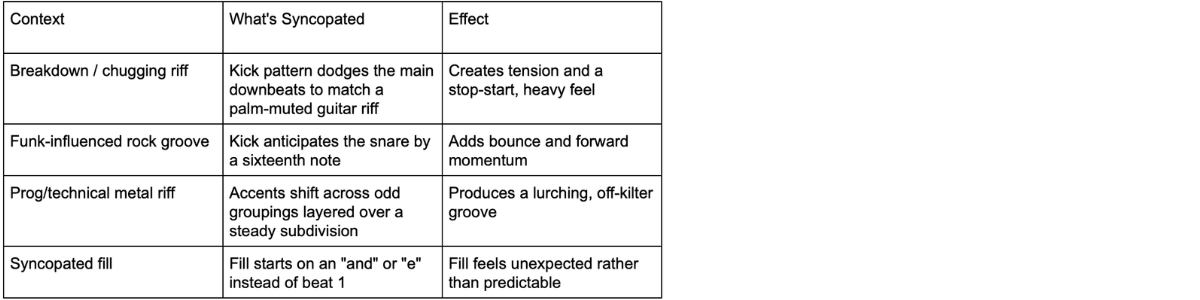
Notice that none of these require anything exotic technically — a blast beat, a double-kick pattern, or a straightforward rock beat can all be syncopated or not, depending purely on where the accents land. Syncopation is a layer you apply on top of technique, not a separate skill set.
Common Mistakes When Playing Syncopation
Losing the Pulse While Playing the Off-Beat
Why it's wrong: Beginners often nail the syncopated hit but drift the underlying tempo to get there, because they're chasing the accent instead of staying locked to the grid.
How to fix it: Keep counting out loud even after you've learned the pattern. The moment you stop counting is usually the moment the time starts sliding.
Rushing Into the Off-Beat Hit
Why it's wrong: Syncopated notes often get anticipated — played slightly early because the drummer is anxious to land the accent — which flattens the exact tension that makes syncopation work.
How to fix it: Practice at a slower tempo than feels necessary and resist the urge to rush toward the accent. The off-beat needs to land exactly where it's supposed to, not a hair early.
Treating Every Beat as Equally Syncopated
Why it's wrong: Over-syncopating a groove — accenting almost everything off the beat — makes a pattern sound chaotic instead of driving. Syncopation works because it's a deviation from an expected pulse, and if there's no clear pulse left, there's nothing to deviate from.
How to fix it: Keep most of your pattern anchored to the beat and use syncopation selectively, on the notes you actually want to stand out.
Only Practicing Syncopation in Isolation
Why it's wrong: Nailing a syncopated exercise on a practice pad doesn't automatically transfer to playing it inside a full groove with a hi-hat pattern, a song structure, and a band around you.
How to fix it: Once an exercise feels solid, immediately apply it to a real beat or a song you're learning. That's the context where syncopation actually needs to hold up.

Beginner Tips for Feeling Syncopation Naturally
- Count out loud longer than feels necessary. Most drummers stop counting the moment a pattern feels okay, then lose the pulse under pressure. Keep counting until it's genuinely automatic.
- Listen for syncopation in songs you already know. Once you know what to listen for, you'll start hearing syncopated kicks and snare hits everywhere in rock and metal you've heard a hundred times without noticing.
- Start with one syncopated note, not a whole pattern. Trying to syncopate an entire groove at once is how timing falls apart. Change one note, get it solid, then change another.
- Use a metronome on beats 2 and 4 only. This forces you to feel the "and" and "e" subdivisions yourself instead of leaning on a click for every subdivision — a genuinely useful drill once straight time is solid.
- Write your own syncopated variation of a beat you already play. I usually take a groove I already know cold and shift a single kick hit off the beat just to hear what changes. It's the fastest way to internalize the feel rather than just the theory.
Final Thoughts
Syncopation isn't a trick you bolt onto a groove — it's a shift in where you place emphasis within a pattern you probably already know how to play. Once you can count it, hear it, and move accents deliberately instead of by accident, you'll notice it in nearly everything you listen to, and you'll start writing it into your own beats and fills without having to think it through note by note.
Start slow, keep counting out loud, and change one note at a time. That's the whole method. The feel comes from repetition, not from understanding the theory perfectly on the first pass.
FAQ
What's the difference between syncopation and an off-beat?
An off-beat is a specific location — the "and" between two main beats. Syncopation is the broader concept of accenting any weak subdivision, including off-beats, "e"s, and "a"s, in a way that goes against the expected pulse. Every off-beat accent is syncopation, but syncopation isn't limited to just the "and."
Do I need to read music to understand syncopation?
No. Counting out loud and training your ear will get you there faster than notation alone. Reading helps once you want to transcribe or write out syncopated patterns precisely, but the feel comes from counting and listening first.
Why is syncopation harder at faster tempos?
At faster tempos, the gap between the expected beat and the syncopated hit shrinks, giving you less room to correct if your timing drifts. Always learn a syncopated pattern slow and build up speed gradually rather than trying to play it fast from the start.
Is syncopation only used in funk and jazz?
No — that's a common misconception. Syncopation is foundational to rock and metal grooves too, especially in breakdowns, chugging riffs, and progressive playing. It's just less obviously labeled in those genres than it is in funk.
What's a good book or resource for practicing syncopation?
Ted Reed's "Progressive Steps to Syncopation for the Modern Drummer" is the standard reference most drum teachers assign, and it's worth working through even if you never play jazz — the exercises translate directly into rock and metal kick and snare patterns.
How do I know if a fill or groove I'm playing is syncopated?
Count it out loud. If any of your accented hits land on an "and," "e," or "a" instead of squarely on 1, 2, 3, or 4, it's syncopated. If every accent lines up with the main beats, it isn't.