To play linear drumming, you strike only one drum or cymbal at a time, spacing every hit so no two limbs ever land together — the opposite of a standard rock beat, where the kick and hi-hat often stack on the same beat. The result is a groove or fill that feels open, articulate, and easy to hear one note at a time.
Linear playing shows up everywhere in modern metal and progressive rock — Danny Carey, Tomas Haake, and Matt Halpern all lean on it constantly, and it's one of the fastest ways to add complexity to your playing without needing blinding speed. It's also one of the more confusing concepts for drummers moving past basic rock beats, because it asks you to unlearn the instinct to lock your hands and feet together.
In this guide, we'll define linear drumming clearly, show you how it's different from the grooves you already play, break down the limb-independence work you need to get there, and walk through a step-by-step first fill plus a handful of grooves to build from. We'll also cover the mistakes that trip up most drummers learning this style and how to avoid them. By the end, you'll be able to build your own linear patterns instead of just copying ones you've heard.
When you’re done reading, you will be familiar with:
- What Is Linear Drumming?
- Linear vs. Standard Drumming: What's the Difference?
- Why Metal and Rock Drummers Use Linear Patterns
- The Building Blocks: Sticking and Limb Independence
- Step-by-Step: Playing Your First Linear Fill
- Linear Groove Patterns to Practice
- Common Mistakes
- Beginner Tips
- Conclusion
- FAQ
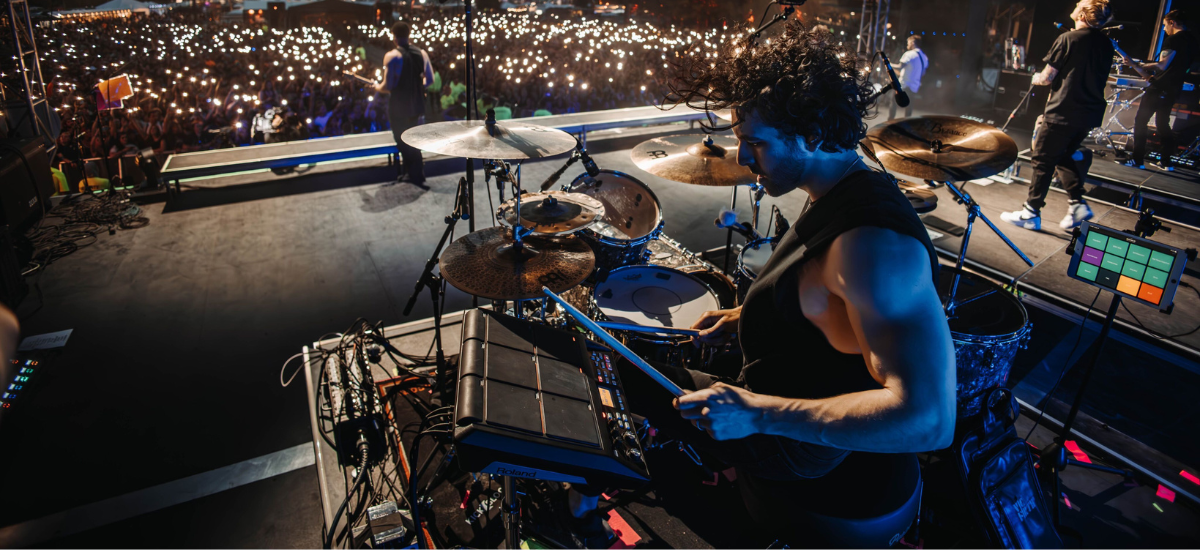
What Is Linear Drumming?
Linear drumming is a way of arranging notes across the kit so that every limb takes its turn — kick, then snare, then hi-hat, then tom, and so on — without any two hitting at exactly the same moment. In standard drumming, you'll often play the kick and hi-hat together, or the snare and hi-hat together. Linear playing removes those stacked hits entirely.
The term comes from session drummer and educator Gary Chester, who taught the concept as a way to build coordination between the four limbs by forcing them to play in sequence rather than in unison. It's not a genre or a specific pattern — it's a rule you apply to how you construct a groove or fill.
Linear vs. Standard Drumming: What's the Difference?
The easiest way to hear the difference is to compare a basic rock beat to its linear equivalent. In a standard rock beat, the hi-hat plays straight eighth notes while the kick and snare land underneath it — meaning the hi-hat frequently overlaps with the kick or snare on the same sixteenth-note slot. In a linear version of that same idea, you'd move the hi-hat note out of the way any time the kick or snare needs that slot, so only one voice ever speaks at once.
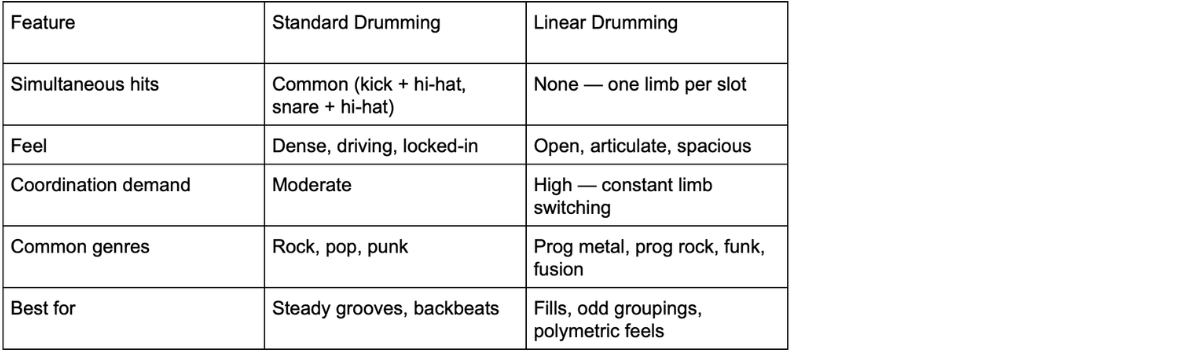
Neither approach is "better" — they're tools for different jobs. Most drummers play almost entirely in the standard style and reach for linear patterns specifically when they want a groove or fill to feel less predictable. If you're still building comfort with basic notation and counting, our guide on reading drum tabs ad where each hit falls.
Why Metal and Rock Drummers Use Linear Patterns
Linear playing became a signature tool in progressive metal and rock because it lets a drummer create complex, angular-sounding parts without needing extreme speed. A slow, spaced-out linear fill can sound just as intricate as a fast one, because the ear is tracking sequence and placement rather than raw velocity.
- Odd groupings feel natural. Bands like Meshuggah and Periphery build riffs around groupings of five, seven, or nine notes. Linear phrasing makes it easier to land kick and snare accents cleanly inside those groupings without limbs colliding.
- It creates space in dense mixes. Metal and prog-rock arrangements are often guitar-heavy. A linear groove that never stacks two drum voices at once cuts through more clearly than a dense, layered pattern would.
- It's a fill-writing tool, not just a groove tool. Even drummers who rarely play full linear grooves use linear thinking to write fills — spacing hits across the kit so a fill sounds deliberate instead of cluttered.
If you already play blast beats or work with odd time signatures, linear drumming is a natural next step — it uses a lot of the same limb-independence work, just applied to spacing instead of speed.
The Building Blocks: Sticking and Limb Independence
Linear drumming isn't a rhythm you memorize — it's a coordination skill. Before you can build your own patterns, you need two things: a mental map of which limb plays which sound, and enough independence that your limbs don't default to playing together out of habit.
Know Your Voices
Every linear pattern is built from a small set of "voices" you rotate between:
- Kick (bass drum) — the foundation, usually the busiest voice in metal-influenced linear playing.
- Snare — usually carries the accents.
- Hi-hat or ride — keeps a sense of pulse between accents.
- Toms — add pitch movement and are common in linear fills especially.
Break the Habit of Playing Together
Most drummers' hands and feet are trained to lock together, because that's how basic grooves work. Linear playing asks you to consciously override that. A simple way to build this: take a basic sticking like right-hand, left-hand, kick, and play it slowly on a practice pad with your foot, making sure no two land at once. It feels awkward before it feels natural — that's expected.
Rudimental control still matters here. If your hands aren't independently even, your linear patterns will sound sloppy no matter how well you've mapped them out. Time spent on the paradiddle and other sticking patterns pays off directly here, since linear phrases are essentially rudiments distributed across the kit instead of played on one surface.
Step-by-Step: Playing Your First Linear Fill
Here's a simple four-beat linear fill using sixteenth notes, moving from kick to snare to toms. Work through it slowly before adding speed.
- Set your subdivision. Count sixteenth notes at a slow tempo — around 60 BPM to start. Each beat has four slots.
- Beat 1: Kick, kick, snare, kick. Play the kick on the first, second, and fourth sixteenth, and the snare alone on the third. Nothing overlaps.
- Beat 2: High tom, kick, snare, kick. Introduce the high tom on the first sixteenth, then alternate kick and snare through the rest of the beat.
- Beat 3: Mid tom, kick, high tom, kick. Keep the kick as your connective thread between the two toms.
- Beat 4: Floor tom, kick, snare, crash (on the following downbeat). Resolve the fill by descending in pitch, landing back on the groove with a crash.
- Loop it slowly. Play the four-beat fill on repeat at your starting tempo until every hit is even and isolated — no rushed pairs, no accidental doubles.
- Increase tempo gradually. Move up in small increments (5 BPM at a time) rather than jumping straight to performance speed.
Linear Groove Patterns to Practice
Fills are the easiest entry point, but linear thinking also works as a full groove. Here are a few practice patterns, ordered from simplest to most demanding.
Pattern 1: Basic Linear Groove
Kick, hi-hat, snare, hi-hat, kick, hi-hat, snare, hi-hat — repeating every eighth note with no two limbs stacked. This is the linear equivalent of the most basic rock beat and a good first target for feeling the "no overlap" rule in a groove context, not just a fill.
Pattern 2: Displaced Snare
Same basic sequence, but move the snare hit off the expected beat 2 and 4 backbeat by a sixteenth note in either direction. This is a staple prog-rock move — it keeps the groove recognizable while adding a subtle, off-kilter feel.
Pattern 3: Odd Grouping Linear Fill
Build a five-note grouping (kick, snare, kick, tom, kick) and repeat it against a steady quarter-note pulse elsewhere in the band. Because the grouping doesn't divide evenly into 4/4, it creates the shifting, "off the grid" feeling common in bands like Meshuggah — related in spirit to the gallop rhythm and other metal-specific groupings, just spread across more limbs.
Common Mistakes
Accidentally Doubling Limbs
Why it's wrong: The whole point of a linear pattern collapses if two limbs land together, even briefly. This usually happens when a drummer's hands revert to habit under tempo pressure.
How to fix it: Slow down until you can consciously track every hit. Say each limb out loud as you play ("kick, snare, hat, tom") until the sequence is automatic.
Rushing the Tempo Before the Pattern Is Clean
Why it's wrong: Linear patterns expose timing weaknesses fast. Speeding up before the sequence is even just locks in bad habits at a higher tempo, which is much harder to unlearn later.
How to fix it: Use a metronome and only increase tempo once you can play the pattern cleanly ten times in a row without a mistake.
Playing Linear Patterns Stiffly
Why it's wrong: Because every hit is isolated, it's tempting to play each one with equal, mechanical weight. This kills the groove and makes linear fills sound like an exercise instead of music.
How to fix it: Add dynamics on purpose — accent the notes that would naturally get emphasis in the phrase (usually the snare and crash) and let the connective kick hits sit slightly softer.
Skipping Limb-Independence Work
Why it's wrong: Trying to learn linear fills as memorized patterns, without building the underlying coordination, means you'll only ever be able to play the exact patterns you've drilled — nothing more.
How to fix it: Spend real practice time on independence exercises separate from any specific fill. Once your limbs move independently by default, building new linear patterns becomes much faster.
Beginner Tips
- Start on a pad, not the full kit. Working out the sticking and foot pattern on a single surface (tapping your foot on the floor) removes the distraction of moving around the kit until the coordination is solid.
- Isolate two limbs at a time. Instead of jumping straight to four-limb patterns, practice kick-and-snare-only linear phrases first, then add the hi-hat, then the toms.
- Say the pattern before you play it. Verbalizing the limb order ("kick-snare-hat-kick") locks the sequence into memory faster than repetition alone.
- Record yourself. Linear mistakes are easy to miss in the moment but obvious on playback. A quick phone recording will catch doubled hits you didn't notice while playing.
- Borrow from songs you already know. Listening closely to drummers like Danny Carey (Tool) or Matt Garstka (Animals as Leaders) and picking out short linear phrases by ear is one of the fastest ways to build a vocabulary of usable patterns.
Conclusion
Linear drumming isn't a genre trick — it's a coordination principle that happens to sound incredible in metal, prog rock, and funk. Once you can reliably keep every limb from overlapping, you have a flexible tool for writing fills and grooves that feel deliberate and open rather than dense and predictable. Start slow, isolate your limbs, and build up from simple two-limb patterns before chasing the four-limb phrases you hear from your favorite drummers.
FAQ
Is linear drumming hard to learn?
It's more of a coordination challenge than a speed challenge, so it's approachable at any skill level as long as you start slow. Drummers with solid rudiment control and basic limb independence pick it up faster, but anyone can build the skill with consistent, slow practice.
Do I need to know rudiments before learning linear drumming?
Not strictly, but it helps enormously. Since linear patterns are often built from familiar stickings spread across the kit, a solid base in rudiments like the paradiddle makes the sticking side of linear playing much more intuitive.
What's the difference between a linear fill and a normal drum fill?
A normal fill can include stacked hits (like a kick and tom together), while a linear fill deliberately avoids any overlap. Linear fills tend to sound more spaced out and articulate, while standard fills can sound denser and more powerful.
Which drummers are known for linear playing?
Danny Carey (Tool), Tomas Haake (Meshuggah), Matt Halpern (Periphery), and Matt Garstka (Animals as Leaders) are commonly cited examples in metal and progressive rock. The technique also has deep roots in funk and fusion drumming, going back to players like David Garibaldi.
Can linear drumming be used in simple rock or pop songs?
Yes, though it's used more subtly there — usually as a fill-writing tool rather than a full groove. A linear turnaround fill can add interest to an otherwise straightforward rock song without changing the overall feel of the track.
How long does it take to get comfortable with linear patterns?
Most drummers with basic independence can play simple linear fills cleanly within a few weeks of regular practice. Applying linear thinking fluidly and improvising your own patterns takes longer — often several months of consistent work.