The best drum brands for most players are Pearl, Ludwig, Tama, DW, Yamaha, and Gretsch — each builds quality kits, but they're not all built for the same player, budget, or sound. Knowing the difference saves you from spending money on the wrong kit.
Walk into any drum shop and the number of name badges on the shells can feel overwhelming — especially if you're buying your first kit or upgrading for the first time. Some brands are famous because of their history and the artists who play them. Others earned their reputation through build quality, consistency, or value at a specific price point. A lot of that reputation is deserved. Some of it is just marketing.
This guide covers the major drum manufacturers you'll actually encounter when shopping, what they're known for, who each one suits best, and how to think about brand vs. budget when you're making a decision. We'll also cover what to look for in any kit at any price — because the brand name on the badge matters less than most beginners think.
When you’re done reading, you will be familiar with:
- Does Brand Actually Matter?
- The Major Drum Brands: What You Need to Know
- Solid Budget Brands Worth Knowing
- Brand vs. Budget: How to Think About It
- What to Actually Look For in Any Kit
- Common Mistakes When Choosing a Drum Brand
- Beginner Tips for Picking a Brand
- Final Thoughts
- FAQ

Does Brand Actually Matter?
Yes — but probably not in the way you're thinking. Brand matters because it tells you something about the company's quality control, the materials they tend to use, the price tier they operate in, and what kind of sound philosophy they've built into their shells. What brand doesn't tell you is whether that specific kit is right for you at that price.
A $600 Pearl kit will outperform a $600 no-name kit every time, because Pearl has decades of production experience and supply chain investment behind that price point. But a $600 Pearl won't beat a $1,500 Yamaha kit just because of the badge — that's price, materials, and construction doing the work.
The practical rule: within the same price range, brand matters. Across very different price ranges, budget almost always wins.
The Major Drum Brands: What You Need to Know
These are the manufacturers you'll see in every drum shop, every studio, and on most professional stages. They've all been around long enough to have a legitimate track record, and all of them make kits across multiple price tiers — from entry-level beginner setups to high-end custom instruments.
Pearl
Pearl is one of the most widely distributed drum brands in the world, and for good reason — they make reliable kits at every price point, from the beginner-friendly Export series all the way up to their high-end Masters and Reference lines. Their beginner kits are consistently some of the best value in the market: the hardware is solid, the shells are decent, and the heads are playable (though most drummers swap them eventually).
Pearl also has some of the best hardware in the industry at mid-range prices — their hi-hat stands, bass drum pedals, and cymbal stands tend to outlast the competition at similar price points. If you're buying a complete kit as a beginner and don't want to overthink it, Pearl is one of the safest choices out there.
- Known for: Reliability, value at beginner/mid price points, excellent hardware
- Popular series: Export (beginner), Session Studio (mid), Masters (pro)
- Best for: First kit buyers, drummers who need durable hardware
Ludwig
Ludwig is arguably the most iconic name in drumming history. Ringo Starr played Ludwig. John Bonham played Ludwig. The Vistalite kit, the Acrolite snare, the Black Beauty — these are instruments that defined the sound of rock for decades. If you've ever heard a vintage rock recording and thought "that's the sound," there's a good chance it came from a Ludwig kit.
Modern Ludwig kits keep that heritage alive with their Breakbeats (a compact 4-piece designed by Questlove), Classic Maple, and Keystone series. Their craftsmanship at the higher end is exceptional, and even their budget kits carry some of that character. Ludwig skews toward warmer, more vintage-sounding tones compared to some of their competitors.
- Known for: Heritage, warm/vintage tone, iconic snare drums
- Popular series: Breakbeats (compact), Accent (beginner), Classic Maple, Keystone (pro)
- Best for: Rock players, drummers who want a classic sound, gear collectors
Tama
Tama is a Japanese brand that's built a reputation for technical precision and consistently excellent hardware. Their Superstar series is a workhorse that shows up in rehearsal rooms and mid-size venues worldwide. At the pro level, the Starclassic line is genuinely impressive — tight shells, excellent bearing edges, and a focused attack that records beautifully.
Tama's Speed Cobra bass drum pedals have a cult following among drummers who need fast, precise footwork. If hardware matters to you — and it should — Tama is one of the first brands worth looking at. Their beginner kit, the Imperialstar, also offers really good value and comes with Meinl HCS cymbals included.
- Known for: Hardware quality, technical precision, great bass drum pedals
- Popular series: Imperialstar (beginner), Superstar (mid), Starclassic (pro)
- Best for: Technical players, drummers who prioritize hardware, metal and rock players
DW (Drum Workshop)
DW is a California-based company that has become synonymous with high-end American craftsmanship. Their kits are not cheap — but at their price point, they're about as good as production drums get. DW builds kits for many of the biggest names in music, and their 5000 series hardware and 9000 series pedals are industry standards in professional touring.
The DW Collector's Series lets you customize nearly every aspect of your kit — shell material, depth, finish, hardware — which makes it a go-to for serious players who want something built exactly to their specs. For beginners, DW is probably overkill, but if you're shopping at the pro level, they belong in the conversation.
- Known for: Premium craftsmanship, excellent pedals, heavy customization options
- Popular series: Performance (mid), Design (mid), Collector's (pro)
- Best for: Professional players, drummers who want American-made quality
Yamaha
Yamaha makes drums the same way they make everything else — with meticulous quality control and consistency across price points. Their beginner kits (the Stage Custom and DTX Compact range) are some of the most reliable in their price class, and the Recording Custom series has been one of the most recorded drum kits in history — you'll hear it on sessions from the 1970s through today.
Yamaha's electronic drum line is also among the best in the industry. If you're considering an e-kit, the DTX series is worth serious attention. They also have some of the most respected hardware at mid-range prices. A Yamaha kit tends to feel neutral and balanced — it won't impose a strong character on your sound, which makes it a great choice for versatile players.
- Known for: Consistent quality control, neutral/versatile tone, electronic drums
- Popular series: Stage Custom (mid), Recording Custom (pro), DTX (electronic)
- Best for: Versatile players, studio work, electronic drum buyers
Gretsch
Gretsch has one of the most distinctive voices of any drum brand. Their shells have a warm, resonant, slightly "ringy" character that sounds incredible in jazz, blues, and classic rock — and can be challenging to control if you're going for a very dry, controlled studio sound. Phil Collins played Gretsch. Max Weinberg plays Gretsch. The sound is warm, fat, and alive.
The Catalina series is accessible and sounds better than its price suggests. The Brooklyn and USA Custom lines are pro-level instruments that hold their own against anything on the market. If tone is your priority and you're drawn to that organic, slightly vintage feel, Gretsch is hard to beat.
- Known for: Warm, resonant tone, jazz and rock heritage, distinctive character
- Popular series: Catalina (mid), Brooklyn (pro), USA Custom (premium)
- Best for: Jazz players, blues, classic rock, tone-focused drummers
Sonor
Sonor is a German brand that doesn't always get the attention it deserves in North America, but has a strong following in Europe and among drummers who care deeply about shell quality. Their AQ2 series is excellent at mid-range prices, and the SQ2 custom line is one of the most customizable production kits on the market. Sonor tends toward a focused, punchy sound with excellent projection.
- Known for: German engineering, excellent shell quality, punchy projection
- Popular series: AQ2 (mid), SQ2 (custom)
- Best for: Drummers who prioritize shell quality, touring players
Solid Budget Brands Worth Knowing
Not every brand operates at the mid-to-pro level, and that's fine — a lot of beginners need something functional and affordable, not something for the studio. These brands consistently deliver at the entry level.
Alesis
Alesis is primarily an electronic drum brand, and they've become one of the most popular entry-level e-kit manufacturers. The Nitro and Strike series are common starter electronic kits — not without limitations (mesh heads and module quality improve significantly as you move up in the Alesis line), but solid for a first electronic setup. If you're considering going electronic, check out the full breakdown in our guide on setting up an electronic drum kit.
Mapex
Mapex makes some of the best bang-for-the-buck acoustic kits at the beginner and mid tier. Their Tornado series is a decent starter kit, and the Armory and Saturn lines are legitimately competitive with mid-range offerings from Pearl and Tama. Mapex sometimes flies under the radar, but their quality has improved significantly over the past decade.
PDP (Pacific Drums and Percussion)
PDP is DW's more affordable sub-brand. Because of that connection, the quality control is solid for the price. The Center Stage and Concept series are popular choices for beginners who want a name-brand kit without paying full DW prices. The hardware benefits from DW's engineering, which matters more than most people realize.
Ahead, Dixon, CB, and GP Percussion
These brands operate at the very entry level — mainly found in starter packs sold at big-box music stores or online. They're playable and useful for getting a feel for the instrument, but the hardware tends to be weaker and the shells less consistent. Fine for a child's first kit or someone just testing the waters, but most players upgrade within a year or two.
Brand vs. Budget: How to Think About It
The biggest mistake drummers make when buying is treating brand loyalty as a substitute for research. Here's a cleaner way to frame the decision:
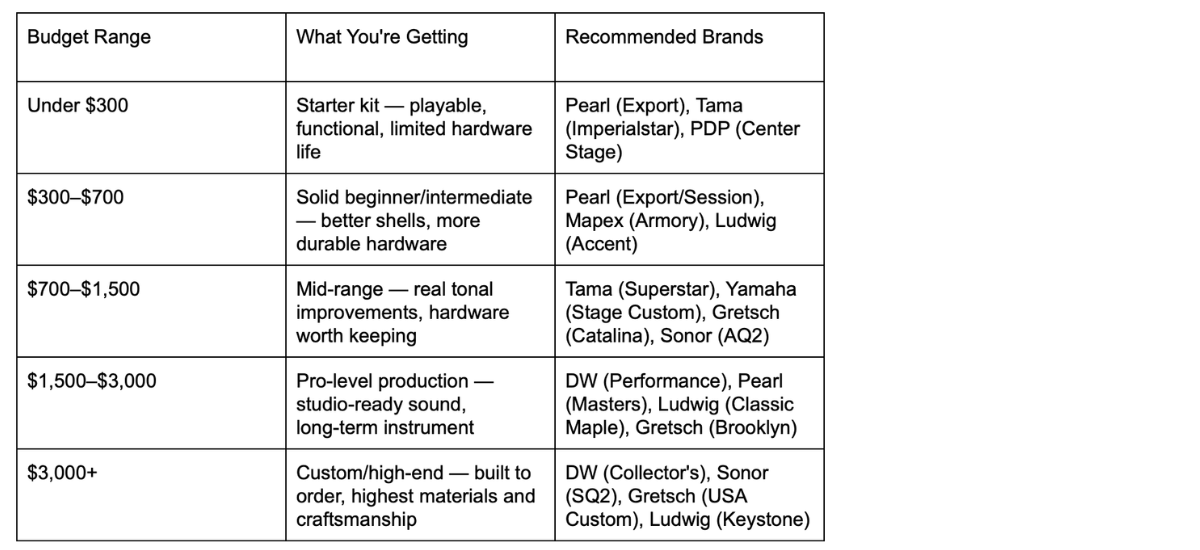
If you're choosing your first full kit, our guide to the best beginner drum sets walks through specific kit recommendations at different price points.
What to Actually Look For in Any Kit
Regardless of brand, these are the things worth examining before you commit to any drum kit:
Shell Material and Construction
Most production kits use poplar, basswood, birch, or maple. Maple is the most sought-after wood — it has warm low-end, good projection, and records beautifully. Birch is brighter and punchier with faster attack, which is why it's popular in recording studios. Poplar and basswood are common in beginner kits; they're fine, but you'll notice the difference once you play a maple kit.
Ply count and shell thickness also matter. A 6-ply maple shell behaves differently than a 10-ply shell of the same wood — thicker shells tend to be louder and more focused, thinner shells more open and resonant.
Bearing Edges
The bearing edge is where the drum head sits on the shell. A well-cut, consistent bearing edge is one of the most important factors in how a drum tunes and responds. Cheap kits often have inconsistent edges — which is why even replacing the heads doesn't help as much as you'd hope. High-end kits invest heavily in edge quality.
Hardware Quality
Lugs, tension rods, tom arms, bass drum legs, and cymbal/hi-hat stands all take a beating. Inferior hardware fails faster, strips threads, and generally makes your life miserable during setup. Many drummers keep their first kit's shells for years but upgrade the hardware early. Pay attention to how solid the tom arm mounts feel and whether the legs on the bass drum are properly spiked. Knowing how to tune your drums properly also becomes much easier when the hardware holds its position reliably.
Included Heads
Most kit heads at the entry and mid level are factory stock and acceptable to get started, but not exceptional. The good news is heads are one of the easiest and most cost-effective upgrades you can make — swapping to quality heads from Evans, Remo, or Aquarian will improve any kit's sound dramatically. Our guide on how to choose drum heads covers what to swap to based on your sound goals.
Common Mistakes When Choosing a Drum Brand
Buying Based on Your Favorite Drummer's Gear
Why it's wrong: The fact that Dave Grohl plays a DW kit has very little to do with whether a DW kit is right for you at your budget. Pro drummers play what they're sponsored to play, or what costs thousands of dollars more than the kit you're actually comparing. The brand endorsement doesn't translate down the price range.
How to fix it: Use artist endorsements as proof that a brand builds quality at the top end — not as a reason to buy a specific kit. Focus on what that brand offers at your actual price range and compare it to what other brands offer at the same price.
Ignoring the Cymbals and Hardware That Come with a Kit
Why it's wrong: Many beginner drum sets come packaged with cymbals and hardware, and the included cymbals are often the weakest part of the deal. Cheap brass cymbals sound thin and trashy — and no amount of good drumming will make them sound better. If the deal looks great but the cymbals are low-quality, you'll be replacing them within six months.
How to fix it: Factor the cymbal cost into your budget separately. It's often better to buy a shells-only kit at a higher price point and invest separately in a decent hi-hat and crash from Zildjian, Sabian, Meinl, or Paiste. Our complete guide to types of cymbals covers how to choose wisely.
Spending All Your Budget on the Kit and Nothing on Maintenance
Why it's wrong: Drum heads wear out. Heads that are dented, stretched, or pitted can't be tuned to sound good — no matter how good the shells underneath them are. A $200 kit with fresh heads will sound better than a $500 kit with neglected, years-old factory heads.
How to fix it: Budget for head replacement. A full set of decent heads costs $80–$150 and makes a dramatic difference. If your kit sounds bad and you haven't changed the heads in over a year of regular playing, start there before assuming it's the shells.
Buying Used Without Checking the Bearing Edges
Why it's wrong: A used kit from a reputable brand can be excellent value — but only if the shells are intact. Cracked bearing edges, warped shells, and stripped lugs can make even a good brand's drums unplayable, and those problems aren't always visible from a photo.
How to fix it: When buying used, run your finger around the bearing edge of each shell. It should be smooth and consistent all the way around. Tap near each lug and listen — the pitch should be even. Check every tension rod for thread damage. A good used kit from a solid brand beats a cheap new kit almost every time, but only if the shells are healthy.

Beginner Tips for Picking a Brand
- Start with the big five for your first kit: Pearl, Tama, Yamaha, Ludwig, and Mapex consistently deliver at beginner prices. Any of them will serve you well for the first few years.
- Play before you buy if at all possible. Different shells have different characters. Even within the same brand, kits sound different. If you can get to a drum shop and sit behind a few kits in your price range, you'll know immediately which one feels right.
- Look for complete kits that include hardware but not cymbals. Hardware bundled with a kit is usually a good deal. Cymbals bundled with a kit are usually not. Separate the two and you'll get more value.
- Don't underestimate the snare drum. Most kit snare drums at the beginner level are mediocre. A used Ludwig Acrolite, Pearl Free-Floating, or even a decent budget snare you buy separately can transform how your kit sounds. If one piece is worth upgrading first, it's the snare.
- A mid-range used kit beats an entry-level new kit. A used Tama Superstar or Yamaha Stage Custom in good condition is worth more than a new Pearl Export or similar kit at the same price. Used gear from quality brands is one of drumming's best-kept secrets.
- The drum throne matters more than most beginners think. Whatever kit you buy, pair it with a seat you can actually sit on for a full practice session. A wobbly, uncomfortable throne will affect your playing and your posture. Knowing how to choose the right drum throne is worth your time.
Final Thoughts
No single drum brand is universally best — the right choice is the one that fits your budget, your sound, and where you are as a player. Pearl and Tama are safe bets for beginners. Yamaha is hard to beat for reliability and versatility. Gretsch and Ludwig have tonal personalities that either click with you or they don't. DW is where you end up when budget is no longer the main constraint.
More than the badge, focus on the bearing edges, the hardware, and the heads. Those three things determine 80% of how a kit actually sounds and plays. Buy the best kit you can afford from a reputable brand, change the heads early, learn to tune, and your kit will serve you well for years.
FAQ
What is the best drum brand for beginners?
Pearl and Tama are consistently the strongest choices for beginners. The Pearl Export and Tama Imperialstar both offer durable hardware, decent shells, and good overall value. Yamaha's Stage Custom is also excellent for players willing to spend a bit more.
What drum brand do most professionals use?
DW, Pearl, Tama, and Yamaha dominate professional touring and studio settings. Ludwig has a strong presence in rock and heritage contexts. Many pros are also sponsored, so what you see on a stage is as much about endorsement deals as personal preference.
Is Ludwig better than Pearl?
They're different more than one is "better." Ludwig skews toward warm, vintage character — great for rock and jazz. Pearl skews toward versatility and durability, especially at mid-range prices. At comparable price points, it comes down to sound preference and whether you value Pearl's hardware or Ludwig's tonal character.
Are expensive drums worth it?
At the professional level, yes — the improvement in shell quality, bearing edge precision, and hardware longevity is real and audible. Below $700 or so, the difference between a mid-range kit and an expensive one is noticeable but not as dramatic. The upgrade that gives most drummers the best return is better drum heads, not a more expensive kit.
Can a cheap drum kit sound good?
With fresh heads, proper tuning, and decent technique, yes. A well-tuned entry-level kit with quality heads will sound better than a mid-range kit with old, neglected stock heads. Brand and price only take you so far — setup and maintenance fill in the rest.
What brand makes the best snare drum?
Ludwig's Black Beauty (steel) and Acrolite (aluminum) are icons. Pearl's Free-Floating series is beloved by studio players. Tama and DW both make excellent snares. For budget options, the Pearl Sensitone is widely praised. "Best" depends heavily on what sound you're after.