Most beginners can play a basic beat and keep a steady tempo within 4 to 8 weeks of consistent practice. Playing actual songs with confidence usually takes 3 to 6 months. Getting to the point where you can sit in with a band comfortably — most players hit that somewhere between one and two years in.
That range is wide, and it's wide for real reasons. How fast you progress depends on how often you practice, whether you're getting proper guidance, whether you've played another instrument before, and honestly — how well you respond to the physical demands of the instrument. Drumming is coordination work, and some people's bodies adapt faster than others. That's not discouraging; it's just honest.
What this guide will do is give you realistic expectations at each stage, explain what actually separates fast learners from slow ones, break down what "learning drums" looks like in practice at 1 month, 3 months, 6 months, and 1 year, and tell you the mistakes that reliably slow beginners down. By the end, you'll know where you're headed and what to focus on to get there faster.
When you’re done reading, you will be familiar with:
- A Realistic Timeline: What to Expect at Each Stage
- What Actually Affects How Fast You Progress
- What Does "Learning Drums" Actually Mean?
- How Much Practice Time Do You Really Need?
- Common Mistakes That Slow Beginners Down
- Tips to Speed Up Your Progress
- Final Thoughts
- FAQ
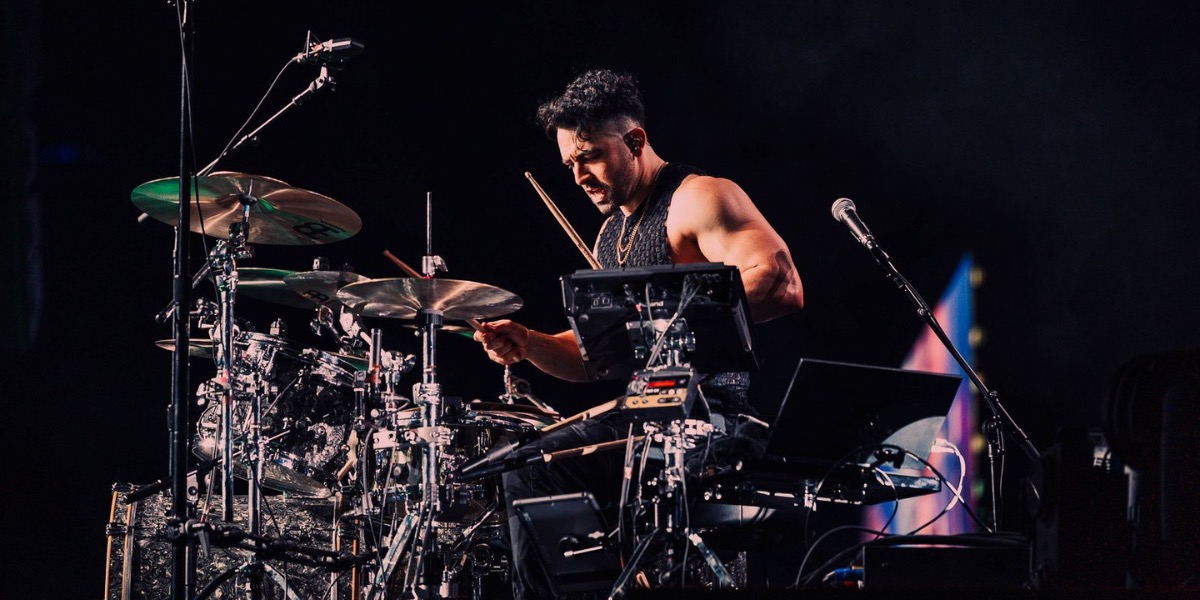
A Realistic Timeline: What to Expect at Each Stage
Progress isn't linear — you'll have weeks where everything clicks and weeks where you feel like you're going backwards. But there are recognizable milestones most beginners hit in a predictable order, assuming they're practicing regularly (even just 20–30 minutes most days).
Weeks 1–4: Getting Oriented
Your first month is almost entirely about physical coordination and basic orientation. You're teaching your hands and feet to move independently of each other — which is genuinely hard and feels awkward for most people at first. That discomfort is normal and temporary.
By the end of week four with consistent practice, most beginners can:
- Sit comfortably at a kit with proper posture and reach
- Hold sticks correctly in at least one grip style
- Play a basic kick-snare pattern (bass drum on beats 1 and 3, snare on 2 and 4)
- Add a steady hi-hat on top
- Count through a simple beat without losing their place completely
It won't sound polished. Your timing will be inconsistent, and you'll lose the coordination between limbs more often than not. That's fine — those are the exact things you're there to train.
Learning to hold your sticks right from day one makes a real difference in how quickly this first stage goes. There are several grip styles, and getting the fundamentals right early means you don't have to unlearn bad habits later. Our guide on how to hold drumsticks covers the main options and how to decide which one to use.
Months 1–3: Building Real Coordination
This is the stage where things start to click. Your limb independence improves noticeably, your timing gets more consistent, and playing starts to feel physical rather than purely mental. You're not counting out loud every beat anymore — you're starting to feel it.
By the end of three months of regular practice:
- You can play several standard rock beats without stopping to think
- You can keep a steady tempo for a full song length (with a metronome)
- You've started to understand drum notation or drum tabs well enough to learn patterns from them
- Simple fills at the end of phrases don't completely derail your groove
- You can probably play along to at least a few simple songs all the way through
This is often when drumming starts to genuinely feel fun rather than just frustrating. If you push through the first 4–6 weeks of awkward coordination work, you reach a point where the instrument starts rewarding you.
Being able to read drum notation — or at least drum tabs — matters a lot here. It gives you access to a huge library of patterns you can learn on your own, which accelerates progress dramatically. Our guide to reading drum tabs is a good starting point if you haven't tackled this yet.
Months 3–6: Playing Songs and Developing Groove
Between three and six months, the focus shifts from "can I do this" to "can I make this sound good." Keeping time stops being a conscious effort and starts being automatic. You start noticing dynamics — playing softer ghost notes on the snare, varying hi-hat intensity, letting the kick breathe.
Realistic expectations by month six:
- A repertoire of 10–15 songs you can play through from start to finish
- Comfortable with basic rudiments — single stroke roll, double stroke roll, paradiddle
- Can play at multiple tempos without losing the groove completely
- Starting to learn fills that connect sections of songs naturally
- Basic understanding of different genres (rock, shuffle, jazz feel)
6 Months to 1 Year: Getting Band-Ready
This is the gap between "I play drums" and "I play drums with other people." Playing with a band introduces challenges that solo practice doesn't — you have to lock in with a bassist, respond to dynamics in real time, adjust your tempo without a metronome, and recover from mistakes without stopping.
Most drummers who are practicing consistently and have had some instruction are band-ready somewhere in this window. That doesn't mean gig-ready — it means you can sit in a rehearsal room and be more of a contribution than an obstacle.
By the end of year one:
- Comfortable with a broad range of beats across genres
- Can improvise basic fills in real time without derailing the groove
- Understand how to tune and maintain your kit
- Have strong enough fundamentals to learn new material quickly
- Beginning to develop your own feel and rhythmic personality
Year 2 and Beyond: Mastery Is a Moving Target
After year one, drumming never stops getting harder — which is actually what makes it interesting. You'll spend years developing limb independence across different meters, learning genre-specific techniques, refining your tone and dynamics, and building the kind of musicality that separates good drummers from great ones. Professional touring and session drummers will tell you they're still learning. That's not false modesty. The instrument has a very high ceiling.
What Actually Affects How Fast You Progress
Two people starting on the same day with the same kit can be in completely different places after six months. Here's what separates them:
Practice Frequency and Consistency
This is the biggest variable by far. Four 20-minute sessions per week will get you further than one two-hour session per week — even though the total time is the same. Short, frequent sessions build muscle memory and coordination faster than long, infrequent ones. Your brain consolidates motor skills during rest, so daily or near-daily short sessions outperform weekly marathon sessions consistently.
Whether You Have Guidance
Self-teaching is possible and many great drummers have done it. But learning without any feedback means your mistakes compound. You can practice a bad technique for months and get really good at doing it wrong. A good teacher catches those errors early — which might save you a year of having to unlearn something. Even a few lessons when you're starting out is better than none.
Prior Musical Experience
If you've played another instrument, especially one that required you to read notation or develop rhythm, you'll adapt faster. Guitarists and pianists often struggle with the independence required for drumming, but they understand music theory and timing in ways that help. Singers with good rhythm tend to progress quickly too. If you've never played anything before — that's fine, it just means the very first weeks have an extra layer of newness to them.
Your Practice Kit Setup
Practicing on a full acoustic kit is ideal. Practicing on a quality mesh-head electronic kit is nearly as good. Practicing only on a single pad — better than nothing, but it only develops your hands, not your feet or your coordination between all four limbs. If you're practicing on an acoustic kit in a space where you can actually play and hear yourself, your progress will be faster than someone who has to muffle everything or limit themselves to brush-only playing.
What You Practice
Randomly noodling on a kit for 30 minutes is very different from structured practice with a metronome, focused on a specific technique or pattern. Deliberate practice — working on one specific thing, slowly, until it's right, then building up speed — develops skill faster than playing through things you already know. A good practice structure covers warm-up rudiments, technique work, groove and pattern practice, and song application. Our full guide on how to practice drums walks through a concrete routine you can follow.
What Does "Learning Drums" Actually Mean?
Part of why the "how long" question is hard to answer is that "learning drums" means different things to different people. The timeline looks completely different depending on your actual goal:
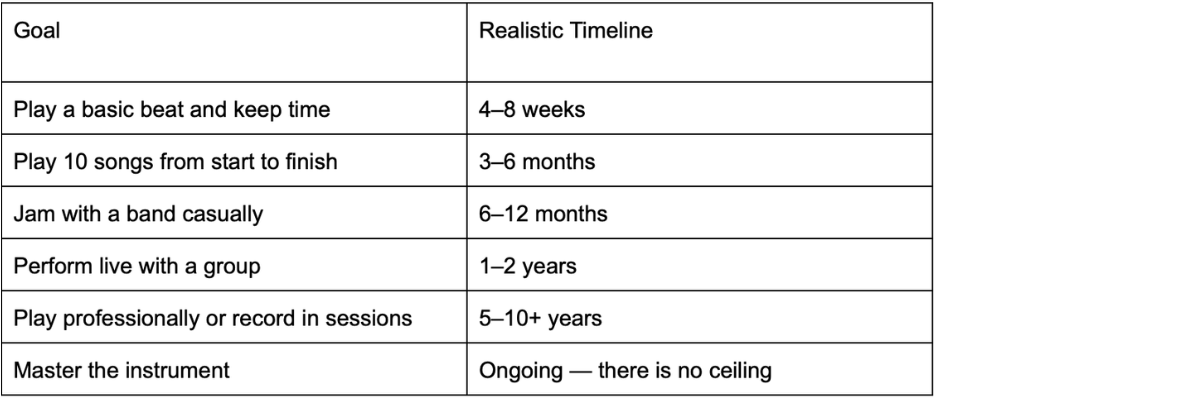
Be honest with yourself about which of these goals is actually your target. Most people learn fastest when they set a specific, achievable near-term goal — "I want to be able to play 'Smoke on the Water' all the way through" — rather than the vague "I want to learn drums."
How Much Practice Time Do You Really Need?
The short answer: 20–30 minutes per day is enough to make solid progress, especially in the first year. More is better, but consistency beats volume.
Here's a rough guide to how total practice hours map to skill levels:
- 50 hours (about 3 months at 30 min/day): Basic beats, simple songs, foundational grip and posture
- 150 hours (about 10 months at 30 min/day): Solid groove, fills, intermediate songs, basic rudiments
- 500 hours (about 2.5 years at 30 min/day): Band-ready, genre versatility, developing musicality
- 1,000+ hours: Approaching the stage where you sound reliably good in a range of musical contexts
These are general averages — some people get to 500 hours faster with intensive daily practice, others are in it for the long haul at 20 minutes a day. The important thing is that hours only count if you're practicing with intention.
Using a practice pad for sessions when you can't get to a full kit is a great way to keep up hand technique and rudiments between full practice sessions. A good practice pad gives you a realistic stick rebound and is quiet enough to use almost anywhere. Our guide to drum practice pads covers what to look for.
Common Mistakes That Slow Beginners Down
Practicing Too Fast Too Soon
Why it's wrong: When you practice a pattern faster than you can execute it cleanly, you're reinforcing the mistakes, not the pattern. Your muscle memory doesn't care whether you played something correctly or incorrectly — it locks in whatever you repeat most. Playing sloppy at speed and then trying to clean it up later is twice as hard as learning it slowly in the first place.
How to fix it: Start every new pattern at a tempo where you can play it perfectly. Then increase the metronome in small increments — 5 BPM at a time — only when the pattern is clean at the current tempo. It feels slow and boring at first. It's also the fastest way to actually get there.
Skipping the Metronome
Why it's wrong: Your internal sense of time is not as accurate as you think it is, especially as a beginner. Playing without a metronome lets you speed up during hard passages and slow down during easy ones without realizing it — which means you're practicing inconsistent timing and ingraining it. This becomes a serious problem when you eventually play with other musicians.
How to fix it: Use a metronome or a drum machine loop for almost every practice session. Free metronome apps are fine. Set it at a comfortable tempo, listen to it, and try to lock your kick drum to it. Starting with just your kick on the click and building from there is a proven way to develop a strong internal clock.
Only Practicing What You're Already Good At
Why it's wrong: It's deeply satisfying to play through patterns and songs you already know. It's also mostly a waste of practice time. Comfortable repetition doesn't build new skill — it just reinforces existing skill. The things that actually make you better are the things you can't do yet.
How to fix it: Identify one specific thing you're struggling with at the start of each practice session and spend the first 10–15 minutes working on it deliberately. That thing should be hard enough that you make mistakes, but not so hard that you can't make any progress. The 70% rule works well: you should be getting it right about 70% of the time at your target tempo.
Neglecting Rudiments
Why it's wrong: Rudiments are the vocabulary of drumming — the basic building blocks that all more complex patterns are built from. Skipping rudiment work in favor of only playing songs is like trying to write before learning the alphabet. Your fills will be limited, your coordination ceiling will be lower, and your dynamic control won't develop as fully.
How to fix it: Even 10 minutes of rudiment practice per session — single stroke roll, double stroke roll, paradiddle, flam — builds the coordination and control that makes everything else easier. You don't have to drill them obsessively. Just include them. Our guide on drum rudiments for beginners is a solid starting point.
Comparing Your Progress to Others Online
Why it's wrong: Social media and YouTube show you highlight reels, not average sessions. The teenager who posted a video playing a complex pattern after "only two months" didn't show you the eight hours a day they were practicing, the fact that they'd played piano since age five, or the three takes it took to get that clean recording. Progress comparison without knowing full context is useless and discouraging.
How to fix it: Compare yourself to you — specifically, where you were three months ago. Record yourself occasionally and watch it back. That's your real benchmark. Most people are surprised by how much they've improved when they have an honest comparison point.
Tips to Speed Up Your Progress
- Set a goal, not just a duration. "I want to be able to play 'Seven Nation Army' by the end of the month" is more motivating and more instructive than "I'm going to practice for 30 minutes every day." Goals give your practice sessions direction.
- Record yourself playing. You hear yourself differently through a recording than through headphones while you're playing. Listening back to a recording of yourself is one of the fastest ways to identify what you actually need to work on, because you're not managing the physical demands of playing at the same time.
- Play along to real music as soon as you can. Trying to lock in with a real recording — even if you're only playing the kick and snare — trains your ear and your timing in ways a metronome alone can't. Songs like "Should I Stay or Should I Go" by The Clash or "Are You Gonna Go My Way" by Lenny Kravitz have straightforward drum parts that are great for early practice.
- Get even occasional instruction. If full-time lessons aren't feasible, even a lesson every few weeks to check your technique and get feedback on what to focus on is valuable. Online drum lessons have made this much more accessible and affordable than it used to be.
- Practice your feet separately. A lot of beginners neglect the kick drum and hi-hat pedal because they're new to using their feet for music. Spend some time just doing kick patterns with your right foot and hi-hat foot independently before adding your hands. The feet are often the last thing to develop and the most important thing to work on early.
- Learn songs you actually love. Motivation is a real factor in how fast you progress. You'll practice more consistently if you're working on music you're genuinely excited about than if you're grinding through exercises that bore you.
Final Thoughts
If you're asking "how long will it take me to learn drums," you're already thinking about it the right way — because you're thinking about it as a timeline with stages, not a binary pass/fail. Four to eight weeks to a functional beat. Three to six months to playing songs. A year or more to playing comfortably with others. A lifetime if you let it be one.
The speed is almost entirely in your control: how often you practice, how deliberately you practice, whether you get feedback, and whether you stay motivated. The instrument will meet you where you are. Show up consistently, use a metronome, don't skip the fundamentals, and you'll surprise yourself with how fast you move.
FAQ
Is it hard to learn drums as an adult?
Not as hard as most adults fear. Adults actually have some advantages over kids — better focus during practice, more self-discipline, and a clearer picture of what they want to achieve. The main challenge is that adult beginners tend to be more self-conscious and critical of slow progress. The physical learning curve is the same regardless of age.
Can I learn drums without a full kit?
Yes, especially in the early stages. A practice pad and a pair of sticks will develop your hand technique and rudiments effectively. An electronic kit with foot pedals adds your bass drum and hi-hat practice. The gap between pad-only practice and full kit practice is biggest when you start working on coordination between all four limbs — at that point, having a full kit (acoustic or electronic) matters a lot more.
How many hours a week should a beginner practice?
Three to five hours per week is a solid starting point — spread across several sessions rather than one long block. Even two hours per week will produce meaningful progress if you're practicing with focus and intention. More than five hours per week in the early stages can actually lead to fatigue and frustration; better to build up gradually.
Do I need lessons to learn drums?
No, but they help significantly. Many excellent drummers are self-taught, especially in rock, pop, and metal. But self-teaching is slower and more error-prone, and it's easy to ingrain bad habits that become problems later. If lessons aren't accessible or affordable, high-quality YouTube instruction and online drum schools have made self-teaching much more reliable than it used to be.
What's the hardest thing to learn on drums?
Most beginners say independence — getting all four limbs to do different things simultaneously. Specifically, the combination of a ride cymbal pattern, a hi-hat foot ostinato, a snare backbeat, and bass drum patterns happening at the same time is genuinely neurologically challenging. Jazz drumming requires exactly this, which is why jazz drumming is considered one of the more demanding disciplines on the instrument.
How long did famous drummers practice before getting good?
John Bonham was playing seriously by age 12 and had years of band experience by his late teens. Neil Peart came to drumming relatively late (16) and practiced obsessively for years before Rush's first album. Dave Grohl largely self-taught in his teens. The commonality isn't background — it's hours of focused, engaged practice over years. There aren't shortcuts, but there are genuinely faster and slower ways to use the time you have.