Drum triggers are small sensors clipped or mounted to a drum head that convert the vibration of each hit into an electronic signal, which a trigger module or DAW then uses to reinforce, replace, or blend with the drum's natural sound. Metal and rock drummers use them mostly on the kick and snare to get a tighter, punchier, more consistent tone at high speed — live or in the studio.
If you've ever recorded a fast double bass part and had the kick sound thin and inconsistent from hit to hit, or watched a touring metal band get that huge, machine-gun kick tone every single night regardless of the room, triggers are usually the reason. They solve a real problem: acoustic drums are inconsistent by nature, and at 220+ BPM with blast beats or dense double bass patterns, that inconsistency becomes obvious fast.
In this guide, we'll cover what triggers actually do, the different types you'll run into, why they matter so much for metal and rock drumming specifically, how to physically set one up on your kit, how to dial in a trigger module or plugin, the mistakes that make triggers sound fake or trigger falsely, and answers to the questions most drummers have before trying them. By the end you'll know whether triggers are worth adding to your setup and exactly how to get them working right.
When you’re done reading, you will be familiar with:
- What Are Drum Triggers?
- Types of Drum Triggers
- Why Metal and Rock Drummers Rely on Triggers
- How a Trigger Actually Captures a Hit
- Step-by-Step: Setting Up a Drum Trigger
- Dialing In Your Trigger Module or Plugin
- Triggering vs. Full Sample Replacement
- Common Mistakes When Using Drum Triggers
- Beginner Tips for Working With Triggers
- Final Thoughts
- FAQ
What Are Drum Triggers?
A drum trigger is a small piezo or contact-mic sensor that reads the physical vibration of a drum head when it's struck and converts that vibration into an electronic signal. That signal gets sent to a trigger module, an audio interface, or a plugin, which then either reinforces the drum's natural sound with a blended electronic layer or replaces it outright with a sampled hit.
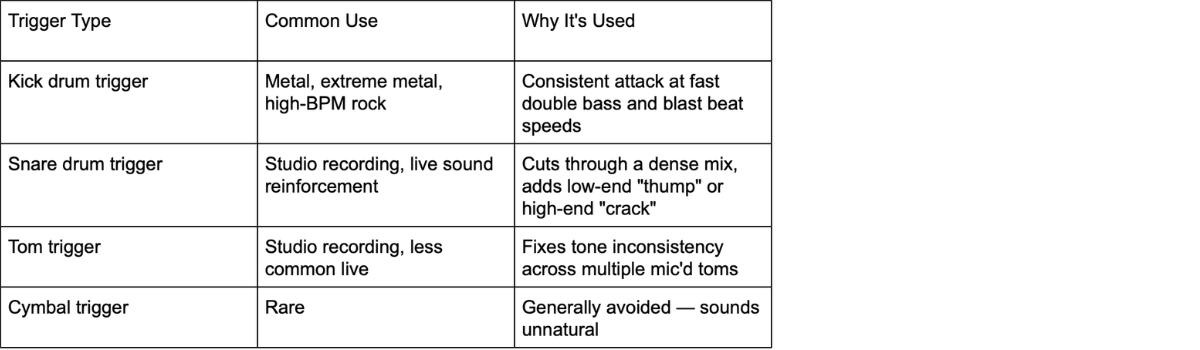
Triggers are most common on the bass drum in metal and rock, since that's the drum under the most pressure to sound huge, fast, and identical from hit to hit. Snare triggers are the second most common application, followed by toms. You'll rarely see a trigger on cymbals — the sound and playing technique don't translate the same way, and cymbal triggering tends to sound obviously artificial.
It's worth separating two related but different things here: a trigger is the sensor and the signal path. A trigger module (or plugin like Slate Trigger, Steven Slate's original hardware unit, or Toontrack Superior Drummer used as a trigger host) is what interprets that signal and produces the reinforced or replaced sound. You need both pieces working together.
Types of Drum Triggers
Not all triggers do the same job. Here's the breakdown you'll actually run into.
Acoustic Triggers
These clip onto or stick to the drum head of an acoustic drum you're already playing. They don't replace your kit — they add a sensor to it so the natural sound can be reinforced or blended with a sample in the mix. This is what most touring metal drummers use: a real acoustic kit with kick and snare triggers feeding a module or the front-of-house engineer's rig.
Electronic Drum Triggers
Electronic kits (like Roland V-Drums or Alesis kits) use built-in mesh-head or rubber-pad triggers instead of acoustic shells entirely. Every hit is triggered by design — there's no natural drum sound to blend with, only the sampled or modeled tone the module produces. If you're comparing an acoustic kit with add-on triggers against a fully electronic kit for practicing metal patterns quietly, the underlying trigger technology is related but the use case is different.
By Drum Type
Why Metal and Rock Drummers Rely on Triggers
Triggers exist because acoustic drums are naturally inconsistent, and that inconsistency gets magnified at metal tempos. A few reasons they've become close to standard in the genre:
- Speed exposes weak hits. During a blast beat or a fast double bass run, not every stroke lands with identical force or in the identical spot on the head. A trigger normalizes that, so a slightly weaker hit still produces a full, consistent sound.
- Studio consistency across takes. Producers recording a metal album want every kick hit to sit at the same volume and tone across dozens of takes and punches. Triggering (or full sample replacement built from triggered hits) makes that achievable without re-tuning or re-mic'ing between songs.
- Live sound reinforcement. In a loud live mix, a purely acoustic kick can get buried under distorted guitars and a five-string bass. A triggered signal blended in at front-of-house gives sound engineers a clean, punchy low end to work with, night after night, regardless of the room.
- Genre expectation. Modern death metal, deathcore, and djent in particular have a "sound" — ultra-tight, sample-like kick and snare — that's become part of the genre's sonic identity. Triggering (sometimes heavily) is how that sound gets achieved consistently.
None of this means your natural kick or snare sound doesn't matter. Tuning is still the foundation — a trigger reinforces what's already there, it doesn't fix a badly tuned or poorly dampened drum. If your bass drum dampening is off or the head is dead, triggering just amplifies a bad starting point.
How a Trigger Actually Captures a Hit
Most drum triggers use a piezo element — the same basic technology found in contact mics and some guitar pickups. When the drum head vibrates from a stroke, the piezo generates a small voltage proportional to how hard and fast the head is moving. That voltage is the trigger signal.
The trigger module (or plugin) reads that signal's amplitude and, in more advanced setups, its shape and attack curve. Based on that reading, it decides which sample to play and how loud to play it — a soft hit fires a quieter or different sample than a hard rimshot-style hit, assuming the module or plugin has velocity layers programmed in.
This is why trigger quality and module quality both matter. A cheap piezo can pick up vibration from a neighboring drum (called crosstalk or bleed) and false-trigger, firing a sample when you didn't actually hit that drum. A good module has a noise gate and threshold controls specifically to prevent that.
Step-by-Step: Setting Up a Drum Trigger
Here's the practical process for adding a trigger to an acoustic bass drum or snare — the most common starting point for metal and rock drummers.
1. Choose Kick or Snare First
If you're new to triggering, start with the kick. It's the drum that benefits most from consistency at metal tempos, and it's the easiest to isolate acoustically since it's separated from the rest of the kit.
2. Mount the Trigger Correctly
Most kick triggers clip onto the bass drum hoop and press a sensor pad against the batter head, usually a few inches off-center from where the beater strikes. Snare triggers typically clip to the rim in a similar way, or stick directly to the underside of the batter head with adhesive. Avoid placing the sensor directly in the strike zone — you want it close enough to read a strong signal but out of the beater or stick's path.
3. Run the Cable to Your Module or Interface
Connect the trigger's output cable to a trigger module (a dedicated hardware unit) or directly into an audio interface if you're triggering through software like Slate Trigger or a DAW plugin. Keep the cable run away from power cables where possible to reduce electrical interference.
4. Set Your Gate and Threshold
Every module has a threshold control — this sets how hard a hit needs to be before it fires a sample. Set it low enough to catch your softest intentional hits, but high enough that it ignores bleed from other drums. This single setting is the difference between a trigger that feels responsive and one that either misses ghost notes or fires false hits constantly.
5. Blend, Don't Just Replace
Most modules let you set a mix level between your natural mic'd sound and the triggered sample. Starting with a blend rather than a full replacement keeps the sound honest to your actual playing dynamics while still tightening up consistency. We'll cover this distinction more in the next section.
Dialing In Your Trigger Module or Plugin
Once the hardware is mounted and connected, the real work is in the settings. A few controls you'll see across most modules and trigger plugins:
- Threshold: The minimum signal strength required to fire a sample. Too low and you'll catch bleed; too high and quiet hits and ghost notes won't trigger.
- Sensitivity/Gain: How much the incoming signal is amplified before it hits the threshold. Works alongside threshold to fine-tune responsiveness.
- Retrigger time: A short window after a hit during which the module won't fire again, even if it detects another signal spike. This prevents a single stroke from double-triggering due to head bounce.
- Velocity curve: How the module maps hit strength to sample volume and layer selection. A linear curve treats force changes evenly; a curved response can exaggerate or compress dynamics.
- Mix/blend level: How much of the triggered sample sits under (or replaces) your natural mic'd sound.
I usually start with threshold and retrigger time first — get the module firing reliably and only on intended hits — before touching velocity curves or sample selection. Chasing tone before the trigger is reading cleanly just wastes time.
Triggering vs. Full Sample Replacement
These terms get used interchangeably but they're not quite the same thing, and it's worth knowing the difference before you go looking for gear or plugins.
Live triggering happens in real time — a hit fires a sample instantly, either blended with the mic'd signal or on its own, and that's what the audience or listener hears as it happens. This is how most touring metal acts run front-of-house kick and snare.
Sample replacement (or "drum replacement") is typically a studio, post-recording process. The engineer records your acoustic performance normally, then uses software to analyze the recorded transients and replace or reinforce each hit after the fact, with far more control over timing and blend than a live trigger allows. This is standard practice on most modern metal and rock albums, even ones marketed as sounding "all-natural."
Both approaches rely on the same underlying idea — using the transient of a hit to trigger a cleaner or more consistent sound — but live triggering has to work in real time with the gear you're wearing on stage, while studio replacement has the luxury of editing after the fact.
Common Mistakes When Using Drum Triggers
Triggers are simple in concept but easy to get wrong in practice. These are the mistakes I see most often.
Setting the Threshold Too Low
Why it's wrong: A threshold set too low picks up vibration from neighboring drums and cymbals, causing the module to fire samples you didn't actually play. This is the single most common complaint people have about triggers sounding "fake" or glitchy.
How to fix it: Raise the threshold gradually while playing normally until bleed stops triggering false hits, then back off slightly to make sure your softest intended hits still register.
Mounting the Sensor in the Strike Zone
Why it's wrong: A trigger mounted where the beater or stick actually makes contact will read inconsistent, distorted signals and can get physically damaged over time.
How to fix it: Mount it a few inches off-center, in a spot that still reads strong vibration from every stroke without being in the direct impact path.
Skipping the Acoustic Foundation
Why it's wrong: Drummers sometimes treat triggers as a fix for a poorly tuned or badly dampened drum. A trigger reinforces or replaces the transient, but a loose, buzzy, or under-tensioned drum still feels and sounds wrong to play, and a bad acoustic signal makes the trigger's job harder too.
How to fix it: Tune and dampen the drum properly first. Our guide on how to tune a bass drum covers getting that foundation right before you add electronics on top.
Using a Full Replacement With No Blend
Why it's wrong: A 100% replaced sample with zero acoustic signal underneath tends to sound stiff and disconnected from the actual performance — every hit sounds identical regardless of how it was actually played, which flattens out dynamics and feel.
How to fix it: Blend the triggered sample with your natural mic'd sound rather than replacing it entirely, unless you specifically want that ultra-uniform, programmed-sounding kick.
Ignoring Retrigger Time
Why it's wrong: Without a retrigger window set, a single stroke's head bounce can register as two separate hits, creating a stutter or flam that wasn't actually played.
How to fix it: Set a short retrigger time (start around 5–10 milliseconds and adjust by ear) so the module ignores rebound artifacts from the same stroke.
Beginner Tips for Working With Triggers
A few habits that make triggers easier to work with:
- Start with just the kick. It's the highest-impact drum for metal and rock, and isolating one drum first makes it much easier to learn how threshold and gain settings actually behave.
- Play normally while setting the threshold. Don't just tap the drum lightly to test — play through an actual fast double bass or blast beat pattern so the module is dialed in for how you really play, not a soundcheck tap.
- Keep a reference of your natural sound. Record a short clip of your kick without any triggering so you have something to compare against once the trigger is blended in. It's easy to lose track of how much the sample is actually doing.
- Check your beater and pedal setup too. A trigger can't fix inconsistent footwork. If your double bass pedal technique is uneven, that unevenness will still show up in the triggered signal, just with a more consistent tone layered on top of it.
- Don't over-rely on triggers live if you're gigging small rooms. In a small club with minimal sound reinforcement, an overly aggressive trigger blend can sound thin or artificial compared to a well-tuned, well-mic'd acoustic kick. Save the heavier triggering for bigger stages and studio work.
Final Thoughts
Drum triggers aren't a shortcut around good technique or good tuning — they're a tool for making a solid performance sound consistent at the speeds and volumes metal and rock demand. Get the acoustic foundation right first, mount the sensor correctly, and take the time to dial in threshold and retrigger settings by ear rather than guessing.
Once it's set up properly, a trigger becomes something you stop thinking about — it just quietly makes every blast beat and double bass run sound as tight as your best take, every night.
FAQ
Do I need drum triggers to play metal?
No. Plenty of metal drummers play entirely acoustic, especially in smaller venues or genres that favor a more natural, dynamic kick sound. Triggers become more valuable as tempos increase and as you move into bigger stages or studio recording, where consistency matters more.
What's the difference between a drum trigger and a drum module?
The trigger is the sensor that reads the vibration from a hit. The module is the hardware or software unit that interprets that signal and produces (or blends in) a sample. You need both — a trigger alone doesn't make any sound by itself.
Will triggering make my drums sound fake?
It can, if the blend is too heavy or the threshold is poorly set. A well-set-up trigger, blended subtly with a well-tuned acoustic drum, should sound like a tighter, punchier version of your real kit — not a completely different, obviously electronic sound.
Can I use drum triggers on an electronic kit?
Electronic kits already function on trigger technology — every pad is essentially a built-in trigger feeding a sound module. The setup process (threshold, sensitivity, velocity) is conceptually the same as triggering an acoustic drum, just built into the kit from the factory.
How much does a basic drum trigger setup cost?
A single kick drum trigger and an entry-level module can be found for a modest cost, while professional multi-trigger setups with dedicated hardware modules cost significantly more. Many drummers start with a software-based option (a trigger plugin running through an audio interface) before investing in dedicated hardware.
Do triggers work on toms and cymbals too?
Tom triggers are common in studio settings for evening out tone across multiple mic'd toms. Cymbal triggering is rare and generally avoided — the way cymbals are played (grazing strokes, chokes, bell hits) doesn't translate well to trigger technology, and the results tend to sound noticeably artificial.