To play triplets on drums, you divide each beat into three even notes instead of two, usually counted "1-trip-let, 2-trip-let," and spread those three notes across your hands, feet, or both to build the rolling fills and gallop-style grooves you hear all over rock and metal.
That one-line answer gets you the concept, but triplets only become useful once you can feel them at different speeds, move them around the kit, and drop them into an actual groove without losing time. A lot of drummers can play a triplet fill in isolation and then completely fall apart the moment they have to come back into a straight beat afterward — the timing seam between triplets and straight notes is where most players get exposed.
In this guide, we'll break down what a triplet actually is and how it's different from straight subdivisions, the three main triplet types you'll run into, how to count and internalize the feel, a step-by-step practice method for building triplets from scratch, how triplets show up specifically in rock and metal playing, the mistakes that trip up most beginners, and a handful of practice tips that speed up the whole process.
When you’re done reading, you will be familiar with:
- What Are Triplets in Drumming?
- Triplets vs. Straight Subdivisions: Why the Feel Is Different
- The Three Triplet Types Every Drummer Should Know
- How to Count and Internalize Triplets
- Step-by-Step: Learning to Play Triplets
- Using Triplets in Rock and Metal Drumming
- Common Triplet Mistakes and How to Fix Them
- Beginner Tips for Practicing Triplets
- Final Thoughts
- FAQ

What Are Triplets in Drumming?
A triplet is a group of three notes played in the space normally taken up by two. Instead of splitting a beat evenly into halves (like straight eighth notes) or quarters (sixteenth notes), a triplet splits it into thirds. In written notation, triplets are marked with a small bracket and the number "3" over the group, which tells you those three notes share the time slot of two notes of the same value.
This matters because a huge amount of what makes a fill or a beat sound "rock straight" versus "rolling" or "galloping" comes down to whether the underlying subdivision is duple (two, four, eight notes per beat) or triple (three, six, twelve notes per beat). Triplets are where that triple feel comes from, and once your ear can recognize it, you'll start hearing it constantly — in fills, in blues shuffles, in metal gallops, and in almost every drum solo you've ever liked.
If you're still getting comfortable with reading rhythms in general, our guide to reading drum notation covers the basics of note values and time signatures that make triplets click faster.
Triplets vs. Straight Subdivisions: Why the Feel Is Different
Straight subdivisions land evenly and predictably — think of a metronome click, or a basic rock beat's steady eighth-note hi-hat. Triplets land in a different grid entirely, which is why switching between the two feels like a gear change rather than just playing faster or slower.
Here's how the subdivisions stack up per quarter-note beat:
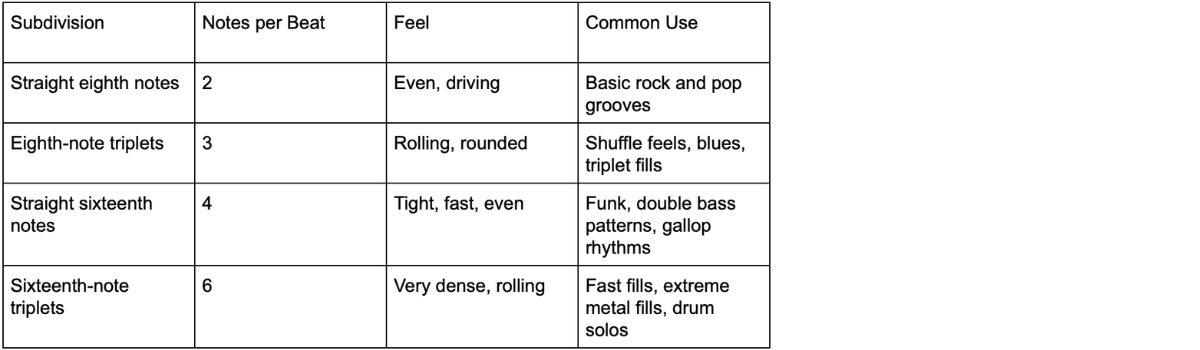
Notice that a triplet subdivision always has an odd number of notes stacked against the beat (3, 6, 12), while straight subdivisions are always even (2, 4, 8). That's the entire difference on paper — but the way it feels under your hands is night and day. A straight sixteenth-note fill sounds machine-even. A triplet fill sounds like it's rolling forward.
The Three Triplet Types Every Drummer Should Know
Not all triplets take up the same amount of time. The name tells you the note value being tripled, which tells you how fast the three notes fly by.
Eighth-Note Triplets
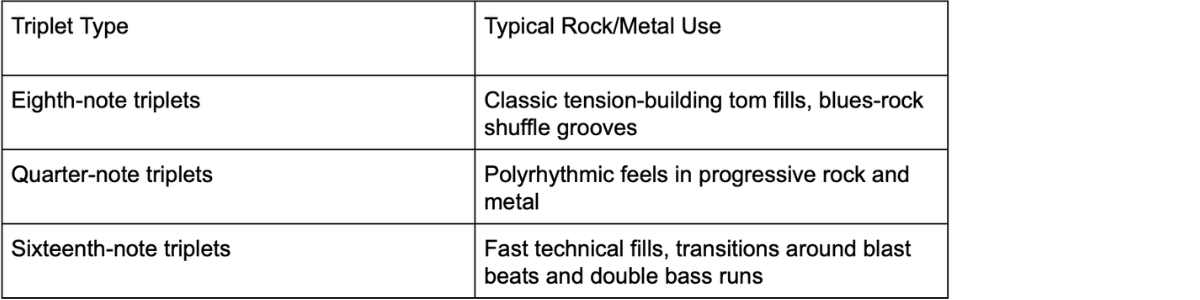
The most common triplet you'll encounter. Three notes fill the space of one quarter note (or two straight eighth notes). This is the triplet behind shuffle grooves, blues fills, and the classic "gallop" feel you hear across rock and metal.
Quarter-Note Triplets
Three notes fill the space of two quarter notes (half a measure in 4/4). These are slower and less common in basic playing, but they show up in prog rock and metal when a drummer wants to create a polyrhythmic pull against the underlying pulse — the beat seems to briefly "float" against the rest of the band.
Sixteenth-Note Triplets
Six notes fill the space of one quarter note — twice as fast as eighth-note triplets. These show up in fast, dense fills and are a staple of technical and extreme metal drumming, where speed and control both matter. If you're chasing that kind of speed, our guide on building real hand speed pairs well with sixteenth-note triplet practice.
How to Count and Internalize Triplets
The fastest way to internalize a triplet is to give it a verbal count that has three natural syllables. The standard is "trip-o-let" or "1-trip-let, 2-trip-let, 3-trip-let, 4-trip-let" for a full measure of eighth-note triplets in 4/4.
Say it out loud before you touch the sticks. Clap or tap your leg on each syllable at a slow, steady tempo. Once the three-against-one feel is locked into your voice, transferring it to your hands gets much easier — you're playing what you're already saying, not inventing a new motor pattern from scratch.
Step-by-Step: Learning to Play Triplets
Once you can count and feel the triplet, here's the order that gets it into your hands and feet cleanly.
1. Play Triplets on a Single Surface
Start on just the snare drum with alternating sticking (right-left-right, then left-right-left for the next group). Use a metronome set to a slow tempo — somewhere around 60 BPM — and play one triplet group per click. Don't move on until this feels relaxed, not rushed.
2. Set Your Metronome to Click the Triplet Subdivision
Most metronome apps let you set a subdivision or a triplet feel directly, so the click itself outlines "1-trip-let" instead of just the quarter note. This removes the guesswork and trains your internal clock against the actual triplet grid rather than your own estimate of it. Our guide to using a metronome covers how to set up subdivided clicks if your app supports them.
3. Move the Triplet Around the Kit
Once the sticking is smooth on the snare, spread the three notes across different drums — snare, high tom, low tom, for example. This is where triplets start sounding like actual fills instead of a practice exercise. Try snare-tom-tom, tom-tom-snare, and other three-piece combinations to build vocabulary.
4. Add the Kick Drum Into the Pattern
Substitute one of the three triplet notes with your bass drum instead of a hand. A common starting point: hands on beats one and two of the triplet, kick on beat three. This is the foundation for triplet-based double bass patterns used heavily in metal.
5. Drop the Triplet Into a Groove
Play a basic beat for one or two bars, then insert a one-beat or one-bar triplet fill before returning to the groove. This is the actual skill — most drummers can play triplets in isolation but lose the pocket transitioning in and out of them. Practice the transition as deliberately as the triplet itself.
6. Increase the Tempo Gradually
Once the pattern is clean and the transition is solid, raise the metronome by small increments — 5 BPM at a time. Chasing speed before the pattern is clean just bakes sloppy timing in at a faster tempo.
Using Triplets in Rock and Metal Drumming
Triplets aren't a niche technique — they're baked into some of the most recognizable rhythms in rock and metal.
The galloping rhythm heard in classic metal riffing (think of the rhythmic "duh-duh-DUH" pulse under a fast riff) is closely related to triplet subdivision, even when it's technically written as a dotted-eighth-sixteenth pattern rather than a true triplet — both create that same uneven, forward-leaning push. If you want the specific pattern breakdown, our gallop rhythm guide covers it in detail.
Triplet-based fills are also a go-to move for classic rock drummers building tension before a big hit — three-note groupings across the toms that build speed and land right on the downbeat of the next phrase. And in progressive metal, quarter-note triplets are used deliberately to create a polyrhythmic feel against the band's straight pulse, similar to the concepts covered in our polyrhythms guide.
On the extreme end, sixteenth-note triplets show up in fast fills and transitional patterns around blast beats, where a drummer briefly shifts the subdivision to add variation to an otherwise relentless, even pulse — our blast beat guide is a good next stop if that's where you're headed.
Common Triplet Mistakes and How to Fix Them
These are the mistakes I see most often when drummers are first getting triplets under their hands.
Rushing the Middle Note
Why it's wrong: The middle note of a triplet is the one most players clip short, which squeezes the three notes into an uneven "long-short-long" pattern instead of three truly equal notes. It's a subtle timing error that still sounds sloppy to a trained ear.
How to fix it: Slow down and count out loud — "1-trip-let" — while listening specifically for equal spacing between all three syllables. Recording yourself and playing it back is the fastest way to catch this, since it's often hard to hear in the moment.
Confusing Triplets with Straight Sixteenth Notes
Why it's wrong: Both subdivisions can sound "fast" to an untrained ear, but they're mathematically different (3 notes per beat versus 4), and mixing them up means playing over the wrong grid entirely — the fill won't land back on time.
How to fix it: Practice both subdivisions back-to-back at the same tempo so your ear learns to tell them apart. Eighth-note triplets have a rolling "1-trip-let" feel; straight sixteenths have a flat, even "1-e-and-a" feel.
Practicing Only on the Snare
Why it's wrong: A triplet that only ever lives on one drum doesn't transfer to real fills, which almost always move across multiple surfaces. Drummers who skip this step can play a clean triplet in a practice room and then fall apart the first time they try to use one in a song.
How to fix it: As soon as the sticking feels comfortable, move the pattern around the kit — snare to toms, toms to kick — so your hands and feet learn triplets as a movable shape, not a fixed drill.
Ignoring the Transition In and Out
Why it's wrong: The triplet itself is rarely the hard part — losing the tempo when you drop back into a straight groove afterward is what actually derails most players. It's a common reason fills sound great in isolation but wreck the song when used live.
How to fix it: Always practice triplets in context: two bars of a straight groove, one beat of triplet fill, then straight back into the groove. Treat the transition bars as part of the exercise, not an afterthought.
Beginner Tips for Practicing Triplets
- Count out loud before you play. Getting the "1-trip-let" rhythm into your voice first makes the physical pattern click faster once you pick up the sticks.
- Use a triplet metronome setting if your app has one. Hearing the actual subdivision click, rather than just the quarter note, keeps you honest about evenness.
- Start every new triplet pattern at a tempo where you can't make a mistake. Speed comes from repetition at a clean tempo, not from forcing a fast tempo early.
- Record short practice clips. Triplet timing errors are easy to miss in real time but obvious on playback.
- Isolate hands, then feet, then combine. Trying to nail a hand-and-foot triplet pattern all at once usually means neither part is actually solid.
- Apply every new triplet pattern to a real groove within the same practice session. A pattern you can only play in isolation isn't fully learned yet.
Final Thoughts
Triplets are one of those fundamentals that quietly show up everywhere once you know what you're listening for — in fills, in gallop rhythms, in shuffle grooves, in the polyrhythmic textures of prog metal. The pattern itself is simple: three equal notes where you'd normally expect two. The real skill is making that pattern feel natural at any tempo and moving in and out of it without the song losing its footing. Count it, play it slow, spread it across the kit, and the rolling triplet feel will start showing up in your playing everywhere it belongs.
FAQ
What's the difference between triplets and sixteenth notes?
Triplets divide a beat into three equal notes; sixteenth notes divide it into four. They're different subdivisions entirely, which is why a triplet fill feels rolling and a sixteenth-note fill feels flat and even, even at the same tempo.
How do I count triplets out loud?
The standard count is "1-trip-let, 2-trip-let, 3-trip-let, 4-trip-let" for a measure of eighth-note triplets in 4/4. Saying it out loud before playing helps you internalize the three-syllable feel.
Are triplets hard to learn?
The concept is simple, but the feel takes deliberate practice, especially transitioning between triplets and straight time without losing the tempo. Most drummers get the basic pattern within a few practice sessions and spend longer refining the transitions.
What songs or styles use triplet fills?
Triplet fills are common across blues, classic rock, and metal — anywhere a drummer wants a rolling, forward-leaning fill rather than a flat, even one. Shuffle grooves are also built on an eighth-note triplet feel.
Can triplets be played with double bass drumming?
Yes. Splitting a triplet between your hands and feet, or playing a full triplet on the bass drum alone, is a common way to build speed and variation into double bass patterns, especially in technical and progressive metal.
Do I need to read sheet music to learn triplets?
No. Triplets can be learned entirely by counting and listening, though being able to read the notation helps once you start pulling patterns from books or transcriptions. Our guide on reading drum tabs is a lighter starting point if formal notation feels like a bigger jump than you want right now.