To play in an odd time signature, break the measure into small groups of twos and threes that add up to the total beat count, then anchor your kick and snare pattern to those groupings instead of trying to "feel" the whole bar at once. Once the grouping clicks, 7/8 or 5/4 stops feeling exotic and just becomes a slightly lopsided groove.
Odd time signatures show up constantly in the bands most rock and metal drummers grew up idolizing — Tool, Meshuggah, Rush, Dream Theater, Opeth, Karnivool. If you've ever tried to air-drum along to "Schism" or "YYZ" and lost the beat halfway through, you already know why this stuff trips people up. It's not that the rhythms are impossibly hard; it's that most of us are trained almost exclusively on 4/4, so anything else feels like it's fighting your internal clock.
This guide breaks down what odd time signatures actually are, why they matter for rock and metal drumming specifically, how to count and internalize them without getting lost, and a practice path that takes you from clapping out a 7/8 phrase to playing full grooves in 5/4, 7/8, and 9/8. We'll also cover the mistakes that keep drummers stuck in a rut with odd meters and how to get past them.
When you’re done reading, you will be familiar with:
- What Is an Odd Time Signature?
- Why Odd Time Signatures Matter for Rock and Metal Drummers
- The Most Common Odd Time Signatures You'll Run Into
- How to Count and Feel Odd Time Without Losing the Beat
- Step-by-Step: Learning to Play in Odd Time
- Odd Time Grooves You Can Practice Right Now
- Common Mistakes When Playing Odd Time Signatures
- Beginner Tips for Getting Comfortable in Odd Meters
- Conclusion
- FAQ

What Is an Odd Time Signature?
Understanding what makes a time signature "odd" is the foundation for everything else in this guide, so it's worth getting precise about it before you touch the kit.
A time signature tells you two things: how many beats are in each measure (the top number) and what kind of note counts as one beat (the bottom number). Most rock, pop, and metal you've ever played lives in 4/4 — four quarter-note beats per measure, counted "1, 2, 3, 4." An odd time signature simply has a top number that doesn't divide evenly into pairs the way 4/4 does. Common examples are 5/4, 7/8, 9/8, and 11/8.
The key thing to understand is that odd time isn't a different kind of counting system — it's the same quarter notes and eighth notes you already know, just grouped into a measure that has an "extra" or "missing" beat compared to 4/4. A measure of 7/8 is really just a measure of 8th notes with one eighth note lopped off. That's it. It sounds intimidating on paper and feels completely different once you're playing it, because your body naturally wants to resolve back to an even four.
If you're shaky on reading time signatures and rhythmic notation in general, our guide on reading drum notation covers the basics you'll want in place before tackling odd meters.
Why Odd Time Signatures Matter for Rock and Metal Drummers
Odd time isn't a jazz-only curiosity or a music-theory party trick — it's baked into some of the most influential rock and metal of the last several decades, and being able to play it opens up a huge amount of repertoire.
- Progressive rock and metal practically require it. Rush, Tool, Dream Theater, Opeth, Between the Buried and Me, and Karnivool all lean on odd meters as a core part of their sound, not an occasional gimmick.
- It trains your internal clock. Drummers who can hold odd time steady tend to have noticeably better timing in straightforward 4/4 too, because they're not relying on autopilot to find the beat.
- Bands notice. If you're auditioning for a band that writes anything outside straight rock beats, the ability to comfortably drop into a 7/8 verse or a 5/4 bridge without flinching sets you apart immediately.
- It connects to polyrhythm and syncopation. Odd time signatures, polyrhythms, and syncopated phrasing are related but distinct skills. If you've already worked through polyrhythms or syncopation, odd time will click faster because your rhythmic vocabulary is already broader than a typical 4/4-only drummer's.
The Most Common Odd Time Signatures You'll Run Into
You don't need to master every possible meter to get functional in odd time. A handful of signatures cover the overwhelming majority of what you'll encounter in rock and metal.
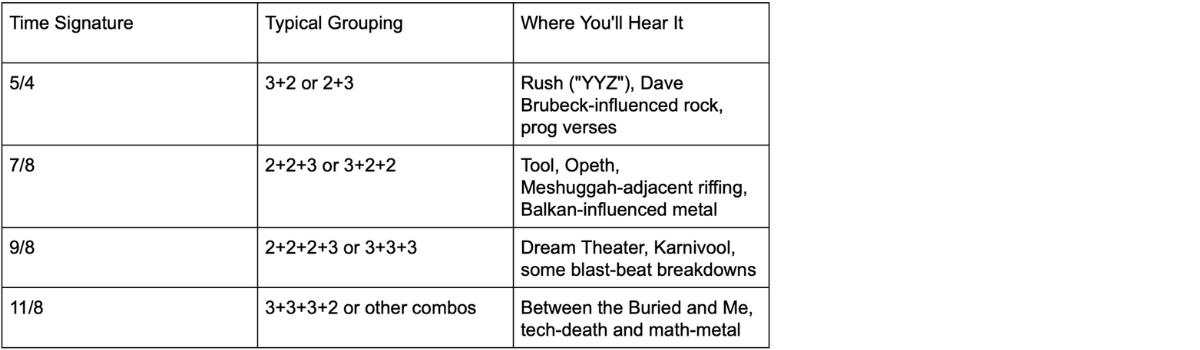
Notice the pattern: every one of these is built from smaller groups of 2 and 3, and the same time signature can be grouped different ways depending on how the riff phrases. That grouping — not the raw number on the page — is the actual key to playing odd time comfortably.
How to Count and Feel Odd Time Without Losing the Beat
Most drummers get lost in odd time because they try to count straight through a measure ("1-2-3-4-5-6-7") the same way they count 4/4. That works for reading, but it doesn't help you feel the groove. The fix is counting in groups instead.
Break the Measure Into 2s and 3s
Take 7/8 as an example. Instead of counting "1-2-3-4-5-6-7," count it as three small groups: "1-2, 1-2, 1-2-3." Say it out loud while tapping your leg. You'll notice the last group naturally feels like it has a little extra weight — that's the "odd" part of odd time, and it's what gives these grooves their lurching, off-kilter character instead of sounding broken.
Say the Groupings, Not Just the Numbers
A trick a lot of touring drummers use: instead of counting numbers, count the group sizes out loud — "two, two, three" for a 2+2+3 grouping of 7/8, or "three, two" for a 3+2 grouping of 5/4. This keeps your brain focused on the shape of the phrase rather than getting tangled trying to remember what number you're on.
Feel the Long Group as the "And"
In most odd meter rock and metal, the group of three functions almost like a big pickup or anticipation into the next downbeat. Once you feel that group of three as motion toward the "1" rather than as a separate chunk of time, odd meters start to groove instead of just counting correctly.
Step-by-Step: Learning to Play in Odd Time
Here's a practical progression for going from "I can count it" to "I can play a full groove without thinking about it."
1. Clap the Grouping Before You Touch the Kit
Pick one time signature — start with 7/8 grouped 2+2+3. Clap and count it out loud at a slow tempo until it feels automatic, with no hesitation on the group of three. Don't skip this step; trying to play a groove before the grouping is internalized is the single biggest reason drummers give up on odd time.
2. Play the Grouping as a Single Voice
Move to the kit and play the grouping on just the hi-hat or ride, accenting the start of each group ("2, 2, 3"). This isolates the timing from any coordination challenge, so you can focus entirely on locking the feel to a metronome.
3. Add a Simple Kick Pattern
Once the hi-hat grouping is solid, add kick drum hits on the first note of each group. Now you're playing two limbs, but the kick is reinforcing the same information your hi-hat is already giving you, so it shouldn't feel like a huge jump.
4. Layer in the Snare Backbeat
Add a snare hit somewhere that makes musical sense — often on the "and" of the last group, or on the downbeat of the phrase after the group of three. Experiment with placement; odd time grooves have more flexibility here than a standard rock backbeat, and where you place the snare changes the whole feel of the groove.
5. Practice at a Crawl, Then Build Speed
Set your metronome well below the target tempo — sometimes half speed or slower. Odd time grooves fall apart under tempo pressure faster than 4/4 grooves do, because there's no muscle memory autopilot to fall back on yet. Our guide to practicing with a metronome covers pacing techniques that apply directly here.
6. Play Along to the Real Song
Once your groove is solid on its own, play along with the actual track. Real songs rarely sit as cleanly on the grid as a practice exercise, and playing with the recording exposes any spot where your internal feel doesn't match the music.
Odd Time Grooves You Can Practice Right Now
These are simplified starting patterns — not transcriptions of specific songs — meant to get your hands and feet used to the feel of each meter.
7/8 Groove (Grouped 2+2+3)

Count it "1-2, 1-2, 1-2-3" and let the kick mark the start of each group.
5/4 Groove (Grouped 3+2)

Count it "1-2-3, 1-2" and notice how the snare naturally wants to land on the "2" group.
9/8 Groove (Grouped 3+3+3)

This grouping feels closer to a rolling triplet-based feel, which is why it shows up so often in prog metal breakdowns.
Loop each pattern with a metronome for a few minutes daily rather than grinding through all three in one sitting. Odd time feel builds slowly, similar to how linear drumming patterns need repetition before the coordination stops feeling mechanical.
Common Mistakes When Playing Odd Time Signatures
Counting Numbers Instead of Groupings
Why it's wrong: Counting straight through "1 through 7" keeps your brain doing math instead of feeling the phrase. You'll be able to count it correctly and still play it stiffly, because the groove never actually settled into your body.
How to fix it: Switch to counting the group sizes ("two, two, three") instead of the raw beat numbers. This reframes the measure as a shape rather than a math problem.
Rushing the Group of Three
Why it's wrong: The longer group in most odd meters is where drummers unconsciously speed up, because it feels like it's "catching up" to get back to beat one. This creates a lurching, uneven tempo that fights the rest of the band.
How to fix it: Practice the group of three in isolation with a metronome click on every eighth note, not just the downbeats, until it sits at exactly the same tempo as the groups of two.
Practicing Only With a Metronome, Never With Music
Why it's wrong: A click track tells you nothing about phrasing, dynamics, or how the odd meter interacts with a bass line or guitar riff. Drummers who only practice against a click can play a perfect exercise and still fall apart in a real song.
How to fix it: Once the basic groove is solid, always graduate to playing along with the actual reference track. That's where odd time actually starts to make musical sense instead of feeling like an academic exercise.
Trying to Learn Multiple Odd Meters at Once
Why it's wrong: Jumping between 5/4, 7/8, and 9/8 in the same practice session scrambles the grouping feel you're trying to build for each one. You end up mediocre at all of them instead of solid at one.
How to fix it: Pick one time signature and stay with it until you can groove on it without thinking, typically a week or two of focused daily practice, before adding a second meter.
Beginner Tips for Getting Comfortable in Odd Meters
- Start with songs, not exercises. Learning "YYZ" or a Tool tune you already love gives your ear a reference point that a dry practice pattern can't.
- Tap your foot on the big grouping, not every eighth note. Physically feeling the 2-2-3 shape in your body — not just your hands — locks the groove in faster.
- Use a metronome that can subdivide oddly. Apps like Moises or Time Guru let you set accented clicks on custom groupings, which is far more useful for odd time than a basic quarter-note click.
- Sing the groove before you play it. If you can vocalize the kick, snare, and hi-hat pattern as a rhythm syllable ("boom-tss-boom, tss-boom-tss"), your hands will follow much faster once you sit at the kit.
- Don't abandon your regular 4/4 practice. Odd time is a skill you build alongside your fundamentals, not instead of them. I usually spend the first ten minutes of a session on straight time before touching anything odd, just to keep my basic feel sharp.
Conclusion
Odd time signatures aren't a separate rhythmic language — they're the same beats and subdivisions you already know, arranged into groupings that don't resolve into an even four. Break the measure into small chunks of two and three, count the shape instead of the raw numbers, and build up from a single limb to a full groove at a tempo slow enough to stay clean. Give it consistent, focused practice and 7/8 stops sounding like a party trick and starts sounding like just another groove in your vocabulary.
FAQ
What is an odd time signature in drumming?
An odd time signature is any meter whose top number isn't a straightforward multiple of 2, like 5/4, 7/8, 9/8, or 11/8. It means the measure has an amount of beats that doesn't divide evenly the way 4/4 or 2/4 do.
Is 3/4 an odd time signature?
Not usually classified as one in practice — 3/4 (waltz time) is common enough and simple enough to feel that most drummers group it as its own category. "Odd time" in rock and metal conversation typically refers to 5/4 and above.
What's the easiest odd time signature to start with?
7/8 grouped as 2+2+3 is a common starting point because the groupings are short and the "extra" beat is easy to isolate and feel. 5/4 is also approachable, especially grouped as a familiar 3+2 or 4+1.
Do I need to read sheet music to play odd time?
No — you can learn everything in this guide by counting and playing by ear. Reading notation helps once you're transcribing specific songs, but the grouping method works whether you're reading a chart or just listening closely to a track.
Why do odd time signatures feel so unnatural at first?
Almost all popular music you've grown up hearing is in 4/4, so your body has years of muscle memory built around even groupings. Odd time isn't inherently harder — it's just unfamiliar, and that unfamiliarity fades with focused practice.
Can odd time signatures change within a song?
Yes, and it's common in progressive rock and metal for a song to shift between 4/4, 7/8, and 5/4 across different sections. Once you're comfortable in individual odd meters, practicing the transitions between them is the next skill to build.