To get real value out of Stick Control for the Snare Drummer, you work through its sticking patterns slowly with a metronome, playing each line evenly on a snare or pad until your weak hand keeps up with your strong one, then gradually add accents, speed, and movement around the kit.
That one paragraph is the whole idea, but it's also exactly where most drummers go wrong. They buy the book, flip to a page that looks cool, blast through it as fast as they can, and wonder why their hands still feel lopsided a year later. Stick Control isn't a book you read — it's a book you drill, slowly, for months, and the drummers who get the most out of it are the ones who treat every page like a lesson instead of a race.
In this guide, we'll cover what the book actually is and why it's stuck around since 1935, why it matters specifically for rock and metal drummers chasing speed and endurance, how the book is structured, a step-by-step approach to practicing from it, how to take the patterns off the pad and onto a full kit, the mistakes that waste most people's time with it, and practical tips for building it into a routine that actually moves the needle.
When you’re done reading, you will be familiar with:
- What Is Stick Control?
- Why Rock and Metal Drummers Need It
- How the Book Is Organized
- Step-by-Step: How to Practice From Stick Control
- Taking Stick Control Patterns Around the Kit
- Common Mistakes When Practicing Stick Control
- Beginner Tips for Getting More Out of It
- Final Thoughts
- FAQ

What Is Stick Control?
Understanding what the book is actually for changes how you practice it, so it's worth a quick history before we get into exercises.
Stick Control for the Snare Drummer is a practice book written by George Lawrence Stone in 1935. It's not a method book in the traditional sense — there's almost no explanation on the page. It's page after page of sticking patterns: sequences of R's and L's (right hand, left hand) that you play on a snare drum or practice pad, one line at a time, usually repeated 10 to 20 times each before moving to the next.
The genius of the book is its simplicity. Every exercise trains the same underlying skill — getting your hands to move independently, evenly, and under control — through hundreds of slightly different combinations. Stone originally wrote it for orchestral and rudimental drummers, but it's become the single most recommended technique book across every genre, including rock, metal, jazz, and everything between. If a drum teacher tells you to "go work on your hands," there's a good chance they mean this book.
Why Rock and Metal Drummers Need It
It's easy to assume a 90-year-old orchestral snare drum book has nothing to do with blast beats and breakdowns, but the opposite is true — the physical skill it builds is the exact skill extreme drumming depends on.
- Hand evenness for blast beats. A clean blast beat needs both hands hitting with identical timing and volume at high speed. Any imbalance between your right and left hand shows up immediately as a rushed or dragging beat.
- Endurance for extended sections. Metal and hardcore songs often demand minutes of sustained 16th notes. Stick Control's repetitive format is, by design, an endurance builder — you're not just learning a pattern, you're training your hands to hold up under fatigue.
- Control at low volume for ghost notes. The same hand independence that makes a blast beat clean also makes ghost notes sit properly under a groove. Stick Control trains dynamic control, not just speed.
- A foundation for everything else. Rudiments, fills, gallop rhythms, linear patterns — nearly every technique-focused post on this blog assumes a baseline of hand control. Stick Control is where that baseline gets built.
I usually tell newer students that Stick Control won't teach you a single beat you'll play in a song. What it teaches you is the hand control that makes every beat you already know sound tighter.
How the Book Is Organized
The book has a clear structure, and understanding it helps you know where to start and how to progress instead of flipping around at random.
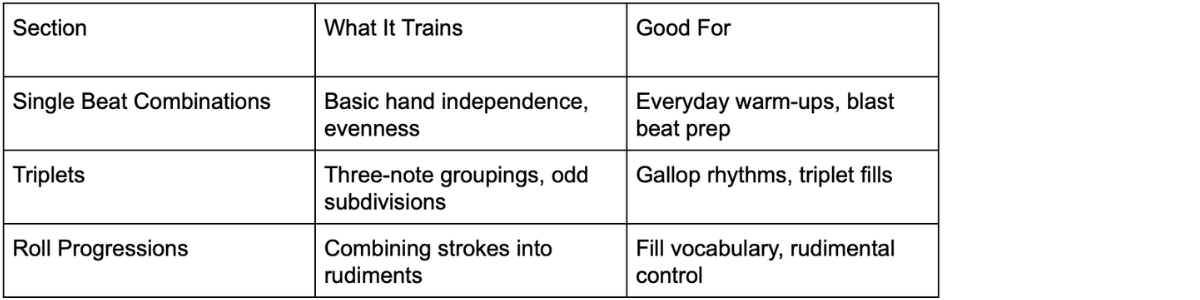
It's split into three main sections:
- Single Beat Combinations (pages 5–38). Lines built from single strokes in different R/L orders — RLRL, RRLL, RLRR, and so on. This is where almost everyone starts, and where most of the hand-independence work happens.
- Triplets (pages 39–43). The same idea applied to three-note groupings instead of even eighth or sixteenth notes, which is directly useful for gallop-style rhythms and triplet-based fills.
- Short Roll Progressions and Rudimental Studies (pages 44 onward). More advanced combinations that build toward full rudiments — flams, drags, and roll patterns layered on top of the sticking work from earlier pages.
Each page is a set of individual lines, and each line is meant to be repeated continuously — Stone's own instruction in the book is to play each line "20 times without stopping," though most modern teachers adjust that number based on tempo and a student's current level.
Step-by-Step: How to Practice From Stick Control
The book itself gives you almost no instruction on how to actually practice it, so here's the process that gets results.
1. Start on Page 5, Not Wherever Looks Cool
The book is sequenced from simple to complex on purpose. Skipping ahead to a page with a flashier-looking pattern usually means practicing a skill you haven't built the foundation for yet. Start at the beginning, even if the first few pages feel almost too easy.
2. Set a Slow, Honest Tempo
Pick a tempo where you can play the line cleanly for the full repeat count without your hands tensing up or the pattern falling apart. For most players starting out, that's somewhere around 60–80 BPM per stroke. Speed is not the goal in the first few weeks — evenness is.
3. Play Each Line on a Snare or Practice Pad
A pad is fine for most of this work and easier on your ears during long sessions. Play directly on the drum periodically too, since the rebound and feel are different — our guide to tuning a snare drum is worth a look if your practice snare feels dead or inconsistent under your sticks.
4. Listen for the Weak Hand, Not the Strong One
Most drummers can already play their dominant hand evenly. The entire point of this book is bringing the other hand up to match it. If one hand sounds noticeably louder, faster, or sloppier than the other on a given line, that's the hand to focus your attention on — not the one that already sounds fine.
5. Add Accents Once the Line Is Clean
Once you can play a line evenly at your target tempo, go back through it and add accents — playing certain notes louder than others, using a bigger stroke while keeping the unaccented notes light. This is what turns a flat sticking exercise into something that trains real dynamic control, the same control you need for fills and ghost notes.
6. Move Through the Book Gradually
You don't need to master every single line before moving on. A common approach is working through a page over several days, then rotating a handful of pages into your daily warm-up so the material stays fresh instead of being drilled once and forgotten.
Taking Stick Control Patterns Around the Kit
Once a pattern feels genuinely comfortable on the snare, it's worth moving it off the pad and into real playing — this is the step a lot of drummers skip entirely.
- Move sticking patterns between the snare and toms. Playing an RLRL line while moving your hands around the kit builds the same coordination used in fills and linear patterns.
- Add your kick foot. Play a Stick Control line with your hands while adding a steady kick drum pulse underneath. This starts building the limb independence that gallop rhythms and double bass patterns eventually demand.
- Apply triplet pages to the ride or hi-hat. The triplet section translates directly into shuffle and gallop feels once you shift it from the snare to a cymbal.
- Use it as your warm-up, every time. A few pages at the start of every practice session, before you touch a beat or a song, keeps your hands sharp and catches bad habits before they show up in your playing.
Once patterns feel natural at the kit, they start blending into your actual vocabulary — you'll notice sticking ideas from the book showing up in fills and grooves without consciously thinking about them. If you're building a broader practice habit around this, our guide to practicing drums covers how to structure a full routine around exercises like these.
Common Mistakes When Practicing Stick Control
Playing Too Fast, Too Soon
Why it's wrong: Speed without control just trains your hands to play sloppy patterns quickly. It feels productive because it's loud and busy, but it reinforces the exact unevenness the book is supposed to fix.
How to fix it: Drop the tempo until the line sounds identical from hand to hand. Only increase speed once that evenness holds for the full repeat count, not just the first few strokes.
Only Practicing Your Strong Hand's Favorite Pages
Why it's wrong: It's natural to gravitate toward lines that already feel comfortable. But those are usually the lines that favor your dominant hand, which means you're skipping the exact work the book exists to do.
How to fix it: Work through the book in order rather than picking favorites, and pay closer attention to any line where your weak hand feels awkward — that discomfort is the signal you're building something new.
Practicing Without a Metronome
Why it's wrong: Without a steady reference, it's almost impossible to hear small timing inconsistencies between your hands. You can feel like you're playing evenly when you're actually rushing or dragging one side.
How to fix it: Practice every line with a click. Our guide to using a metronome for drums covers how to build this into your routine if it's not already a habit.
Never Taking Patterns Off the Pad
Why it's wrong: A sticking pattern that only exists on a practice pad doesn't automatically show up in your playing. Drummers who treat Stick Control as an isolated exercise often don't see it translate into better fills or grooves.
How to fix it: Regularly move patterns onto the full kit — snare to toms, hands with feet, sticking ideas inside actual fills — so the coordination becomes part of how you play, not just something you do during warm-ups.
Beginner Tips for Getting More Out of It
- Use it as a daily warm-up, not a one-time project. Ten to fifteen minutes before every practice session builds far more consistency than an occasional long session.
- Record yourself occasionally. Your hands can feel even when they're not. A phone recording will expose imbalances your ears miss in the moment.
- Say the sticking out loud at first. Reading "R-L-R-L" aloud while you play helps your brain lock onto the pattern before your hands take over automatically.
- Pair it with a mirror. Watching your hands helps you catch uneven stick heights, which is often the first sign one hand is doing less work than the other.
- Don't skip the boring pages. The plainest-looking lines are often doing the most work. If a page feels too simple, it's usually a sign you should slow down rather than skip it.
- Revisit early pages even after you've moved on. Coming back to page 5 after weeks of harder material is a fast way to check whether your fundamentals actually held up.
Final Thoughts
Stick Control isn't exciting, and that's kind of the point. It's slow, repetitive, unglamorous work that builds the hand control everything else in your playing depends on — from a clean blast beat to a ghost note that actually sits right under a groove. Start at page 5, keep the tempo honest, pay attention to your weak hand, and give it time. The payoff shows up everywhere else you play, even though the book itself never asks you to play a single song.
FAQ
Do I need the physical book to practice Stick Control?
No, though many drummers prefer it for the page layout and repeat markings. PDF versions and apps built around the book's exercises exist, but the practice method described here works with any version.
How long does it take to get through the whole book?
There's no fixed timeline — most drummers work through it over months or even years, revisiting earlier pages as their control improves. It's meant to be a long-term practice companion, not a book you finish and set aside.
Is Stick Control only useful for snare drum?
The exercises are written for snare drum, but the hand control they build applies everywhere — grooves, fills, and any technique that depends on your hands working independently and evenly.
Can complete beginners use this book?
Yes. Beginners should stick to the early pages and a slow tempo, since the value comes from clean, controlled repetition rather than speed. It pairs well with basic drum rudiments as part of an early technique routine.
Does Stick Control help with double bass or foot technique?
Not directly, since the exercises are hand-focused, but the coordination skills transfer well once you start layering a kick drum pulse underneath the sticking patterns, as covered above.
What's the difference between Stick Control and a rudiment book?
Rudiments are specific, named sticking patterns (like the paradiddle or flam). Stick Control is broader — it's hundreds of sticking combinations, some of which overlap with rudiments, designed to build general hand control rather than teach a fixed vocabulary.