To play a drum solo, pick a simple rhythmic idea (a motif), repeat it, then develop it by moving it around the kit, changing the dynamics, and building toward a clear peak. A good solo is a short story told with rhythm, not a pile of the fastest licks you know.
Most beginners freeze when the band stops and everyone looks at the drummer, so they either flail at tempo or run out of ideas after eight bars. The fix isn't more speed. It's having a plan: a few reliable building blocks, a sense of shape, and enough control that you can land the ending every time.
In this guide you'll learn how to structure a solo from start to finish, which rudiments and fills carry the most weight, how to use double bass and cymbals for a heavier rock or metal feel, and how to practice so you can improvise with confidence. We'll also cover the mistakes that make solos sound cluttered and a few tips drummers actually use on stage.
When you’re done reading, you will be familiar with:
- What makes a drum solo actually good?
- Skills to have before you start
- Building a solo step by step
- Using the whole kit: toms, cymbals, and kick
- Rock and metal solo ideas
- How to practice improvising
- Common drum solo mistakes
- Beginner tips
- Conclusion
- FAQ
What Makes a Drum Solo Actually Good?
Before you learn any licks, it helps to know what listeners respond to. Audiences rarely remember how many notes you played. They remember tension, release, and a moment where the room moved with you.
Shape beats speed
Every memorable solo has a shape: it starts somewhere, grows, peaks, and resolves. Think of it like a song with only one instrument. If you start at full speed and full volume, you have nowhere left to go.
Repetition makes ideas land
A short phrase played twice and then varied sounds intentional. Ten different phrases in ten bars sound like noise. Repeating an idea gives the listener something to hold onto, which is what makes the variation exciting.
Space is part of the playing
A beat of silence before a big fill makes the fill hit harder. In my experience, the solos that get the biggest reaction are often the ones with the most deliberate gaps.
Skills to Have Before You Start
You don't need to be a virtuoso to play a solid solo, but a handful of fundamentals make improvising far less stressful. If any of these feel shaky, a few weeks on them will pay off more than any flashy lick.
Steady time
If your pulse wavers, every idea sounds sloppy. Practice with a metronome, and make sure you can keep a basic groove steady before you try to leave it. Our guide on how to read drum tabs also helps if you want to write your solo ideas down.
Core rudiments
Solos are built from sticking patterns. The ones you'll use constantly:
- Single and double stroke rolls: the basis of speed and flow around the toms.
- Paradiddles: let you alternate hands while moving across the kit without losing balance.
- Flams: add weight and accents to a phrase.
- Triplets: give you a rolling, galloping feel that works for both rock and metal.
Clean fills
A fill is a mini solo, so strong fills are the best training ground. Practice playing fills that start and end on the beat so you always know where you are.
Relaxed grip and posture
Tension kills endurance. Keep your fulcrum loose, let the sticks rebound, and sit on your throne with your feet comfortably placed so you can move around the kit without twisting.
Building a Solo Step by Step
The easiest way to avoid freezing is to follow a repeatable structure. The steps below give you a framework you can fill with your own ideas. Once it feels natural, you can break the rules on purpose.
- Pick a tempo and keep a pulse in your head. Even if the kick stops, the beat doesn't. Count quarter notes silently.
- Choose a simple motif. Two to four beats of a rhythm, such as a snare triplet followed by a bass drum hit.
- State it clearly. Play the motif on one drum, usually the snare, at moderate volume.
- Repeat it. Play it again exactly. This anchors the listener.
- Develop it. Move the motif to the toms, double the rhythm, add a cymbal accent, or change the ending.
- Build intensity. Increase volume, density, and speed gradually. Add the double bass or crashes as you climb.
- Peak and drop. Hit your biggest moment, then use space or a quieter passage to reset.
- Land the ending. Finish on a planned fill or a crash that brings the band back in on the downbeat.
Example: a simple four-bar idea
Here's a pattern you can try, written in counts (R and L are your hands, K is the kick):
- Bar 1: R L R L R L (sixteenth-note triplets on the snare), then K on beat 4.
- Bar 2: Repeat bar 1 exactly.
- Bar 3: Play the same sticking, but spread it across snare, high tom, and mid tom.
- Bar 4: Finish with a floor tom roll into a crash on the next downbeat.
Using the Whole Kit: Toms, Cymbals, and Kick
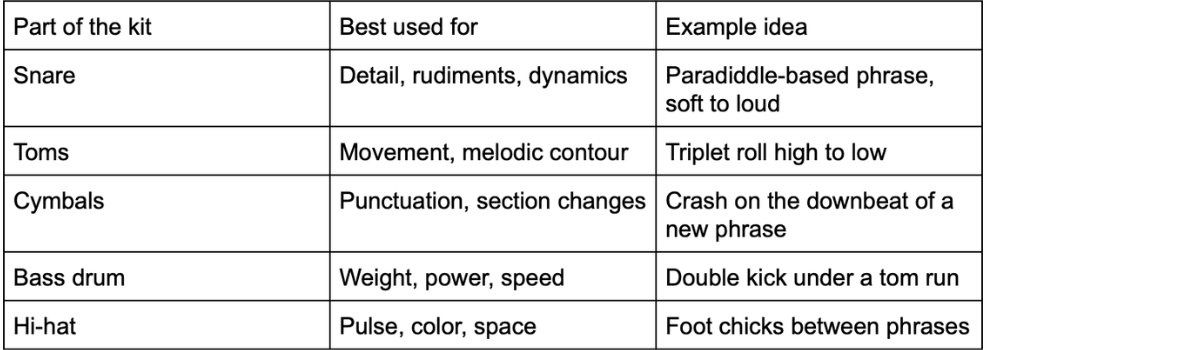
A solo that stays on one drum gets boring quickly. Moving around the kit adds color and lets you create the feeling of a phrase traveling. If you want a refresher on what each piece is called, see our overview of the parts of a drum set.
Toms for movement
Play a pattern high to low for a falling effect, or low to high for a rising one. Because toms are pitched, you can create a melodic contour. Make sure your drum tuning gives you clear separation between them.
Cymbals for punctuation
Use crashes to mark the start of a new section and a ride or hi-hat to create a steady pulse underneath. A choked crash is a great way to cut an idea off cleanly.
Kick for weight
Bass drum notes under a snare or tom phrase add power. Even simple unison hits (kick and tom together) make a phrase feel huge.
The snare for detail
The snare is where your rudiments live. If you want to sharpen it, our guide on how to tune a snare drum will help it speak clearly at low volumes, which matters for dynamic solos.
Rock and Metal Solo Ideas
Rock and metal solos lean on power, repetition, and groove. They tend to feel like heavy riffs played on drums, which is why the ideas below work so well in those styles.
Groove-based solos
Start with a heavy half-time or four-on-the-floor feel and gradually break it apart. This lets the audience stay locked in while you add ornaments.
Double bass runs
Alternate kick patterns under hand phrases. Try sixteenth-note kick under an eighth-note hand pattern, then drop the kick out suddenly for contrast. If you're new to double kick, our overview of the drums on a kit and a solid pedal setup will make the technique far easier to build.
Gallop and triplet feels
A gallop pattern (kick, kick-snare, kick) over a steady cymbal is an instant metal flavor and sounds big even at moderate tempos.
Call and response
Play a phrase on the hands, answer it with a kick phrase, then combine both. This sounds structured and is easy to remember.
Odd groupings
Groupings of five or seven notes over a steady beat create tension. Resolve them back to a four-beat count at the end so the band can re-enter smoothly.
How to Practice Improvising
You can't improvise from nothing, so the goal is to build a vocabulary you can rearrange on the spot. These exercises train that skill without needing a band.
Learn two-bar phrases
Write or memorize ten short phrases. Practice moving between them in any order. Soon you'll be able to string them together like sentences.
Solo over a loop
Play a backing track or click with a simple groove, then solo over four bars before returning to the beat. This trains your sense of where the downbeat is.
Limit yourself
Try soloing using only the snare and kick, or only one rudiment. Limits force creativity and prevent you from relying on the same patterns.
Record yourself
Listen back with fresh ears. You'll quickly hear which ideas worked and where you rushed. A practice pad also helps build the stamina for longer solos, which we cover in our guide to choosing the right sticks for comfortable control.
Transcribe and borrow
Learn the solos of drummers you love, then pull two or three licks from each. Use them as raw material, not as scripts.
Common Drum Solo Mistakes
Mistake 1: Starting too fast and too loud
Why it's wrong: You use up all your energy in the first few seconds, so the rest of the solo feels flat and you tire out quickly.
How to fix it: Start at a moderate volume with a simple motif and plan a gradual build. Save your loudest, busiest playing for the final third.
Mistake 2: Losing the pulse
Why it's wrong: Without a steady internal beat, fills drift and the band can't tell where to come back in.
How to fix it: Practice with a metronome, count quarter notes out loud, and tap your foot or hi-hat pedal quietly while you play.
Mistake 3: Playing every lick you know
Why it's wrong: A string of unrelated ideas sounds like a drum clinic exercise, not music.
How to fix it: Choose two or three ideas per solo and develop them. Repeat before you vary.
Mistake 4: Ignoring dynamics
Why it's wrong: Playing everything at one volume flattens the performance and makes it tiring to listen to.
How to fix it: Practice playing the same phrase at three levels: soft, medium, and loud. Use ghost notes and accents to shape each phrase.
Mistake 5: No planned ending
Why it's wrong: A solo that trails off leaves the band confused and the audience unsure when to clap.
How to fix it: Decide on your ending before you start: a signature fill, a set number of bars, and a crash on the downbeat.
Beginner Tips
- Keep it short. Eight to sixteen bars of well-shaped playing beats two minutes of wandering.
- Plan your first four bars. Knowing how you'll open removes most of the nerves.
- Use a stick trick sparingly. Visual flair is fun, but only if you've nailed the basics first.
- Check your setup. Cymbals and toms should be in comfortable reach so you don't have to stretch mid-phrase.
- Watch the band. Make eye contact and signal when you're about to finish so everyone comes back in together.
- Rest before the big moment. A half-beat of silence can make your biggest fill sound twice as large.
Conclusion
A great drum solo comes from a clear idea, a simple structure, and the confidence to leave space. Start with one motif, repeat it, develop it around the kit, build to a peak, and finish with a planned ending. Practice improvising in short bursts with a metronome, borrow ideas from drummers you admire, and keep your playing musical rather than just fast. Do that consistently and your next solo will feel like a highlight instead of a hurdle.
FAQ
How long should a drum solo be?
For most live band situations, 8 to 32 bars is plenty. Longer solos need more variety and dynamics to hold attention.
Can beginners play drum solos?
Yes. Start with a simple motif, a few rudiments, and a clear ending. A basic solo played with confidence sounds better than a complex one played nervously.
Do I need double bass to play a good rock or metal solo?
No. Double bass adds a lot of power, but strong ideas, dynamics, and groove can carry a solo on a single pedal.
Should I memorize my solo or improvise?
Both work. Many drummers prepare a loose structure and a few key phrases, then improvise the details. That gives you safety without sounding stiff.
How do I stop running out of ideas?
Build a small library of phrases, practice linking them in different orders, and return to your main motif whenever you feel stuck.
What rudiments are most useful for solos?
Single strokes, double strokes, paradiddles, flams, and triplet patterns cover most of what you'll need.