To play accents on drums, you hit certain notes noticeably louder than the notes around them by raising the stick higher before the stroke, while keeping the unaccented notes low and even. The contrast between loud and soft is what gives a groove its punch, and it's the same skill that makes blast beats sound violent instead of muddy and gallops sound like they gallop instead of just trot.
That one sentence covers the "what," but not the "how." Getting accents to actually sound clean under your hands takes more than swinging harder on the notes you want to pop — it takes stick height control, a couple of specific stroke types, and a lot of slow, deliberate reps before it becomes automatic.
In this guide, we'll break down what an accent actually is, the three stroke types every drummer needs to control dynamics, a step-by-step practice path from a single accent to full patterns, how accents differ from ghost notes, the mistakes that keep accents sounding weak or sloppy, and practical tips for locking this skill into your playing for good. By the end, you'll have a clear practice framework you can run today.
When you’re done reading, you will be familiar with:
- What Are Accents in Drumming?
- Why Accent Control Matters for Rock and Metal Drummers
- The Three Strokes Every Accent Depends On
- Step-by-Step: How to Practice Accents
- Accents vs. Ghost Notes: What's the Difference?
- Common Mistakes When Playing Accents
- Beginner Tips for Better Accent Control
- Conclusion
- FAQ

What Are Accents in Drumming?
An accent is any note you play louder than the notes surrounding it. In written drum notation, an accent shows up as a small ">" symbol above or below the note head. Everything else in that phrase — the notes without the mark — gets played at a consistent, lower volume so the accented note actually stands out.
Accents aren't decoration. They're how a drummer shapes a pattern so it has a pulse instead of sounding like a flat wall of identical hits. Take away accents and a blast beat is just noise. Add them back in the right spots and suddenly there's a backbeat buried inside the chaos, or a gallop rhythm that actually gallops instead of just running in place.
You'll see accents in three main places: on rudiments (paradiddles, single strokes, double strokes), inside grooves and beats to emphasize the backbeat or a specific subdivision, and in fills, where accenting the first note of each grouping helps the fill land with intention instead of sounding like a blur.
Why Accent Control Matters for Rock and Metal Drummers
Every genre uses accents, but rock and metal drumming leans on them harder than most. A handful of the genre's signature techniques are built entirely on accent placement:
- Blast beats. At high tempos, the difference between a blast beat that sounds tight and one that sounds like white noise usually comes down to whether the snare and kick accents are landing together and cutting through.
- The gallop rhythm. That galloping "duh-duh-DUH" feel behind so many thrash and power metal riffs only works because the third note in the group gets accented harder than the two before it.
- Breakdowns and chugging riffs. Locking your kick and snare accents to the guitar's palm-muted rhythm is what makes a breakdown hit as hard as the riff underneath it.
- Odd time and polyrhythmic playing. Accenting the "1" of a shifting grouping is often the only thing keeping the listener (and the band) oriented inside a complex meter.
None of that works without dynamic control. If every note comes out at the same volume, your kit loses its ability to communicate where the groove's weight actually falls — and in a genre built on aggression and precision, that's the difference between a part that hits and one that just sits there.
The Three Strokes Every Accent Depends On
Dynamics come down to stick height, not muscle. A loud note starts from higher above the head; a soft note starts closer to it. Most drum educators break this down into three core strokes.
Down Stroke
Start the stick high (around 12 inches above the head), strike with an accent, and stop the stick low after the rebound. You use a down stroke when an accent is immediately followed by an unaccented note — the low finish sets you up perfectly for the quiet note that comes next.
Tap Stroke
Start low (around 1-3 inches above the head) and stay low. This is your unaccented, "ghost-adjacent" stroke — quiet, controlled, and consistent. Most of the notes in any accent exercise are tap strokes, which is exactly why they need to feel effortless.
Up Stroke
Start low, play a quiet note, and let the stick rebound all the way back up to the accent height. You use an up stroke right before an accent — it's the stroke that "loads" your next hit.
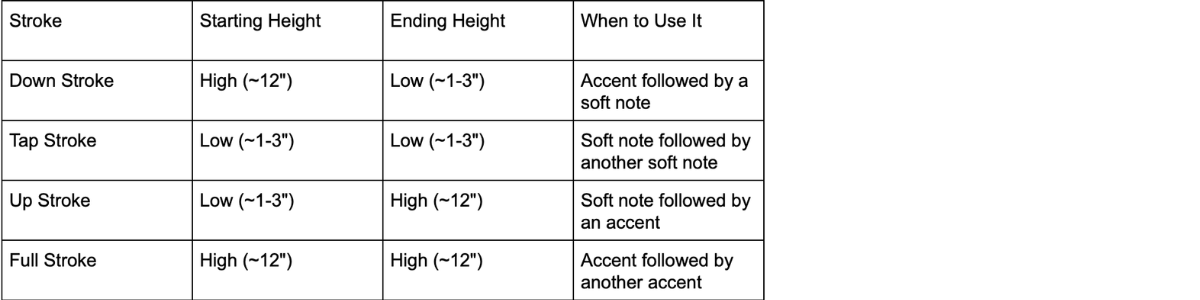
Once these four combinations are automatic, you can accent literally any note in any pattern without stopping to think about it — your hands already know where the stick needs to start and finish.
Step-by-Step: How to Practice Accents
Accent control is built in layers. Rushing straight to full patterns before your hands know the strokes is why most beginners end up with accents that sound forced instead of natural. Work through these in order.
1. Isolate the Four Strokes
Before adding any pattern, play each stroke type on its own for a minute at a time on a practice pad: down strokes only, then taps only, then up strokes only, then full strokes only. Watch the stick in a mirror if you have one — you're checking that your starting and ending heights are actually consistent, not just close.
2. Play a Single Accent on Count 1
Play eight straight sixteenth notes at a slow tempo, accenting only the first note of the group: ACCENT-tap-tap-tap-tap-tap-tap-tap. Use a down stroke on the accent and tap strokes for the rest. This is the foundation every other exercise builds from.
3. Move the Accent Through the Group
Once beat 1 feels solid, shift the accent to note 2, then note 3, and so on through all eight notes, spending a few minutes on each position before moving to the next. This is sometimes called an accent study, and it's one of the most efficient ways to build independent control over any single note in a phrase — useful well beyond drumming, since it's the same skill that lets you place a snare accent anywhere inside a blast beat pattern later.
4. Add Accents to a Rudiment
Take a rudiment you already know — single strokes or paradiddles work well — and add an accent to the first note of each grouping. If you haven't locked down the sticking yet, working through the paradiddle first will make this step much easier, since you won't be thinking about the sticking and the dynamics at the same time.
5. Apply Accents to a Groove
Take a basic rock beat and accent the snare on beats 2 and 4 while keeping your hi-hat notes at a consistent, quieter volume. This is the most practical version of the skill — almost every groove you'll ever play depends on the backbeat popping out above everything else.
6. Apply Accents to Genre-Specific Patterns
Once the groove step feels natural, bring the skill into rock and metal-specific patterns. Try accenting the third note of a triplet-based gallop rhythm, or work on keeping your snare accents locked to the kick inside a slow blast beat before speeding it up. Dynamic control tends to fall apart first at high tempo, so it's worth drilling these patterns slow before you ever try them at full speed.
Accents vs. Ghost Notes: What's the Difference?
Accents and ghost notes are opposite ends of the same dynamic spectrum, and beginners often mix them up. An accent is a note played louder than its surroundings — it's meant to be heard clearly and often carries the groove's pulse. A ghost note is the opposite: a note played so quietly it's barely audible, usually filling in space between backbeats to add texture and groove without competing for attention.
The two work together constantly. A funk or rock groove might have a loud accented backbeat on beats 2 and 4, with quiet ghost notes filling the gaps in between — and the wider that gap in volume, the funkier and more dynamic the groove sounds. If you want to go deeper on the quiet side of that equation, the DBO guide on ghost notes covers the technique in full.
Common Mistakes When Playing Accents
Accenting With Arm Force Instead of Stick Height
Why it's wrong: Muscling an accent by tensing your arm and smashing the drum creates a harsh, uncontrolled sound and tires you out fast. It also makes the transition into the next note clumsy because your hand isn't in a relaxed, ready position.
How to fix it: Let stick height do the work. A relaxed down stroke from 12 inches will naturally produce more volume than a tense stroke from 3 inches, without the extra tension. Focus on starting position, not muscle.
Letting the Unaccented Notes Creep Up in Volume
Why it's wrong: If your "quiet" notes gradually get louder as you focus on the accent, the contrast disappears and the accent stops standing out. This is the single most common reason accent exercises sound weak even after weeks of practice.
How to fix it: Practice the tap stroke on its own until it's genuinely quiet and consistent before adding accents back in. If needed, record yourself — it's much easier to hear volume creep in a recording than while you're playing.
Rushing to Fast Tempos Before the Stroke Types Are Solid
Why it's wrong: Accent control is one of the first things to fall apart under speed. Practicing fast before your hands have the down, tap, and up strokes internalized just reinforces sloppy habits at tempo.
How to fix it: Keep a metronome slow enough that you can consciously feel each stroke's starting height. Only increase tempo once the pattern sounds clean and controlled, not just "close enough."
Treating Every Accent the Same Way
Why it's wrong: Not every accent needs to be maximum volume. Playing every accented note at full intensity flattens out the dynamic range within a phrase and can make patterns like fills sound one-dimensional.
How to fix it: Think in terms of a dynamic range, not just "loud vs. quiet." A fill often has accents of varying intensity — the note that resolves the phrase might deserve more weight than an accent in the middle of it.
Beginner Tips for Better Accent Control
- Practice on a pad before a drum. A practice pad gives you a consistent, controlled surface with less rebound variance than a drumhead, which makes it easier to isolate stick height and feel the difference between strokes.
- Use a mirror or record yourself from the side. Watching your stick heights is often more reliable than trying to feel whether you're doing it right, especially early on.
- Count out loud while you practice. Saying "ONE-two-three-four" while accenting count one keeps your internal sense of timing locked to where the accent should land.
- I usually warm up with an accent study before any session. A couple of minutes moving a single accent through an eight-note group wakes up your hands and your ear for dynamics before you touch anything else.
- Apply accents to music you already know. Once you're comfortable, put on a song and try to identify — then play — the accented notes in the drum part. Real musical context sticks better than isolated drills alone.
- Don't skip slow practice. If you're building a broader practice routine around this, the DBO guide on how to practice drums covers how to structure warm-ups and drills so skills like this one actually stick.
Conclusion
Accents are one of those fundamentals that quietly shape everything else you play. Once the down, tap, and up strokes are second nature, you'll notice it in your grooves, your fills, and especially in genre-specific patterns like gallops and blast beats, where dynamic control is the whole point. Start slow, isolate the strokes, and build up through the accent study before chasing speed — your hands will thank you once it's time to play fast.
FAQ
What does "accent" mean in drum notation?
An accent is marked with a small ">" symbol above or below a note head. It tells you to play that specific note noticeably louder than the surrounding unaccented notes.
How high should my stick go on an accented note?
Around 12 inches above the drumhead is a common reference point, with unaccented notes starting around 1 to 3 inches. The exact numbers matter less than the consistency and contrast between the two heights.
Are accents the same as rimshots?
No. An accent is about relative volume within a phrase and can be played anywhere on the head. A rim shot is a specific technique — striking the head and rim simultaneously — that's often used to make an accented backbeat cut through even harder, but you can accent a note without playing a rim shot at all.
Why do my accents sound weak even though I'm hitting harder?
Usually because the unaccented notes around the accent are also creeping up in volume, which kills the contrast. Focus on keeping your tap strokes genuinely quiet rather than just hitting the accented note harder.
Do I need accents to play a blast beat?
Technically you can play a blast beat with every note at the same volume, but it will sound like a wall of noise. Locking a snare accent to the kick, or accenting specific subdivisions, is what gives a blast beat its punch and makes it sound intentional rather than chaotic.
How long does it take to get comfortable with accents?
Most drummers start feeling the basic down/tap/up strokes within a few practice sessions, but applying accents cleanly inside fast patterns and full songs takes ongoing practice — it's a skill you keep refining for years, not something you finish once.